

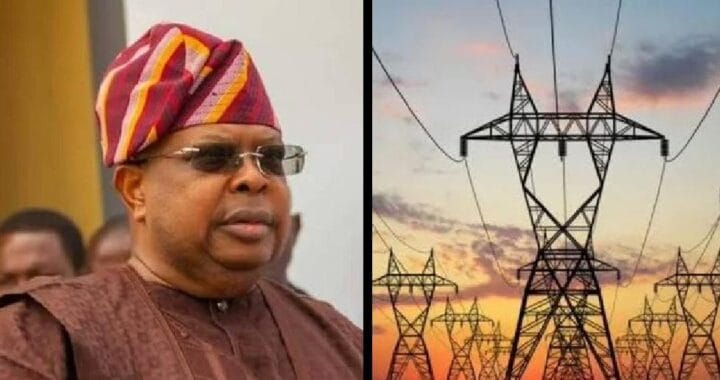
The Minister of Power, Joseph Tegbe, has assured Nigerians that electricity supply will improve significantly before the end of 2026 as the Federal Government intensifies efforts to rehabilitate the national grid and expand renewable energy projects across the country.
Tegbe gave the assurance on Thursday in Abuja during the media launch of the Africa Mini-Grid Programme (AMP) Nigeria Pilot Project, an initiative jointly implemented by the Rural Electrification Agency (REA), the United Nations Development Programme (UNDP) and the Global Environment Facility (GEF).
He said the Tinubu administration was tackling Nigeria’s long-standing electricity challenges through a combination of grid rehabilitation and off-grid renewable energy projects to extend power supply to underserved communities.
“For the avoidance of doubt, before the end of this year, Nigerians will see a significant improvement in electricity delivery,” the minister said.
Tegbe, however, noted that decades of neglect in the power sector could not be reversed within a short period.
“What was badly managed for 50 years cannot be resolved in six months. We are fixing the infrastructure, fixing the main grid, building off-grid assets where necessary and strengthening the resilience of the entire electricity network. The key thing is to give Nigerians electricity,” he added.
The minister described renewable energy, particularly solar power, as an integral part of Nigeria’s electricity strategy rather than a substitute for conventional power generation.
He explained that mini-grids were being deployed to communities beyond the reach of the national grid, allowing more Nigerians to gain access to reliable electricity.
Tegbe also praised the partnership between the REA, UNDP and GEF, describing the Africa Mini-Grid Programme as a practical example of how collaboration could accelerate universal access to electricity.
According to him, the initiative has gone beyond providing power infrastructure by improving livelihoods through better access to electricity for businesses, healthcare facilities, schools and agricultural activities.
The programme has so far delivered 23 mini-grids in underserved communities across 15 states, providing electricity to about 20,000 households and more than 50,000 people while supporting economic activities, particularly in agriculture.
The minister welcomed plans to expand the programme, disclosing that a second phase would add another 50 mini-grids and extend electricity to an additional 50,000 households.
Earlier, the Managing Director of the REA, Abba Aliyu, described the initiative as a model for achieving sustainable energy access while stimulating rural economic growth.
He said reliable electricity had enabled farmers to process and store agricultural produce locally, strengthened small businesses and created employment opportunities in benefiting communities.
“The true impact of the AMP is found in the rice processor whose productivity has doubled, the farmer who now processes and stores produce locally, the woman entrepreneur whose business remains open after sunset, and the young technician who has discovered a new source of livelihood,” Aliyu said.
He explained that the programme was deliberately designed to address both energy poverty and agricultural poverty by integrating productive-use equipment into mini-grid projects.
“For decades, energy poverty and agricultural poverty have existed side by side. The Africa Mini-Grid Programme has challenged this reality by demonstrating that when reliable electricity reaches rural communities, farms become businesses, harvests become industries and communities become local economies,” he added.
Aliyu reaffirmed the agency’s commitment to expanding similar renewable energy projects across the country and called on development partners and private investors to support efforts to achieve universal electricity access.
Also speaking, the UN Assistant Secretary-General and Director of the Regional Bureau for Africa at the UNDP, Ahunna Eziakonwa, commended Nigeria for successfully completing the programme’s pilot phase.
She said the country’s performance had demonstrated both the technical capacity and community support required to scale up similar renewable energy projects.
“Nigeria is one of the first countries to complete the project cycle. This programme was designed with scaling in mind. Because it has demonstrated that Nigeria has the capacity, the will and the community buy-in for this to happen, we are quite confident that more resources will flow,” she said.
The Africa Mini-Grid Programme Nigeria Pilot Project is jointly implemented by the REA and UNDP with funding from the GEF to expand access to decentralised renewable energy, boost rural enterprises, improve agricultural productivity and promote climate-resilient economic development.
📢 Follow National Periscope on WhatsApp
Get breaking news and updates directly on WhatsApp.
Join WhatsApp ChannelPost Disclaimer
All rights reserved. This material and other digital content on this website are not and do not represent the stance of National Periscope but the statements of newsmakers mentioned therein.
For your detailed news reportage... contact the Editor at Joel2oladele@gmail.com






Dangote Refinery Raises Petrol Price to N1,245 Per Litre Nigeria’s Read more
Nigeria Ranks 6th African Country With Cheap Fuel Prices Fuel Read more
National Grid Collapses Again As FG Promises 20,000MW Generation By Read more
•Says President's Leadership Strengthening Democracy [caption id="attachment_22212" align="alignnone" width="1242"] Director-General Read more