
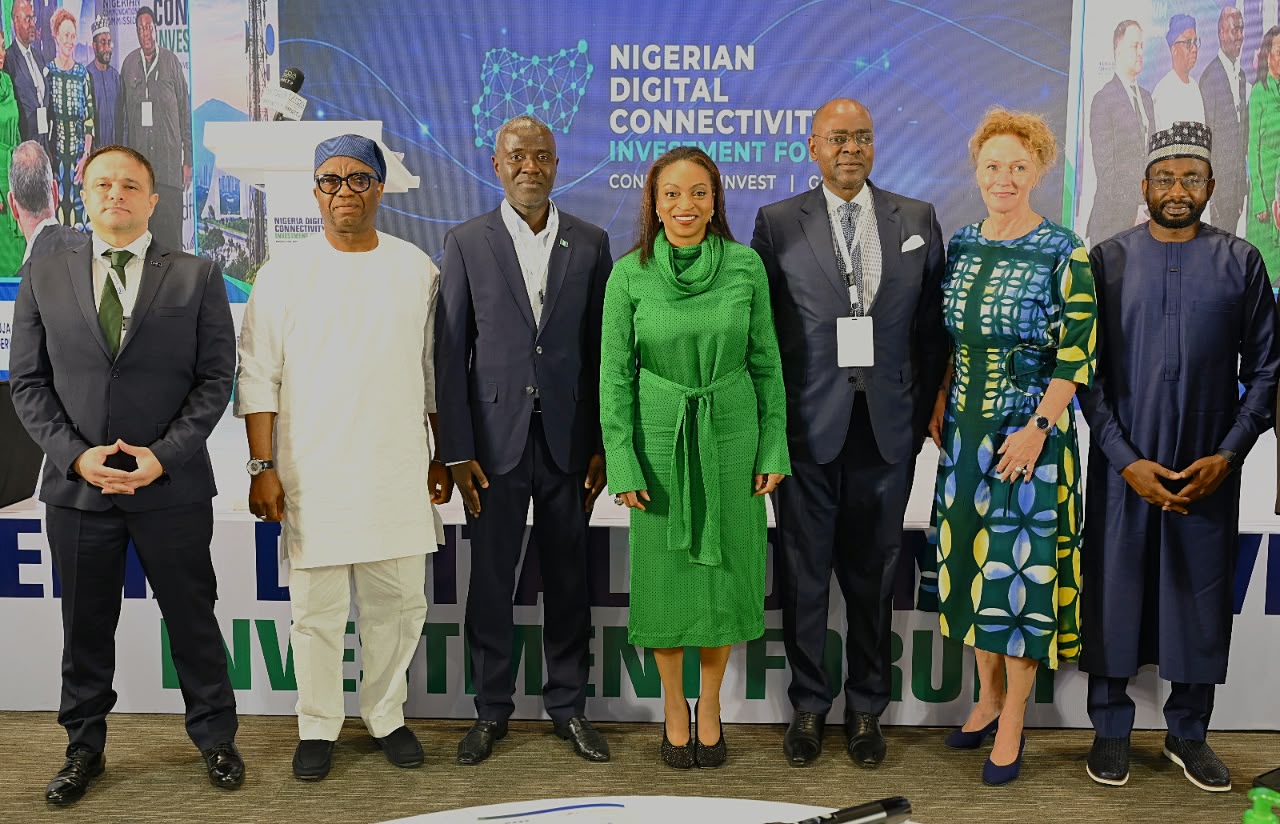
Ambassador Anna Westerholm,
Director General, National Information Technology Development Agency(NITDA),
Mr. Kashifu Inuwa Abdullahi; during the Nigerian Digital Connectivity Investment Forum, yesterday, in Abuja
The Nigerian Communications Commission (NCC) has urged greater public and private investment in telecommunications infrastructure to expand broadband access and improve service quality across Nigeria.
The Executive Vice Chairman and Chief Executive Officer of the NCC, Dr Aminu Maida, made the call at the maiden Nigeria Digital Connectivity Investment Forum in Abuja.
The commission organised the two-day forum with Swedfund and Ookla to bring regulators, investors, infrastructure providers and development partners together.
Maida said Nigeria’s telecoms growth over the past 25 years showed how sound policies and transparent regulation could attract investment and expand connectivity.
He noted that sector liberalisation and transparent licensing had encouraged private investment and driven major growth in communications services.
“The experience of the last two and a half decades underscores the importance of creating an enabling environment for investment. As a regulator, the Commission remains committed to facilitating investment while ensuring consumer protection and promoting fair competition,” he said.
According to Maida, demand for reliable digital connectivity continues to rise among households, businesses, schools and public institutions.
He added that the spread of cloud services, digital platforms and Artificial Intelligence applications would place further pressure on existing telecommunications infrastructure.
The NCC chief disclosed that Nigeria’s data consumption rose from about 1.13 million terabytes in July 2025 to 1.66 million terabytes in July 2026.
That represents an increase of nearly 47 per cent within one year, he noted, adding that the trend would require sustained investment in network expansion and modernisation.
“The investment challenge before us is not merely one of expanding coverage. It is also about ensuring that those already connected enjoy better service quality, improved user experiences, and infrastructure capable of supporting future technologies,” Maida said.
He listed the 2025 telecommunications tariff adjustment, ongoing engagement with state governments on Right of Way challenges and the designation of telecoms infrastructure as Critical National Information Infrastructure among measures aimed at supporting network investment.
The commission, he added, would continue to promote evidence-based regulation to improve transparency and give investors greater certainty about opportunities in the sector.
Maida called on local and international investors, development finance institutions and infrastructure providers to work with the NCC to close connectivity gaps.
“The investment we advance today must ultimately translate into better opportunities for Nigerians, improved access to services, and a stronger digital economy that supports sustainable national development,” he said.
He also highlighted the role of data in guiding investment decisions, citing the NCC’s partnership with Swedfund and Ookla.
According to him, Ookla’s network performance data gives the commission independent insight into users’ connectivity experiences and helps identify areas that require additional investment.
Maida also drew attention to the NCC Consumer Data Lab, funded by the Gates Foundation and developed with Innovations for Poverty Action (IPA).
The platform combines Ookla network performance data, consumer complaints and operators’ intervention reports on one dashboard.
He said the system allows the commission to examine connectivity problems by location and demographic characteristics.
“This helps us investigate service problems and assess whether operators’ interventions have improved consumers’ experience. It also gives us a more useful picture of where further deployment or network upgrades may be needed,” Maida said.
The Minister of Industry, Trade and Investment, Dr Jumoke Oduwole, said digital infrastructure had become central to Nigeria’s investment climate and international trade.
Speaking on “Connectivity and Competitiveness: Digital Infrastructure as a Driver of Investment Climate and Trade”, Oduwole said modern infrastructure must support production, investment and trade.
She noted that the nature of international commerce had changed, making private networks, data centres, digital platforms and secure data systems essential to business transactions.
The Swedish Ambassador to Nigeria, Anna Westerholm, identified gaps in connectivity coverage, quality, affordability and supporting infrastructure as areas requiring joint action.
Westerholm said reliable network performance data could help investors identify opportunities, reduce uncertainty and make better-informed decisions.
She also identified energy, cybersecurity and digital skills as important requirements for sustainable connectivity.
“Sweden is interested in deepening commercial and investment relations with Nigeria, particularly in digitalisation and connectivity. Swedish institutions and companies could contribute technology, commercial expertise, development finance, export financing and project development to support Nigerian infrastructure priorities,” she said.
Ookla’s Vice President of Sales for Middle East and Africa, Tristan Muhader, said connectivity had moved beyond basic communication to become an important part of economic and public activity.
“Connectivity is no longer simply the channel through which we make calls or browse the internet. It is becoming the operating layer for economic and public activity across sectors, from essential services to AI,” Muhader said.
He added that Ookla’s collaboration with the NCC provided independent data on users’ experiences and could help identify areas where infrastructure investment would have the greatest impact.
Representing the Minister of Communications, Innovation and Digital Economy, Dr Bosun Tijani, the Director of the National Frequency Management Council, Adetunji Adeyemo, said reliable, affordable and resilient digital infrastructure remained vital to Nigeria’s economic transformation.
He identified infrastructure, policy and innovation, entrepreneurship and capital as key areas of government focus.
The forum brought together policymakers, investors, development finance institutions, telecoms operators, infrastructure providers, technology companies and development partners to examine investment opportunities across Nigeria’s digital connectivity sector.
📢 Follow National Periscope on WhatsApp
Get breaking news and updates directly on WhatsApp.
Join WhatsApp ChannelPost Disclaimer
All rights reserved. This material and other digital content on this website are not and do not represent the stance of National Periscope but the statements of newsmakers mentioned therein.
For your detailed news reportage... contact the Editor at Joel2oladele@gmail.com






JOEL OLADELE, Abuja The Federal Government has intensified efforts to Read more
[caption id="attachment_21002" align="alignnone" width="1000"] NCC building, Abuja[/caption] The Nigerian Communications Read more
JOEL OLADELE, Abuja Nigeria is set to operate a unified Read more
Communications minister says 5G in Nigeria, but not everywhere The Read more