

The Presidency has assured Nigerians that the proposed State Police system will be built with safeguards to prevent individual office holders from abusing its powers.
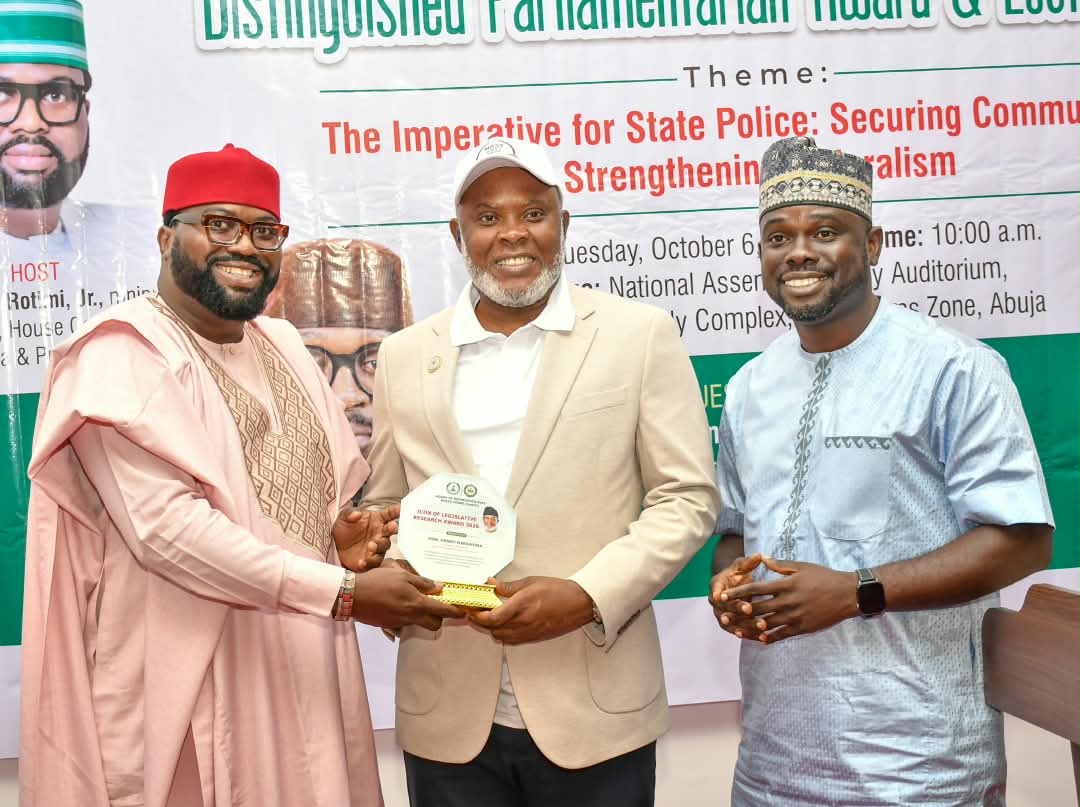
Secretary of the Presidential Working Group on the National Policing Bill, Nnadubem Moghalu, gave the assurance on Tuesday in Abuja at the 2nd Annual Distinguished Parliamentarian Lecture organised by the House of Representatives Press Corps.
The lecture, held at the National Assembly Library Auditorium, was themed, “Imperative of State Police: Securing Communities, Strengthening Federalism.”
Moghalu, who delivered the lead paper, “State Police, Community Security and the Future of Federalism in Nigeria,” said concerns over political interference had been central to the drafting of the proposed National Policing Bill.
He explained that the framework would clearly define responsibilities, establish accountability mechanisms and ensure that institutions responsible for policing had the capacity to enforce those safeguards.
“We are trying to build a system that is as immune to the personal foibles of individuals as possible,” Moghalu said.
He argued that the proposed system had become necessary because the existing centralised police structure was overstretched.
Nigeria has about 380,000 police officers serving a population of more than 200 million, according to Moghalu. About 180,000 of them, however, perform special protection and administrative duties.
That leaves roughly 200,000 officers for core policing duties, effectively putting the ratio at about one active officer to 1,000 citizens.
Moghalu said the same limited workforce was expected to respond to offences ranging from petty theft to kidnapping, banditry and terrorism, describing the arrangement as unsustainable.
Under the proposed dual policing structure, state police would handle offences within their territories, while the Federal Police would retain responsibility for crimes that cross state boundaries or require national coordination.
Human trafficking, cybercrime and offences with international implications would remain among matters handled at the federal level.
He stressed that both levels would need effective cooperation and technology to prevent criminals from escaping justice by moving between jurisdictions.
Moghalu also maintained that funding would remain critical to the success of the proposed reform, noting that many governors already spend money supporting federal security agencies operating in their states.
“You fund what you prioritise,” he said, citing the South-West security outfit Amotekun as an example of a locally based structure that receives state funding but still faces legal and institutional limitations.
The Presidential Working Group secretary further clarified that the constitutional amendment process and the National Policing Bill were separate but connected.
The Sixth Alteration Bill, which would provide the constitutional basis for a dual policing system, has passed both chambers of the National Assembly and is before the state Houses of Assembly.
Four states — Edo, Rivers, Osun and Oyo — had approved the amendment as of the lecture, while at least 24 state assemblies must approve it before the process can move to the next stage.
Moghalu said the constitutional amendment would provide the legal foundation, while the National Policing Bill would establish the operational framework for implementing the new structure.
He warned that the reform would fail if it merely transferred existing weaknesses to state institutions.
“If these reforms merely federalise the status quo, distributing familiar failures across more institutions, they will have failed,” he cautioned.
He added that effective implementation would require sustained funding, training, equipment, welfare and strong accountability mechanisms.
Meanwhile, Niger State Governor Umar Bago has pledged to rally other North-Central states behind the establishment of state police.
Bago, represented by the All Progressives Congress (APC) National Vice Chairman, North-Central, Muazu Bawa Rijau, said Niger State supported bringing policing closer to communities because security challenges were largely rooted in local environments.
The governor said the growing level of insecurity required a security architecture that could understand and respond to the peculiar challenges confronting individual communities.
“When we look at the rate of crime and insecurity in Nigeria, it becomes clear that there is a need for a more effective security architecture that can respond to the peculiar challenges of our communities,” Bago said.
He added that Niger State would support efforts to make the proposed system a reality, arguing that local policing could provide a more direct response to threats within communities and cities.
The Inspector-General of Police, Olatunji Disu, represented by Deputy Commissioner of Police Suleyman Gulma, also backed broad discussions on the proposed reform.
Disu said transparent and multi-stakeholder engagement remained important as the country considers changes to its policing structure.
The Speaker of the House of Representatives, Tajudeen Abbas, represented by the Chairman of the House Committee on Media and Public Affairs, Akin Rotimi, urged journalists to assess the proposed legislation through evidence, principles and its likely consequences.
Abbas also stressed the importance of an independent and critical press in strengthening democratic governance.
The lecture brought together lawmakers, government officials, security representatives and media practitioners to examine the proposed policing reform and its implications for national security and federalism.
📢 Follow National Periscope on WhatsApp
Get breaking news and updates directly on WhatsApp.
Join WhatsApp ChannelPost Disclaimer
All rights reserved. This material and other digital content on this website are not and do not represent the stance of National Periscope but the statements of newsmakers mentioned therein.
For your detailed news reportage... contact the Editor at Joel2oladele@gmail.com



American Missionary Condemns Plateau Killings, Faults Tinubu Over Insecurity An Read more
Plateau Crisis: 'No Safe Haven for Terrorists in Nigeria', FG Read more
[caption id="attachment_22926" align="alignnone" width="947"] Oba of Benin, Oba Ewuare II[/caption] Read more
Troops Arrest Impostors, Neutralise Suspected Terrorists in Plateau Operations JOEL Read more