

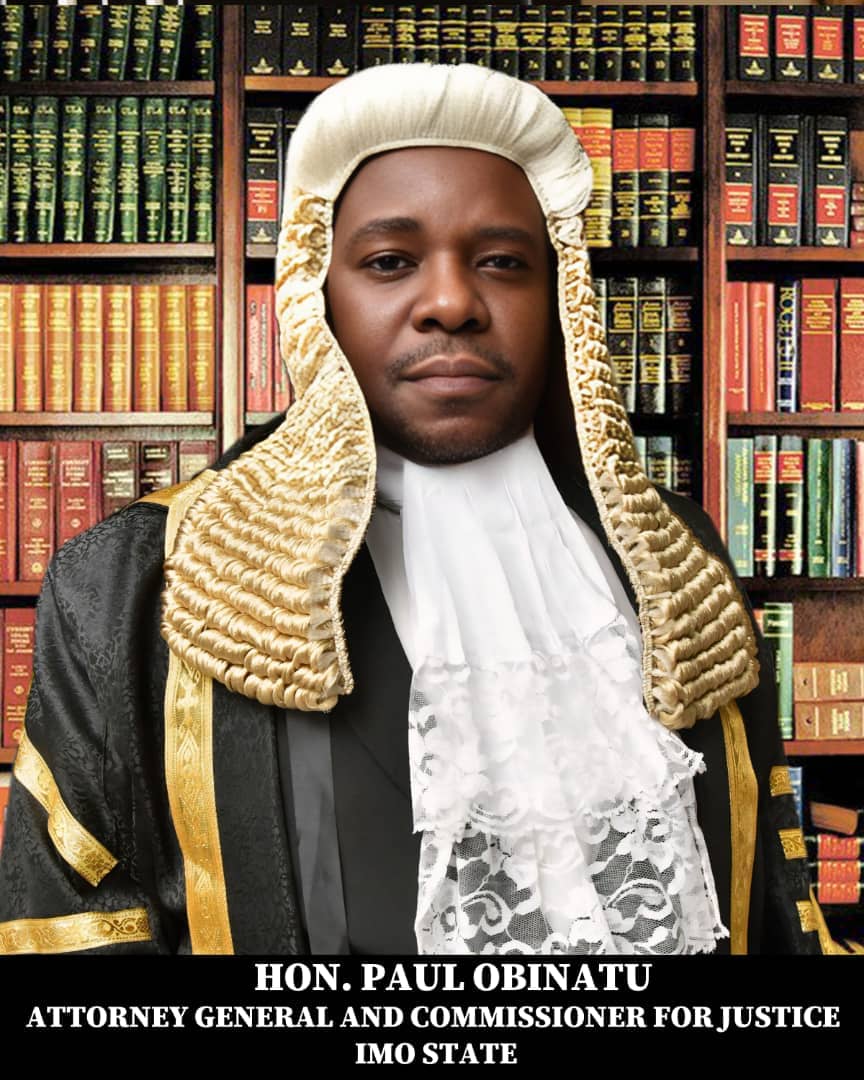
The Imo State Attorney-General and Commissioner for Justice, Paul Obinatu, has challenged the authority of the National Judicial Council (NJC) to dictate the candidates the state should consider for appointment as substantive Chief Judge.
Obinatu argued that the council’s intervention in the selection process encroaches on the constitutional independence of the Imo State Judicial Service Commission (JSC).
In a statement issued on November 6, 2026, he faulted a directive reportedly given to the state commission at the NJC’s 112th meeting on November 3.
The directive concerned the appointment of a substantive Chief Judge for Imo State.
The Attorney-General maintained that although the NJC has the responsibility to recommend a candidate to the governor, it cannot control the process through which the state commission identifies and submits suitable nominees.
He said Section 202 of the 1999 Constitution, as amended, expressly protects the independence of state judicial service commissions.
The provision states that the commission shall not be subject to the direction or control of any other authority or person in exercising its constitutional responsibilities.
Obinatu argued that the NJC cannot use its national institutional status or recommendation powers to override this constitutional safeguard.
He maintained that any directive compelling the Imo JSC to submit a particular candidate would amount to unconstitutional interference in its functions.
The Attorney-General also relied on Section 271(1) and relevant provisions of the Third Schedule to the Constitution to explain the separate responsibilities of the two institutions.
Paragraph 6(a) of Part II of the Third Schedule empowers the State Judicial Service Commission to advise the NJC on suitable persons for nomination as Chief Judge.
On the other hand, Paragraph 21(c) of Part I empowers the NJC to recommend a candidate to the governor from among the names submitted by the state commission.
Section 271(1) provides that the governor appoints the Chief Judge on the recommendation of the NJC, subject to confirmation by the State House of Assembly.
Obinatu said the constitutional provisions establish a sequence in which the state commission identifies suitable candidates, the NJC considers the submitted names and recommends one to the governor.
The governor then exercises the appointing authority, subject to legislative confirmation.
He insisted that the NJC’s recommendation powers do not give it the authority to determine which candidates the state commission must submit.
According to him, such an interpretation would transfer the commission’s constitutional responsibility to the NJC and render the protection under Section 202 meaningless.
The Attorney-General also addressed the NJC’s Guidelines and Procedural Rules for the Appointment of Judicial Officers.
While acknowledging the council’s authority to prescribe and enforce procedures for judicial appointments, he said its guidelines could not confer powers beyond those granted by the Constitution.
He warned that the council’s responsibility to ensure compliance with appointment procedures must not extend to taking over the independent functions of the state commission.
To support his position, Obinatu cited several judicial decisions which he said affirmed constitutional boundaries and institutional independence.
They include *Elelu-Habeeb & Anor. v. Attorney-General of the Federation & Ors.* (2012) LPELR-15515(SC), *Kano State Public Complaints and Anti-Corruption Commission & Anor. v. Salisu & Ors.* (2019) LPELR-47107(CA), and *Bamisile v. National Judicial Council & Ors.* (2012) LPELR-8381(CA).
Others are *FRN v. Nganjiwa* (2022) LPELR-58066(SC), *NJC & Ors. v. Senlong & Ors.* (2010) LPELR-4582(CA), and *Attorney-General of the Federation v. Attorney-General of Abia State & Ors.* (2024) LPELR-62576(SC).
The Attorney-General maintained that the decisions reinforce the principle that every constitutional institution must exercise its powers within the limits prescribed by law, regardless of its institutional standing.
He warned that allowing the NJC to assume responsibilities assigned to the state commission could undermine the integrity of the judicial appointment process.
Obinatu stressed that the disagreement should not be treated as a contest for institutional superiority between the NJC and the Imo JSC.
Rather, he said, both institutions must respect the constitutional boundaries of their respective responsibilities.
He insisted that the process for appointing a substantive Chief Judge of Imo State must follow the Constitution without interference that could undermine public confidence in the judiciary.
📢 Follow National Periscope on WhatsApp
Get breaking news and updates directly on WhatsApp.
Join WhatsApp ChannelPost Disclaimer
All rights reserved. This material and other digital content on this website are not and do not represent the stance of National Periscope but the statements of newsmakers mentioned therein.
For your detailed news reportage... contact the Editor at Joel2oladele@gmail.com







The Supreme Court on Friday restored the leadership authority of Read more
A High Court sitting in Lokoja, Kogi State, has ordered Read more
Appeal Court sacks APC Senator from Kogi Central, declares Natasha Read more
[caption id="attachment_26958" align="alignnone" width="650"] Collage of Rochas Okorocha and Hope Read more