

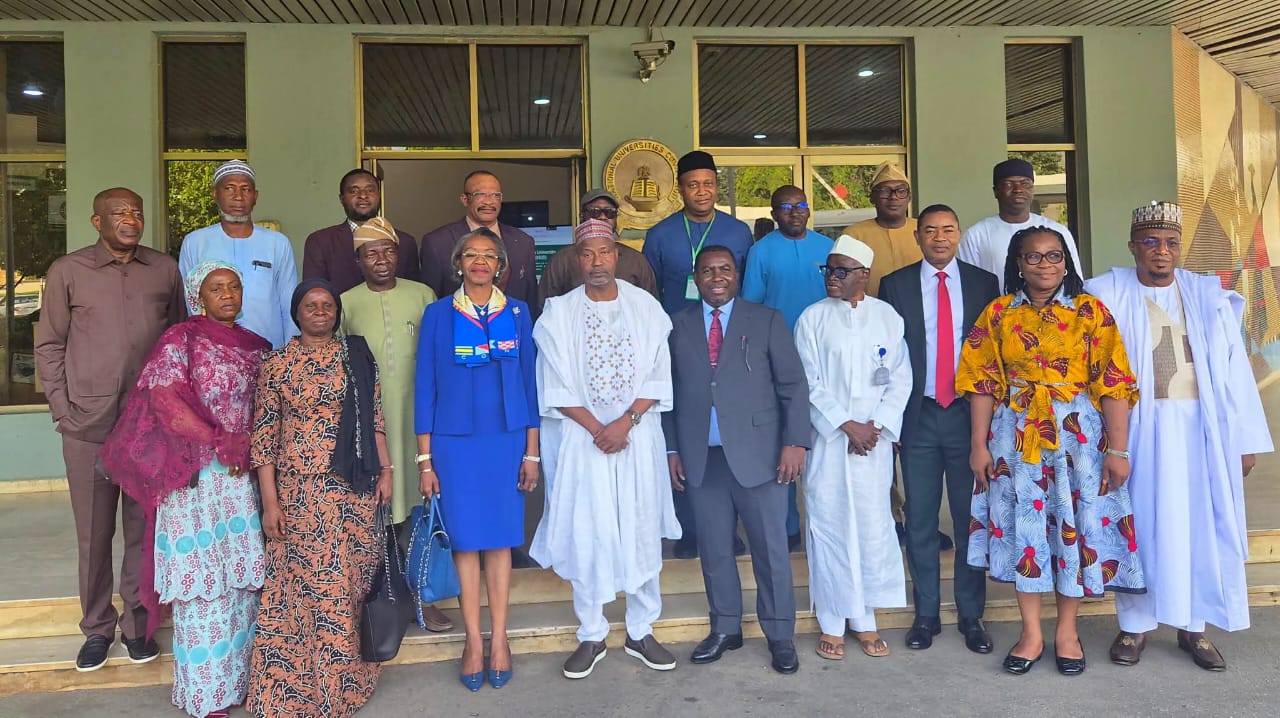
The Independent National Electoral Commission (INEC) has partnered with the National Universities Commission (NUC) to ensure the deployment of credible and non-partisan academic personnel for the 2027 general elections.
The partnership will also involve adjustments to university academic calendars to enable lecturers and other qualified academics to participate in election duties without disrupting students’ studies.
The NUC Executive Secretary, Prof. Abdullahi Yusufu Ribadu, gave the commitment on Monday in Abuja when the INEC Chairman, Prof. Joash Amupitan, led a delegation of national commissioners and senior officials on a courtesy visit.
Ribadu said the commission would engage vice-chancellors to identify suitable academic personnel for deployment as collation and returning officers during the elections.
He also promised to circulate a formal communication to universities once INEC forwarded its request.
“Since we want to have credible elections, we also have to have credible personnel,” he said.
The NUC executive secretary stressed that academic personnel selected for election duties must demonstrate political neutrality, adding that all ad hoc officials should take an oath of neutrality before deployment.
Amupitan said the engagement formed part of INEC’s strategic preparations for the presidential and National Assembly elections scheduled for January 16, 2027, and the governorship and state assembly polls fixed for February 6.
He noted that the Nigerian university system had supported the country’s electoral process for more than a decade, particularly through the participation of vice-chancellors as collation and returning officers.
The INEC chairman said the commission wanted to strengthen the relationship with universities to ensure that academics could discharge their responsibilities in a safe and conducive environment.
He explained that INEC had introduced operational, technological and security measures to improve election administration and protect personnel.
Among the measures, he said, was the introduction of automated arithmetic consistency and over-voting checks on polling unit results recorded on Form EC8A before transmission to the INEC Result Viewing Portal (IReV).
He added that the commission had procured 57,000 new Bimodal Voter Accreditation System (BVAS) devices, bringing the voter-to-device ratio down to 850 per machine.
Amupitan also announced that INEC would conduct a nationwide mock accreditation and result transmission exercise on November 28 across the 36 states and the Federal Capital Territory.
On security, he said the Inter-Agency Consultative Committee on Election Security (ICCES) had extended its operations to every local government and registration area.
He added that the commission had established dedicated security cordons and escort arrangements around collation centres.
The chairman cited Sections 96 and 97 of the Electoral Act 2026, which criminalise violence, abusive rhetoric and threats against electoral personnel.
He also referenced Section 148, which empowers INEC to prosecute electoral offenders directly.
“No Returning Officer or Collation Officer will be left to stand alone against lawlessness,” he said.
Amupitan outlined four areas where the commission required the NUC’s support. They include the timely nomination of academics with verified non-partisan credentials, adjustment of university calendars, collaboration on campus voter education and improved welfare for academics deployed for election duties.
Responding to the proposed adjustment of academic calendars, Ribadu said the entire election cycle would not exceed four weeks.
He suggested that universities could consider a three-to-four-week break to accommodate election-related assignments.
“We will discuss with the Vice-Chancellors and have their calendars tweaked in such a way that it will not affect the elections, nor will it affect the studies of the students,” he said.
Ribadu also proposed that university students could support voter education through campus clubs and other organised activities.
Beyond the immediate election preparations, he called for broader cooperation between INEC and the NUC.
His proposals included student internship opportunities at INEC offices, the introduction of possible electoral studies programmes and joint research into artificial intelligence, robotics and data analytics.
He expressed confidence that INEC would conduct transparent, free and fair elections that could serve as a reference point for other African countries.
The presidential and National Assembly elections will hold on January 16, 2027, while the governorship and state Houses of Assembly elections are scheduled for February 6, 2027.
📢 Follow National Periscope on WhatsApp
Get breaking news and updates directly on WhatsApp.
Join WhatsApp ChannelPost Disclaimer
All rights reserved. This material and other digital content on this website are not and do not represent the stance of National Periscope but the statements of newsmakers mentioned therein.
For your detailed news reportage... contact the Editor at Joel2oladele@gmail.com


The Independent National Electoral Commission (INEC) and the National Orientation Read more
The Independent National Electoral Commission (INEC) has warned that the Read more
INEC, ECONEC Review Implementation of 2023 Election Recommendations JOEL OLADELE, Read more
[caption id="attachment_26275" align="alignnone" width="500"] INEC logo[/caption] The Independent National Electoral Read more