

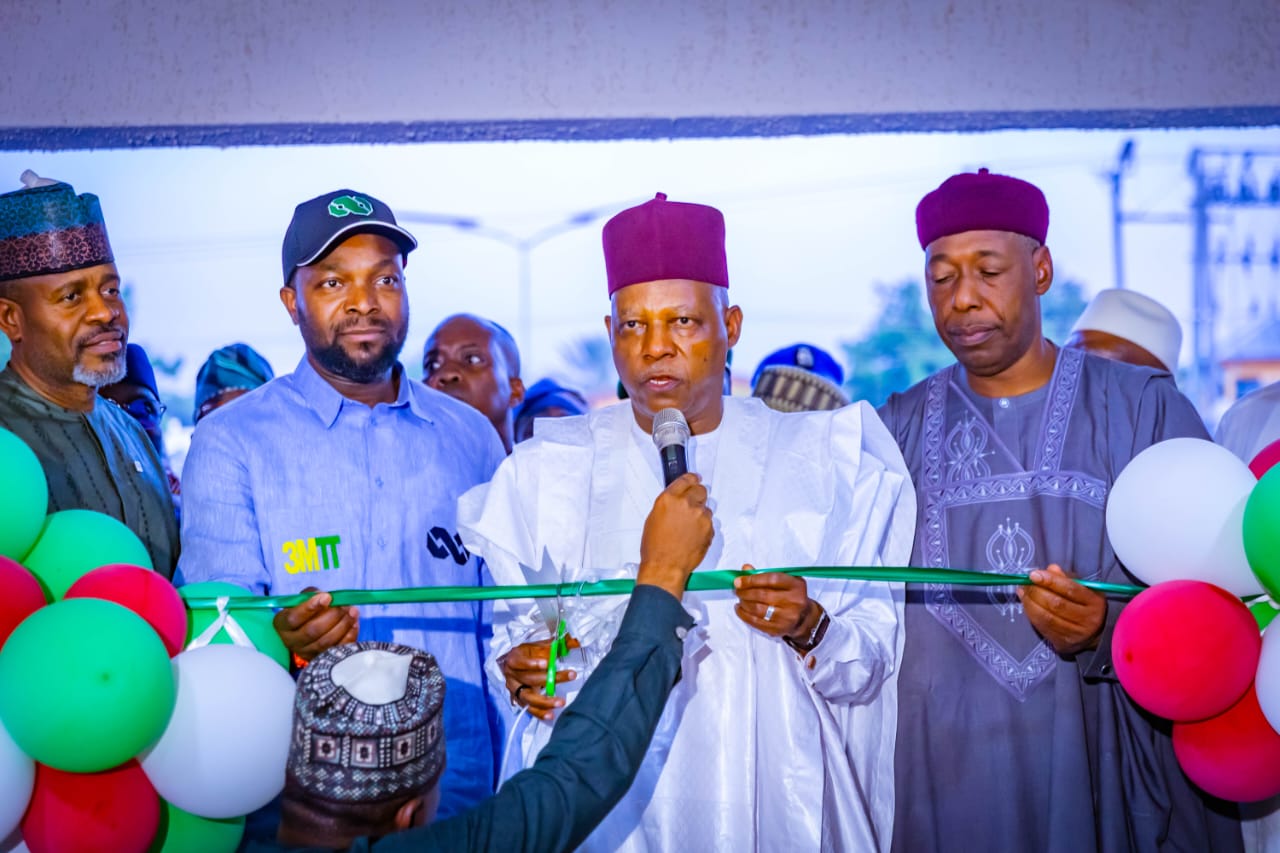
Vice-President Kashim Shettima has inaugurated an innovation hub in Maiduguri, Borno State, to expand access to technology training and equip young people with skills for the digital economy.
The facility, named Ambassador Babagana Kingibe Innovation Hub, will provide practical technology training, collaborative workspaces and opportunities for young Nigerians to develop innovative solutions.
Shettima inaugurated the centre on Monday alongside the Minister of Communications, Innovation and Digital Economy, Dr Bosun Tijani, and Borno State Governor, Prof. Babagana Zulum.
The Federal Ministry of Communications, Innovation and Digital Economy, IHS Nigeria and the Borno State Government jointly established the hub.
It will also support participants in the Federal Government’s 3 Million Technical Talent (3MTT) Programme, offering them facilities to develop technology projects and build professional portfolios.
Speaking at the inauguration, Shettima commended Tijani for extending digital skills development opportunities beyond major urban centres.
He said the initiative would equip young Nigerians with relevant expertise to compete in the global technology industry.
The Vice-President stressed that the government’s digital transformation agenda must accommodate young people in communities outside major cities.
He described the centre as a potential “playground of ideas” where young people could explore their creativity and develop solutions with wider applications.
“His Ministry recognises that digital opportunities must reach Maiduguri and other communities within the state,” Shettima said.
In his remarks, Tijani said the Federal Government was pursuing investments in digital infrastructure alongside human capacity development.
He explained that broadband expansion would deliver greater benefits if Nigerians also acquired the skills to use internet connectivity productively.
The minister cited the National Digital Alphanumeric Postcode System as another government initiative aimed at strengthening the country’s digital infrastructure and services.
He also announced that applications for the next cohort of the 3MTT Programme would open in December.
According to him, the Maiduguri facility would enable programme participants in Borno to collaborate on technology projects, develop professional portfolios and showcase their abilities to potential employers.
“As we connect more communities, we are also helping more young people acquire the skills they need to make use of that connectivity,” Tijani said.
He urged young people across the state to utilise the facility, adding that its success would depend largely on their commitment and participation.
Zulum, who welcomed the intervention, described internet access as essential to economic growth, job creation and security.
However, the governor observed that several local government areas in Borno still lack adequate internet connectivity.
He called for stronger cooperation between the Federal Government and the state to bridge the gaps, particularly in underserved communities.
Zulum also pledged his administration’s support for sustaining the benefits of the projects.
“I therefore express my political will and commitment to partner with the Ministry of Communications, Innovation and Digital Economy to ensure the sustainability of all the projects coming through the support of the Ministry,” he said.
The Maiduguri innovation hub forms part of the Federal Government’s broader efforts to increase Nigeria’s participation in the digital economy.
The strategy combines infrastructure development, technical training and community-based innovation centres to prepare more Nigerians for opportunities in the technology sector.
Other components include Project BRIDGE and the 3MTT Programme, which seek to expand broadband connectivity and build a skilled workforce for the country’s growing digital economy.
The ministry said it would sustain partnerships with state governments, development organisations and private sector players to widen digital access and strengthen technical capacity nationwide.
📢 Follow National Periscope on WhatsApp
Get breaking news and updates directly on WhatsApp.
Join WhatsApp ChannelPost Disclaimer
All rights reserved. This material and other digital content on this website are not and do not represent the stance of National Periscope but the statements of newsmakers mentioned therein.
For your detailed news reportage... contact the Editor at Joel2oladele@gmail.com







[caption id="attachment_23655" align="alignnone" width="300"] (L-R) Prof. Olalekan Yinusa, Executive Director, Read more
[caption id="attachment_22588" align="alignnone" width="579"] Interim Chairman of the governing board Read more
FG Records 60% Progress on 90,000km Fibre-Optic Project JOEL OLADELE, Read more
[caption id="attachment_26851" align="alignnone" width="960"] First Lady Oluremi Tinubu laying the Read more