

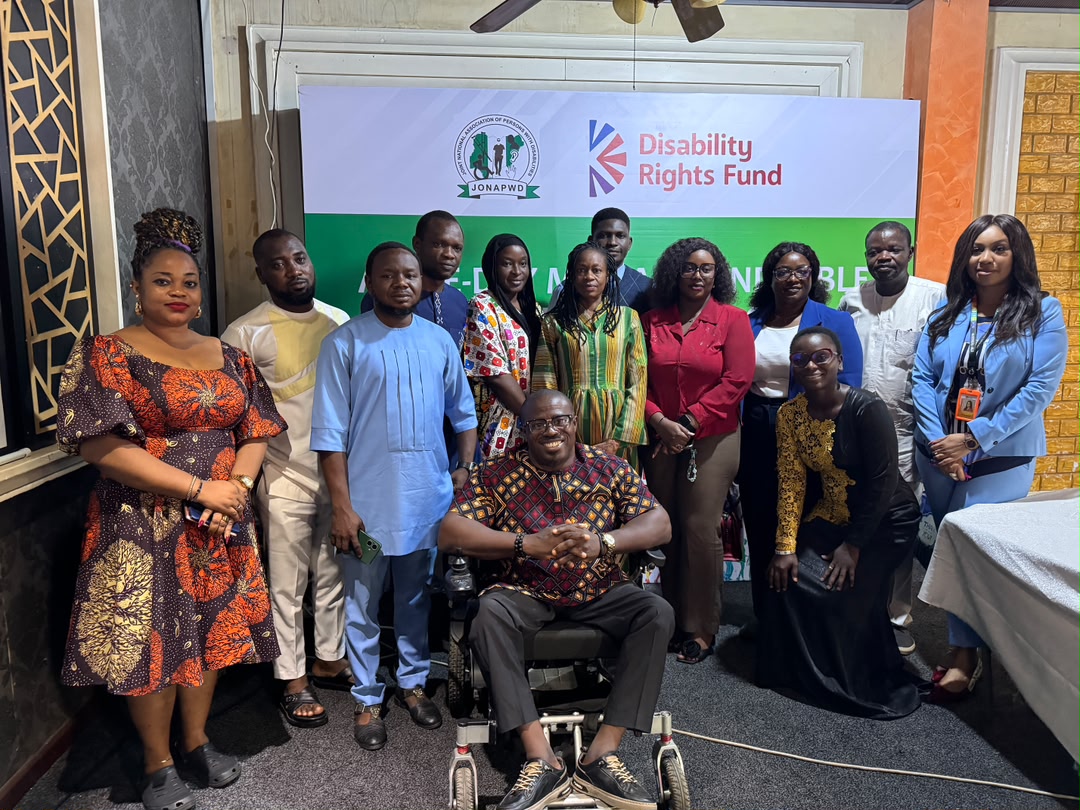
More than 32 million Nigerians with disabilities could remain excluded from critical government programmes and essential services unless urgent steps are taken to accelerate the implementation of the country’s disability inclusion commitments, the Joint National Association of Persons with Disabilities (JONAPWD) has warned.
The association expressed concern over what it described as the slow pace of implementation of Nigeria’s commitments under the 2025 Global Disability Summit (GDS), saying progress on disability inclusion remains inadequate despite policy promises and institutional reforms.
Speaking at a roundtable on Nigeria’s 2025 GDS Commitments in Abuja, JONAPWD President, Abdullahi Aliyu Usman, said the commitments made by Nigeria at the summit should serve as a roadmap for advancing the rights and welfare of persons with disabilities.
Usman, who was represented by the association’s Programme Officer, Bukunmi Adejumo, stressed the need for stronger accountability mechanisms and better coordination among government institutions to ensure that the commitments produce tangible results.
He noted that disability issues often receive limited attention in national development discussions despite affecting millions of Nigerians.
“Most times when government activities are taking place, you hardly hear anything around disability inclusion. That is why platforms like the Global Disability Summit are important to drive commitments and accountability,” he said.
According to him, Nigeria participated in previous editions of the summit held in London in 2018 and 2022 before making fresh commitments at the 2025 edition in Berlin, Germany.
The Global Disability Summit, established in 2017, brings together governments, development partners, civil society organisations and disability advocacy groups to promote inclusive development and humanitarian action.
Usman said that after the Berlin summit, JONAPWD convened stakeholders from organisations of persons with disabilities to develop an action plan for monitoring implementation and engaging relevant government agencies.
He explained that Nigeria’s commitments span 12 key areas, including inclusive education, healthcare, employment, social protection, digital accessibility, legal capacity, climate resilience, accessible infrastructure, humanitarian response and private sector participation.
The JONAPWD president identified accessibility as one of the most pressing challenges confronting persons with disabilities, lamenting that many public buildings and facilities remain inaccessible despite provisions contained in existing regulations.
“We have accessibility standards embedded in our building codes, but somehow those provisions are often ignored during implementation. If we get accessibility right, many of the challenges in education, healthcare, employment and social protection will be significantly reduced,” he said.
He also expressed concern over the state of inclusive education, arguing that many children with disabilities continue to face barriers in accessing quality learning opportunities.
According to him, some schools designated as inclusive institutions still lack the facilities and support systems required to cater to learners with different forms of disability.
Usman further highlighted challenges within the healthcare sector, including limited access to sign language interpretation for deaf patients, inadequate disability-friendly services and difficulties in accessing assistive devices.
“We keep hearing that persons with disabilities are among the poorest in society, yet many government livelihood and social protection programmes are not reaching them in significant numbers,” he said.
He added that disability-disaggregated data now indicates that Nigeria has more than 32 million persons with disabilities, a figure he said underscores the need for deliberate inclusion in public policies and development programmes.
The association also called for greater disability inclusion in humanitarian and emergency response efforts, noting that relief programmes, disaster management plans and early warning systems should be designed to accommodate persons with disabilities.
While acknowledging progress in policy development and institutional reforms, Usman maintained that implementation remains slow.
“Yes, we have seen policy and institutional progress. We have programmes and actions that have been introduced. But it remains evident that implementation is slow. We need stronger voices, stronger commitment, more coordination and greater accountability,” he said.
JONAPWD urged government agencies, development partners and other stakeholders to intensify efforts toward fulfilling Nigeria’s commitments under the Global Disability Summit and ensuring that persons with disabilities are not left behind in the country’s development agenda.
📢 Follow National Periscope on WhatsApp
Get breaking news and updates directly on WhatsApp.
Join WhatsApp ChannelPost Disclaimer
All rights reserved. This material and other digital content on this website are not and do not represent the stance of National Periscope but the statements of newsmakers mentioned therein.
For your detailed news reportage... contact the Editor at Joel2oladele@gmail.com





The Civil Defence, Correctional, Fire and Immigration Services Board (CDCFIB) Read more
Former Speaker, Ghali Na’abba Dies at 65 Former Speaker of Read more
Again, Igboho warns herdsmen to leave Yorubaland. Yoruba Nation agitator, Read more
Just In : Deputy Speaker resigns over medical challenges, replaced Read more