

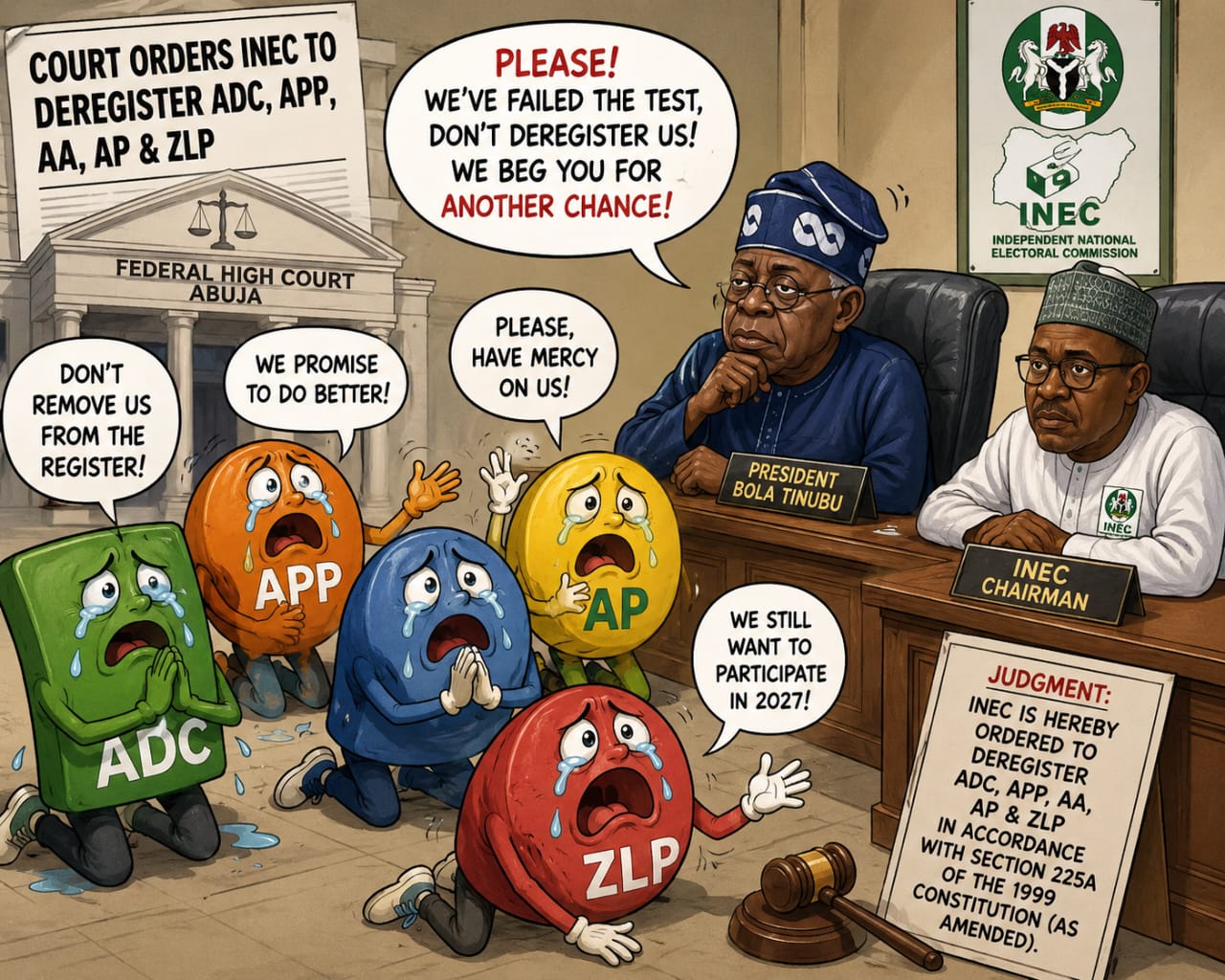
In a landmark decision that is set to drastically alter the structural landscape of Nigerian multi-party democracy ahead of the 2027 general elections, a Federal High Court sitting in Abuja on Monday, June 15, 2026, directed the Independent National Electoral Commission (INEC) to immediately strike down five political parties from its official register.
The affected entities—the African Democratic Congress (ADC), Accord Party (AP), Zenith Labour Party (ZLP), Action Alliance (AA), and Action Peoples Party (APP)—now face administrative extinction following a decisive judgment delivered by Justice Peter Lifu.
The lawsuit, marked FHC/ABJ/CS/2637/2026, was instituted by the Incorporated Trustees of the National Forum of Former Legislators (NFFL). The plaintiffs successfully argued that these organizations have morphed into institutional space-occupiers, failing consistently to satisfy the stringent performance benchmarks legally demanded for their continued existence.
The Constitutional Threshold: Section 225A Demystified
At the heart of this high-stakes litigation is the operationalization of ‘Section 225A of the 1999 Constitution of the Federal Republic of Nigeria (as amended)’. Under our current electoral laws, political party registration is not a permanent luxury or an open-ended inheritance; it is a performance-driven license. To retain active recognition by INEC, a political party must prove its electoral viability by hitting clear legal thresholds. These benchmarks require a party to achieve at least one of the following:
Secure a minimum of 25 per cent of the total votes cast in at least one state of the federation during a Presidential election.
Win at least one elective seat, whether at the local government level (councillorship/chairmanship), state level (House of Assembly/Governorship), or national level (House of Representatives/Senate).
The former lawmakers presented cold electoral statistics proving that the five defendant parties suffered total operational paralysis during the 2023 general elections and subsequent by-elections, failing to mobilize meaningful numbers or win crucial legislative positions. The Attorney General of the Federation, Lateef Fagbemi (SAN), notably threw the weight of the federal executive behind the suit, maintaining that non-performing parties clutter up voting materials, confuse the electorate, and waste public resources on bloated logistics.
Convinced by these arguments, Justice Peter Lifu granted the reliefs, effectively restraining the five affected parties from organizing primaries, conducting rallies, or presenting candidates for upcoming polls.
The Political Aftershocks: Backlash and Jurisdictional Warfare
While institutional purists hail this ruling as a necessary step to cleanse the ballot paper, the affected parties have hit back with furious institutional resistance, setting up a brutal legal battle at the appellate level.
The Accord Party, through its National Chairman, Barrister Maxwell Mgbudem, has swiftly rejected the judgment, labeling it an outright “travesty of justice”. In a terse public statement, Accord pointed out a critical procedural anomaly: Justice Lifu proceeded to deliver his judgment despite a subsisting Court of Appeal stay of proceedings order on the matter. Furthermore, Accord maintains it is constitutionally protected because it won two councillorship seats in Jigawa State, fulfilling the statutory requirement for preservation.
The political ripples of this judgment extend far beyond the party secretariats. International observers note that the deregistration of the ADC introduces a major institutional crisis for top opposition figures—including former Vice President Atiku Abubakar, who has been heavily linked to the party’s platform as a vehicle for his 2027 presidential ambitions.
The Fine Line Between Order and Exclusion
From a developmental standpoint, Nigeria’s electoral space has long suffered from “ballot hyper-inflation.” Navigating a ballot sheet with dozens of obscure acronyms often slows down voting processes and complicates logistics for INEC. In this regard, enforcing Section 225A injects much-needed structural discipline and forces small political blocks to merge into formidable coalitions rather than remaining as fragmented, weak enterprises.
However, the counter-argument is deeply rooted in civil liberties. In a diverse, multi-ethnic society like Nigeria, minor parties often serve as vital ideological outlets for alternative voices, grassroots regional interests, and youth movements that feel locked out by the mega-machineries of the ruling party. Shrinking the democratic space via judicial decrees risks creating a rigid, low-competition system that reduces the choices available to ordinary citizens.
As the legal teams for the ADC and Accord rush to the Court of Appeal to overturn Justice Lifu’s order, the coming weeks will determine whether Nigeria is truly entering an era of streamlined political alignment, or if the judiciary has inadvertently ignited a fire that threatens the foundational diversity of our multi-party democracy.
David Alani Ige
Institutional Archivist & Public Commentator
Igboho, Oyo State.
📢 Follow National Periscope on WhatsApp
Get breaking news and updates directly on WhatsApp.
Join WhatsApp ChannelPost Disclaimer
All rights reserved. This material and other digital content on this website are not and do not represent the stance of National Periscope but the statements of newsmakers mentioned therein.
For your detailed news reportage... contact the Editor at Joel2oladele@gmail.com







APC May Lose Kwara If 2027 Ticket Goes to North, Read more
Guber Poll: INEC Records 96,085 New Voters in Anamabra, Extends Read more
[caption id="attachment_23774" align="alignnone" width="1280"] Prof. Segun Aina[/caption] On 30 June Read more
Edo Primaries: INEC urges political parties to abide by the Read more