
The Federal Government and its African partners have launched ATLAS Umoja AI, a continental artificial intelligence initiative aimed at preserving indigenous languages and ensuring Africa’s cultures and knowledge systems are adequately represented in emerging AI technologies.
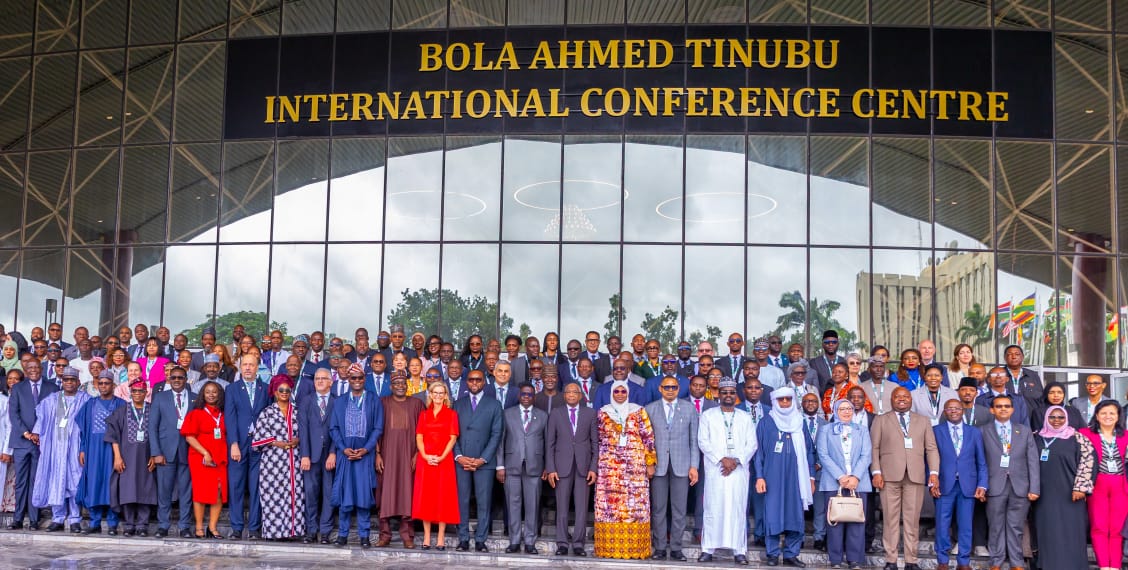
The initiative was unveiled on Thursday at the 7th Ordinary Session of the African Telecommunications Union (ATU) Conference of Plenipotentiaries (CPL-26) in Abuja, where policymakers, regulators and technology leaders urged greater collaboration to position Africa as a key player in global artificial intelligence development.
ATLAS Umoja AI builds on Nigeria’s Nigerian Atlas for Languages and AI at Scale (N-ATLAS), unveiled by the Federal Ministry of Communications, Innovation and Digital Economy during the 80th United Nations General Assembly (UNGA) in New York last September as Africa’s first government-backed open-source large language model.
The expanded initiative broadens the project beyond Nigeria by bringing together governments, researchers, startups and industry stakeholders across the continent to develop AI systems that understand African languages and realities.
Vice President Kashim Shettima described the initiative as a significant milestone in Africa’s digital transformation, saying the continent must work collectively to shape the future of telecommunications and artificial intelligence.
Represented by the Deputy Chief of Staff to the President, Senator Ibrahim Hadejia, Shettima said digital infrastructure had become as critical to national development as roads, railways and electricity.
He said broadband connectivity, artificial intelligence, cloud computing, satellite communications and secure digital networks would determine Africa’s competitiveness in the global digital economy.
“Our future depends on collaboration. We must work together to expand affordable connectivity, strengthen cybersecurity, promote responsible AI governance, harmonise standards, improve spectrum management and accelerate digital trade across our continent,” he said.
The Vice President reaffirmed Nigeria’s commitment to investing in broadband expansion, innovation, AI, cybersecurity and digital public infrastructure, adding that Africa must present a united voice in shaping global technology policies.
“For too long, global technology policies have often been developed without adequate representation of African priorities. That must change,” he added.
Minister of Communications, Innovation and Digital Economy, Dr. Bosun Tijani, said the initiative was conceived to address the glaring under-representation of African languages in existing AI models despite the continent accounting for nearly one-third of the world’s languages.
According to him, fewer than two per cent of African languages currently enjoy meaningful support in modern AI systems.
Tijani said the new continental framework, known as the ATLAS Network, would accelerate the development of large language models built in Africa, by Africans and for African communities.
“Today, I am pleased to announce that, together with partners across Africa, we are taking the next step by expanding this initiative into a continental framework; the ATLAS Network,” the minister said.
He called on all member states of the African Telecommunications Union to join the initiative, stressing that Africa should not merely adopt artificial intelligence but actively shape its future.
Tijani also acknowledged the support of the Global System for Mobile Association (GSMA), describing its partnership as critical to the project’s development.
Co-founder and Chief Executive Officer of Awarri, Silas Adekunle, explained that “Umoja,” a Swahili word meaning “unity,” was deliberately chosen to reflect the initiative’s Pan-African vision of collective innovation.
He said the project evolved from the success of Nigeria’s N-ATLAS platform, revealing that about 5,000 developers had already built applications using the Nigerian model.
According to Adekunle, African developers have long depended on foreign AI models, resulting in valuable data and economic opportunities leaving the continent.
“This is about building an ecosystem and driving the African economy so that creators have the right tools to solve African problems with technology that reflects our way of life,” he said.
He added that the initiative would help AI systems understand Africa’s more than 2,000 languages, most of which currently receive little or no meaningful support from global AI platforms.
“This is a line in the sand. We’re making a statement today that governments, industry and startups are ready to work together to build frontier technology in Africa,” Adekunle added.
Senior Director for Public Policy, Africa, at GSMA, Caroline Mbugua, said ATLAS Umoja AI would position Africa as an active contributor to global AI innovation rather than simply a consumer of emerging technologies.
She disclosed that the initiative is being implemented through a partnership involving GSMA, Awarri, Power AI and Mozisha, with Nigeria, Kenya, Namibia and Togo serving as founding members.
Mbugua urged more African countries to join the platform, noting that wider support for indigenous languages would improve digital literacy and help bridge the continent’s digital inclusion gap.
The conference also reviewed Africa’s preparations for the 2026 International Telecommunication Union (ITU) Plenipotentiary Conference, with delegates calling for stronger continental cooperation on digital governance, artificial intelligence, cybersecurity and telecommunications development.
📢 Follow National Periscope on WhatsApp
Get breaking news and updates directly on WhatsApp.
Join WhatsApp ChannelPost Disclaimer
All rights reserved. This material and other digital content on this website are not and do not represent the stance of National Periscope but the statements of newsmakers mentioned therein.
For your detailed news reportage... contact the Editor at Joel2oladele@gmail.com





The Federal Government has approved the acquisition and deployment of Read more
[caption id="attachment_25383" align="alignnone" width="630"] Phone screen displaying unknown number to Read more
JOEL OLADELE, Abuja The National Broadcasting Commission has said Nigerians Read more
Nigeria has begun a major rethink of its telecommunications Read more