

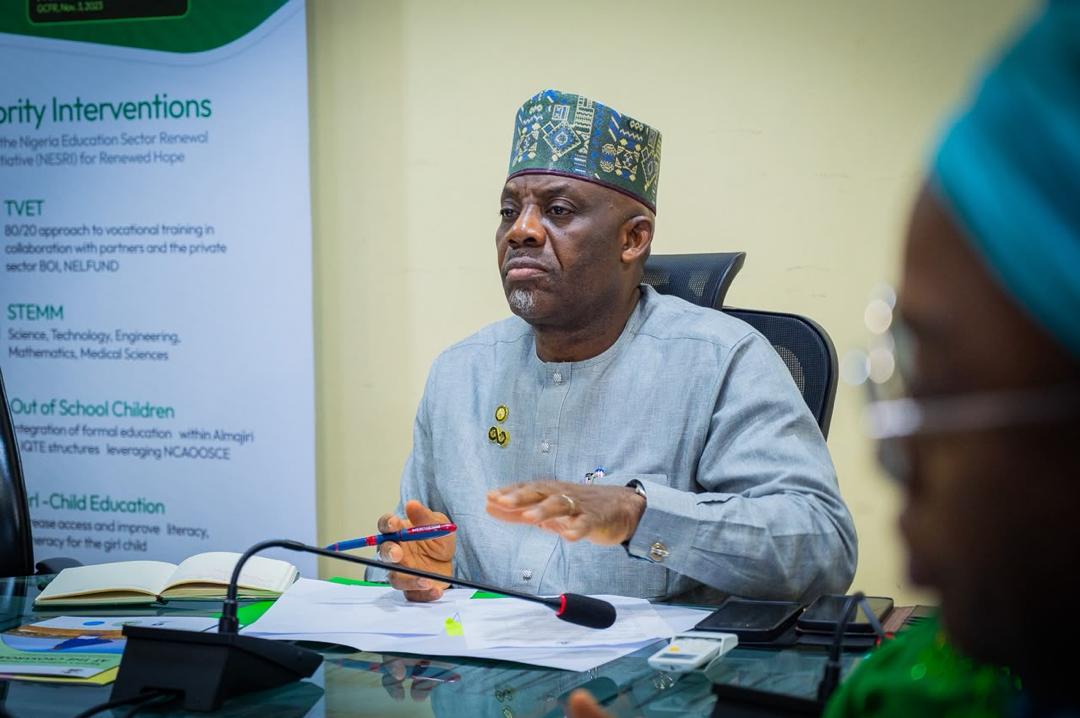
The Minister of Education, Dr Maruf Tunji Alausa, has said President Bola Ahmed Tinubu has fulfilled nearly 100 per cent of the promises he made during the 2023 presidential campaign, citing reforms in education, technical training, medical education and data management as evidence of the administration’s performance.
Alausa made the assertion at the weekend in Abuja while receiving the 2025 Nigeria 2050 Child Foresight Analysis for Futures Literacy and Intergenerational Equity, a flagship initiative of the Anticipatory Governance and Foresight Capacity Programme of the Office of the Vice President, supported technically by UNICEF.
The Child Foresight team, led by its Director-General, Chris Ngwodo, and Special Assistant on Special Duties to the Vice President, Mohammed Ahmed, presented the report to the minister.
The minister said the report was particularly significant because of Nigeria’s youthful population, with about 70 per cent of the estimated 220 million population below the age of 30.
He said the size of the population presented both an opportunity and a responsibility for the government to equip young Nigerians with quality education, relevant skills and productive opportunities capable of turning the country’s demographic strength into an economic advantage.
Alausa said the changes under Tinubu were no longer limited to political promises, but were becoming evident through reforms and outcomes across different sectors, particularly education.
“I can assure you of that one fact because today we have a President who is leading the country, managing this country from the front, with the highest level of integrity, commitment, patriotism and determination to change the face of this country,” he said.
He added that the administration’s interventions were producing tangible benefits for Nigerians.
“And these are not just rhetorics we are hearing now. These are things we are seeing, with a lot of tangible benefits and tangible change in the country,” he said.
The minister said Nigeria was no longer at a crossroads but still had substantial work to do to bridge existing development gaps.
“The country is not at a crossroads again. We have a lot of catching up to do,” he said.
Alausa identified education as one of the areas where the administration’s commitment was being demonstrated, saying the sector was central to Tinubu’s ambition of moving Nigeria towards a $1 trillion economy.
He said the Nigerian Education Sector Renewal Initiative (NESRI) was driving reforms across the education system, with particular attention to Technical and Vocational Education and Training (TVET), STEM education, teacher quality, quality assurance, reduction of the out-of-school population and digitalisation of education data.
According to him, the Federal Government’s renewed emphasis on TVET was helping to change public perception of technical education while creating new routes for young Nigerians to acquire practical skills, become entrepreneurs, secure jobs and progress to higher levels of education.
“Skills are the present and the future,” Alausa said, stressing that the country could no longer operate an education system that failed to prepare young people for the realities of the modern economy.
He recalled that technical education was once an important component of Nigeria’s education system, producing skilled workers, artisans, entrepreneurs and professionals, but suffered decades of neglect and declining public confidence.
The minister said the Federal Government was now repositioning TVET as a key component of national development because of its potential to improve employment, productivity and economic growth.
He also linked the administration’s reforms in medical education and professional training to efforts to tackle shortages of health workers and reduce pressures associated with the migration of Nigerian professionals abroad.
Alausa said Nigeria faced shortages of nurses and other health professionals despite having a large population of young people interested in studying health-related courses.
He said the government was responding by expanding training opportunities in existing teaching hospitals, federal medical centres and specialist hospitals rather than depending solely on the construction of new institutions.
The approach, he said, would allow more Nigerians to acquire high-quality professional training locally while creating a skilled workforce capable of competing internationally.
The minister also highlighted the administration’s growing reliance on data in addressing the country’s out-of-school children challenge.
He questioned the long-standing estimates that placed the number of out-of-school children in Nigeria between 15 million and 17 million, arguing that the figures had often been cited without sufficiently comprehensive household-level verification.
Alausa said evidence from recent household surveys in some states suggested that the actual numbers could be significantly lower than previous estimates.
He cited Kaduna State, where a household survey covering more than 90 per cent of households reportedly recorded fewer than 190,000 out-of-school children, against an earlier estimate of about 585,000.
He also referred to another Kaduna estimate of about 1.2 million children, which he said fell to below 100,000 following a general household survey.
Jigawa State, he added, had equally recorded significant differences between previous estimates and findings from household-level assessments.
The minister, however, said any reduction in the estimated number would not diminish the urgency of getting every Nigerian child into school.
“Even if there’s significant reduction, any child out of school is still too many,” he said.
Alausa disclosed that more than one million children had been moved from the streets into school across the country in the past two and a half years, while Jigawa State alone had reportedly moved more than 180,000 children into school in the last two years.
He said the next task was to sustain enrolment, ensure children remained in school and prevent fresh cases of school exclusion.
The minister said digital education data was becoming increasingly important to achieving those objectives, noting progress recorded in the 2026 Annual School Census through the digitised Nigerian Education Management Information System (NEMIS).
According to him, more than 56 per cent of public schools had submitted their 2026 Annual School Census information, while 41 per cent of private schools had populated their records on the digital platform.
Alausa described the development as a major step towards improving education planning and accountability.
“Without data, you’re flying blind. Data will tell you everything,” he said.
He explained that reliable data would enable the ministry to identify gaps in access and participation, understand why children were out of school, target infrastructure and other interventions, and monitor whether children who returned to school remained enrolled.
The minister said the ministry had also conducted a national assessment to establish a baseline for literacy, numeracy and cognitive development among learners at the primary, junior secondary and senior secondary levels.
He said the exercise would provide a clearer picture of learning outcomes and enable the government to assess the impact of its interventions over time.
Alausa said the reforms and data being generated across the education sector were directly relevant to the Child Foresight Analysis, which seeks to identify the risks, opportunities and drivers likely to shape the lives of Nigerian children and young people towards 2050.
He said the initiative would help embed long-term thinking, systems thinking, adaptive innovation and youth participation into national planning.
The minister commended the Office of the Vice President, the Office for Strategic Preparedness and Resilience (OSPRE) and UNICEF for supporting the initiative, describing the foresight programme as an important tool for moving Nigeria from reactive governance towards anticipatory action.
He said the Ministry of Education would work to align the findings of the report with NESRI, particularly in the areas of future literacy, skills development, long-term education planning, data systems and intergenerational equity.
Alausa said Nigeria now had an opportunity to deliberately shape the future it wanted rather than wait for challenges to emerge before responding to them.
He maintained that the ultimate measure of progress would be whether Nigerian children and young people received better education, acquired relevant skills, found productive opportunities and contributed meaningfully to national development.
“Nigeria has changed, and it has changed for good,” the minister said.
📢 Follow National Periscope on WhatsApp
Get breaking news and updates directly on WhatsApp.
Join WhatsApp ChannelPost Disclaimer
All rights reserved. This material and other digital content on this website are not and do not represent the stance of National Periscope but the statements of newsmakers mentioned therein.
For your detailed news reportage... contact the Editor at Joel2oladele@gmail.com






Jega decries state of the nation, calls for urgent action Read more
NYSC fixes April 2 for physical verification of graduates from Read more
Sexual assault: Court remands suspended UNICAL Prof pending bail A Read more
The Universal Basic Education Commission (UBEC) has reaffirmed its commitment Read more