

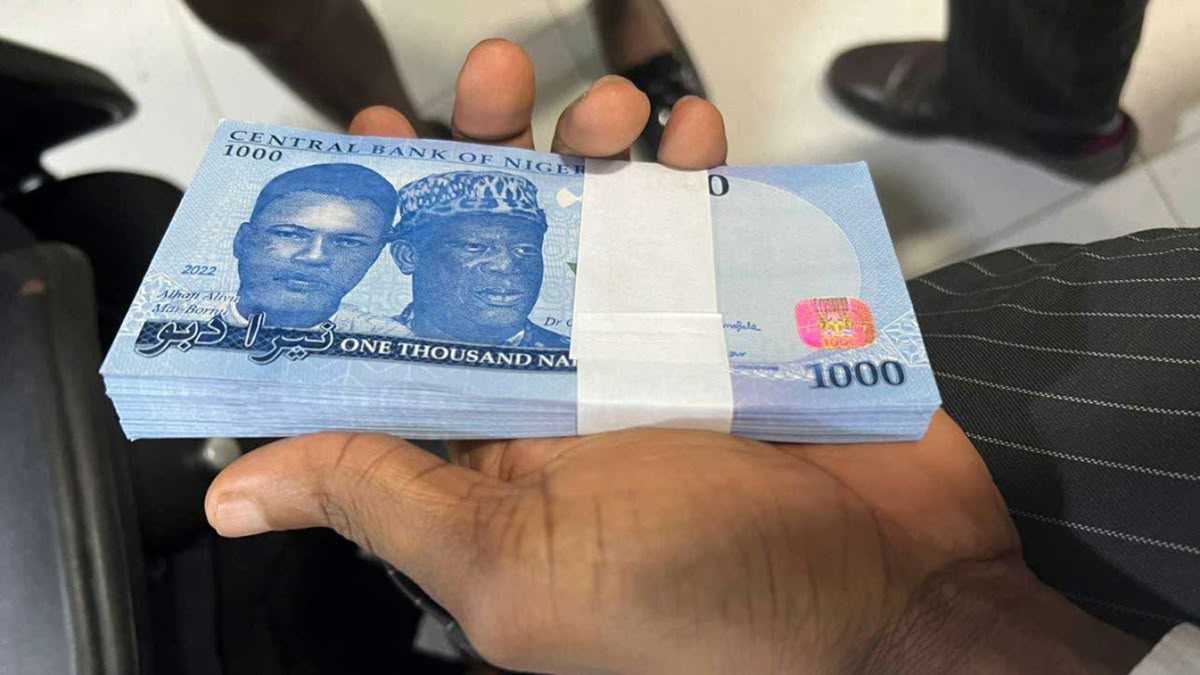
Traders in Borno State have raised the alarm over the circulation of counterfeit N1,000 notes, saying the development is causing losses and threatening confidence in local markets.
The traders, who spoke in separate interviews with the News Agency of Nigeria in Kwaya Kusar on Saturday, said the problem had spread beyond the Kwaya Kusar Grains Market.
According to them, traders in markets across Biu and Bayo Local Government Areas also encounter the fake notes, particularly on busy market days when large volumes of cash change hands.
They said the situation was disrupting commercial activities as traders increasingly became wary of the cash they received from customers.
One of the affected traders, Ibrahim Yusuf, a grain dealer from Gombe, said he had received counterfeit N1,000 notes twice.
Yusuf said he discovered four fake notes after visiting Biu grain market about three weeks ago to buy maize.
He explained that he only noticed the problem while travelling back and preparing to pay his driver.
“One of the new N1,000 notes felt unusually light in my hand, so I suspected it was fake,” he said.
Yusuf later found three other counterfeit notes among the cash he had collected.
He said the development had eaten deeply into his profit because he makes only about N3,000 to N4,000 on each bag of grain after transportation costs.
“I bought three bags, expecting roughly N12,000 in profit, but I ended up with N4,000 in counterfeit notes,” he said.
Yusuf urged government agencies to inspect markets in Biu, Kwaya Kusar and Shani, identify the source of the fake currency and remove it from circulation.
He said authorities needed to act quickly as farmers had begun harvesting, a period that usually brings increased trading activity and greater cash circulation.
Another trader, Alhaji Hassan Mai-Dawa, said he also received counterfeit N1,000 notes from a Point-of-Sale operator in Kwaya Kusar.
He said bank officials detected the fake notes when he went to deposit the money.
Mai-Dawa explained that many traders in the area do not accept transfers, leaving buyers with little choice but to withdraw cash from POS operators.
He said he had encountered a similar problem at Biu market and feared that many traders could unknowingly pass the counterfeit notes to others.
Rice trader Mrs Hauwa Aminu also recounted her experience, saying she sometimes found unusually new N1,000 notes among the cash she received.
She said she once nearly quarrelled with a customer who rejected some notes after seeking a refund.
According to Aminu, the customer insisted that some of the money was fake, while she argued that she had not produced the notes herself.
The disagreement, she said, became so heated that the customer stopped patronising her shop.
Aminu called on the authorities to deploy officials to rural markets, monitor the circulation of counterfeit currency and arrest those responsible.
She said stronger surveillance would protect traders and prevent the fake notes from causing greater losses as commercial activities increase.
📢 Follow National Periscope on WhatsApp
Get breaking news and updates directly on WhatsApp.
Join WhatsApp ChannelPost Disclaimer
All rights reserved. This material and other digital content on this website are not and do not represent the stance of National Periscope but the statements of newsmakers mentioned therein.
For your detailed news reportage... contact the Editor at Joel2oladele@gmail.com







[caption id="attachment_26398" align="alignnone" width="588"] Moove branded vehicle[/caption] Moove, the global Read more
Ride-hailing company Uber has announced the closure of its operations Read more
Nigerian fashion brand DWL earns Qatar government's support •Shortlisted for Read more
Government moves to ban sale, consumption of alcohol The Niger Read more