

•Labour insists petrol must sell at N500 per litre
•My Reforms Did Not Create Nigeria’s Economic Problems – Tinubu
•NLC backs strike, faults rising cost of living
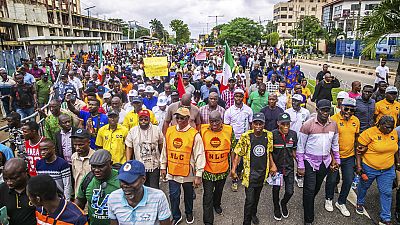
Federal, state and local government workers nationwide have begun a three-day warning strike over the Federal Government’s failure to address key concerns raised by public sector unions.
The industrial action, declared by the Joint National Public Service Negotiating Council (JNPSNC), commenced at midnight today(Friday) and will run until Sunday, October 4, 2026.
The council had given the Federal Government until September 30 to respond to its concerns, including a reduction in petrol prices to N500 per litre, an immediate wage award and the commencement of negotiations for a new national minimum wage ahead of 2027.
The workers had expected President Bola Tinubu to address the issues in his Independence Day address on Thursday.
But the JNPSNC said the President’s speech failed to provide concrete measures to ease the economic hardship confronting workers, their dependants and other Nigerians.
The council subsequently directed all federal, state and local government employees, including workers in ministries, departments and agencies (MDAs), to participate in the warning strike.
The directive was contained in a circular dated October 1 and signed by the council’s National Secretary on the Trade Union side, Olowoyo Gbenga.
The council said the action followed the Federal Government’s failure to respond to a letter sent to President Tinubu on September 21.
“Consequent upon the above, the strike shall start with effect from midnight of Friday 2nd October, 2026 to Sunday October 4th, 2026,” the circular stated.
It directed national and state officials of its affiliate unions to ensure compliance with the industrial action.
“The economic and mental hardships are becoming unbearable and frustrating. The time to act and mobilise workers for the three days warning strike is now,” the council said.
The JNPSNC comprises the Nigerian Civil Service Union (NCSU), Medical and Health Workers Union (M&HWU), Association of Senior Civil Servants of Nigeria (ASCSN) and National Association of Nigerian Nurses and Midwives (NANNM).
Others are the Amalgamated Union of Public Corporations, Civil Service Technical and Recreational Employees (AUPCTRE), Nigeria Union of Public Service, Reportorial, Secretarial, Data Processors and Allied Workers (NUPSRAW), National Union of Printing, Publishing and Paper Products Workers (NUPPPPROW), and National Union of Agriculture and Allied Employees (NUAEE).
Labour insists petrol must sell at N500 per litre
At the centre of the workers’ concerns is the rising cost of petrol, which the JNPSNC said had worsened transportation costs and increased the prices of essential goods and services.
The council wants the Federal Government to take steps to reduce the pump price of petrol to N500 per litre.
In its September 29 statement, it said petrol prices ranging from N1,450 to N2,000 per litre, and as high as N2,500 in some locations, were unacceptable to Nigerian workers.
It proposed the establishment of an intervention fund to address landing costs and support oil and gas operators.
The council also urged the government to ensure that crude oil is sold to the Dangote Refinery and operators of modular refineries at appropriate terms to facilitate increased domestic refining.
A leader of the JNPSNC said the unions were disappointed that the President’s Independence Day address did not respond to their concerns.
“We are deeply disappointed that the President’s Independence Anniversary address failed to address our legitimate demands for a reduction in the pump price of petrol and the introduction of concrete measures to alleviate the excruciating hardship confronting workers and other Nigerians,” the leader said.
“While the President acknowledged the severe suffering inflicted on citizens by government policies, it is deeply concerning that the speech offered no concrete relief or meaningful response to the urgent demands of Nigerian workers.
“In view of this failure to address these pressing concerns, our three-day warning strike will proceed as planned.”
Tinubu says his reforms did not create Nigeria’s economic problems
President Tinubu, however, used his Independence Day address to defend the economic reforms implemented by his administration, saying they did not create the weaknesses confronting the country but were intended to address longstanding structural problems.
In his nationwide broadcast to mark Nigeria’s 66th Independence anniversary, the President said successive administrations had postponed difficult decisions, allowing economic distortions to deepen.
“For too long, the promise of Nigeria was undermined by choices that postponed difficult decisions and allowed deep economic distortions to grow,” he said.
Tinubu said his administration had no choice but to undertake difficult reforms when it assumed office in 2023, comparing the process to the treatment of a serious illness.
He said previous governments had focused on managing the symptoms of Nigeria’s economic problems instead of confronting their underlying causes.
“When this Administration assumed office, we resolved to do things differently. We chose to excise the cancer. The reforms that followed were difficult. The side effects were real. Yet, we must never confuse the medicine with the disease,” he said.
The President specifically defended the removal of petrol subsidy and other economic measures that have contributed to higher living costs, saying the reforms should not be confused with the weaknesses they were designed to address.
“Our reforms did not create the weaknesses in our economy. They confronted them. Now, as certain influential but regressive voices would have us abandon the treatment and return ourselves to the abuse of addictive subsidies, we must resist their siren song. We must remember why we began this journey and how far we have already come,” Tinubu said.
He also argued that indicators showed an improvement in the economy, saying gross domestic product growth had exceeded four per cent during the year, while oil and non-oil sectors had contributed to what he described as renewed stable growth.
According to him, oil theft had declined, inflation had fallen from its peak, foreign reserves had been rebuilt and the foreign exchange market had stabilised.
His position contrasts with the concerns raised by the labour unions, which have continued to point to the impact of high petrol prices, inflation and stagnant purchasing power on workers and households.
NLC backs strike, faults rising cost of living
The Nigeria Labour Congress (NLC) has also called for measures similar to those being sought by the JNPSNC, with its President, Joe Ajaero, using the union’s Independence Day statement to highlight the pressure facing Nigerian workers.
The NLC said rising petrol prices, inflation, stagnant wages, unemployment and insecurity had deepened the economic difficulties confronting workers and other Nigerians.
The labour centre said inflation had eroded the real value of workers’ wages, while higher transportation costs had pushed up the prices of food, rent, school fees and other necessities.
“Petrol now sells at N1,430 per litre or higher in major cities and far more in remote areas. The surge in transportation costs drives up the prices of food, school fees, rent and nearly every necessity of life, while nominal wages remain stagnant,” it said.
The NLC called for measures to immediately reduce petrol prices, saying transportation costs remained a major channel through which inflation affected households.
It also called for a nationwide wage award for federal, state and local government workers as an emergency measure to cushion the erosion of their purchasing power.
The labour centre further sought implementation of tax relief measures it said were agreed with the Federal Government during the October 2023 dialogue between government and labour.
It also called for the immediate establishment of a tripartite committee to negotiate a new national minimum wage ahead of 2027.
“We demand the immediate establishment of a tripartite committee to ensure that a new wage standard for 2027 is formulated and legislated before the year runs out,” the NLC said.
The congress also called for a reduction in the cost of governance and greater transparency in the management of public resources.
It urged the Federal Government to create more economic opportunities for young Nigerians and tackle insecurity, which it said was worsening economic conditions and exposing farmers, teachers and healthcare workers to danger in some parts of the country.
The JNPSNC has directed its affiliate unions to mobilise workers for the three-day action across the federal, state and local government services.
The council said it would continue to press the Federal Government for responses to the issues that prompted the industrial action.
📢 Follow National Periscope on WhatsApp
Get breaking news and updates directly on WhatsApp.
Join WhatsApp ChannelPost Disclaimer
All rights reserved. This material and other digital content on this website are not and do not represent the stance of National Periscope but the statements of newsmakers mentioned therein.
For your detailed news reportage... contact the Editor at Joel2oladele@gmail.com



Jega decries state of the nation, calls for urgent action Read more
Fresh revelations as CBN investigator summons Lemo, others over Union Read more
Most governors in review committee not paying minimum wage -NLC Read more
APC accuses Fubara of plotting to declare Rivers Assembly illegal Read more