

•Amupitan Pledges Neutrality, Operational Excellence
•18 Parties Submit Presidential Tickets as Final Candidate Lists Near
•Police Begin Clearance Operations in Kogi, Niger, Benue, Taraba
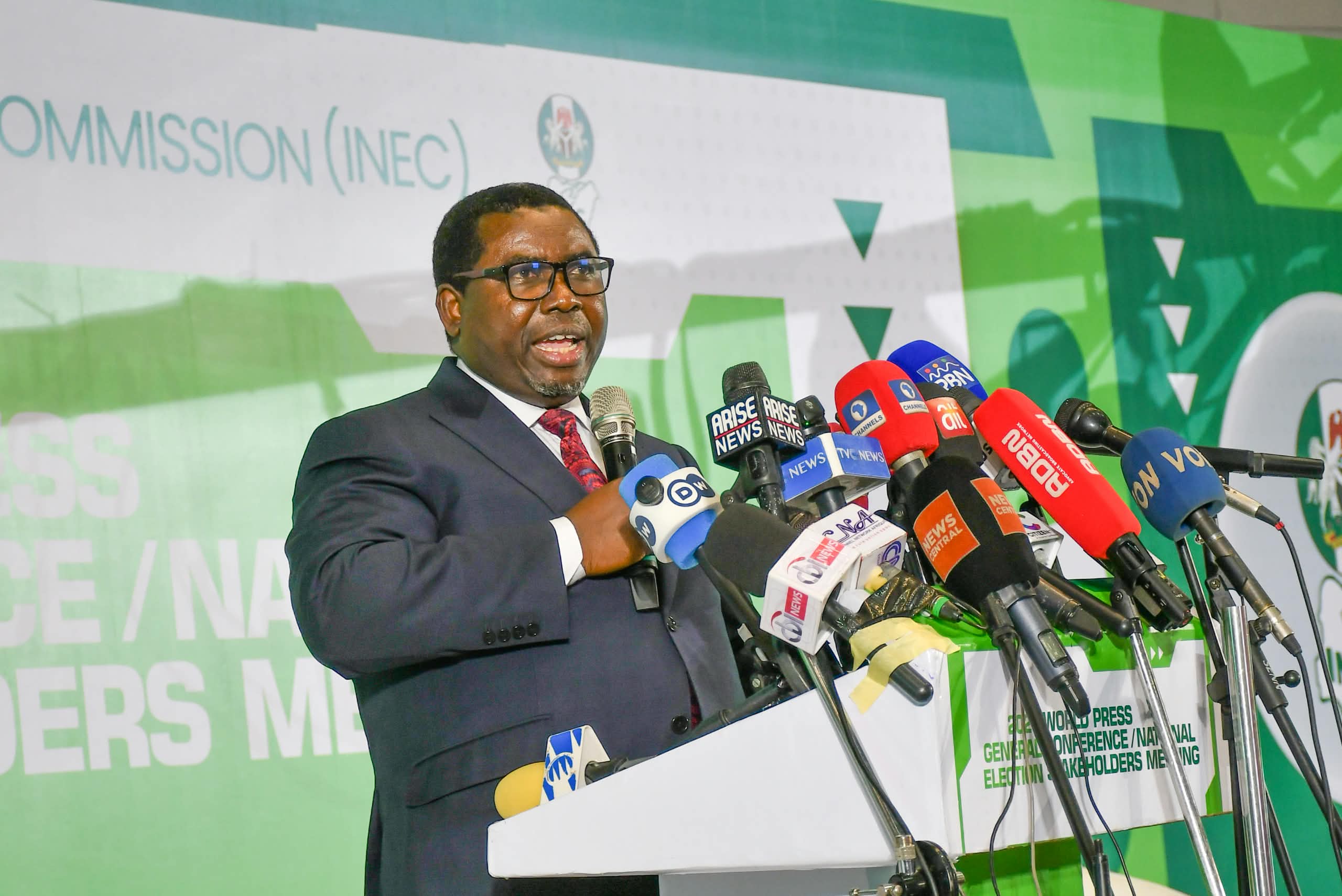
The Independent National Electoral Commission (INEC) has put the number of registered voters for the 2027 general elections at 103,428,715, with Ekiti and Bayelsa recording the lowest figures among the 36 states.
INEC Chairman, Prof. Joash Amupitan, disclosed the figure on Tuesday in Abuja at a national stakeholders’ meeting and press conference marking 100 days to the elections.
The register followed the completion of the three-phase Continuous Voter Registration (CVR), biometric verification and a clean-up exercise conducted by the commission.
According to the figures, Ekiti has 1,055,708 registered voters, while Bayelsa follows with 1,200,691. Lagos has the highest number with 7,488,633, followed by Kano with 6,570,276 and Kaduna with 4,662,640.
Katsina has 3,876,051 registered voters, Rivers 3,736,434, Oyo 3,588,111, Delta 3,525,988, Benue 3,057,225, Ogun 3,037,981 and Bauchi 3,012,547.
The commission said the CVR exercise added 10,772,421 new voters to the register.
Amupitan said the completion of the registration and verification processes had moved the commission into the final phase of preparations for the elections.
“The register now has 103,428,715 registered voters following the completion of the three-phase Continuous Voter Registration exercise and the subsequent biometric verification and clean-up,” he said.
INEC will display the register nationwide from October 9 to 15, allowing citizens to examine their details and raise claims or objections.
Distribution of newly issued Permanent Voter Cards (PVCs) will also begin on October 9, with the first phase taking place at local government centres.
Amupitan assured Nigerians and the international community that the commission would remain neutral and focused on delivering credible elections.
“As we begin this 100-day sprint to the 2027 General Election, we reassure the nation and the international community of our total commitment to neutrality, operational excellence, and the sacred integrity of the ballot box,” he said.
He said the commission had completed nine of the 14 statutory milestones on its revised timetable, adding that election materials, technology, logistics and workforce preparations had moved into the execution stage.
The commission has also recorded progress in political party preparations, with 18 of the 22 registered political parties submitting presidential and vice-presidential candidates for the 2027 election.
The final National Assembly candidate list was published on September 12, while the final list of candidates for governorship and State House of Assembly elections is expected on October 10.
On technology, the commission has acquired 57,000 new Bimodal Voter Accreditation System (BVAS) machines as part of preparations for the elections.
A nationwide BVAS stress test is scheduled for October 23 to 28, followed by a mock accreditation and election simulation in November.
The commission has also established an Artificial Intelligence (AI) Division within its Information and Communication Technology structure to support results verification, anomaly detection and cyber protection.
Amupitan, however, warned that the growing use of generative AI, voice cloning and deepfakes could pose serious challenges to the electoral process.
He urged the media and the public to verify election-related information before sharing it, stressing that accuracy should take precedence over speed.
“In national elections, it is far more important to be right than to be first,” he said.
Security agencies are also intensifying preparations ahead of the elections, with the police commencing clearance operations in Kogi, Niger, Benue and Taraba states.
The Assistant Inspector-General of Police, Idu Alinyenu, who represented the Inspector-General of Police, said the operations were aimed at addressing security concerns in areas affected by criminal activities and other threats.
He said the force was working to tackle what he described as pockets of fear created by the changing geography of insecurity.
Beyond security operations, the commission said it was working with the Economic and Financial Crimes Commission (EFCC), Independent Corrupt Practices and Other Related Offences Commission (ICPC) and Nigerian Financial Intelligence Unit (NFIU) to monitor campaign financing, vote-buying and other forms of electoral malpractice.
More than 100,000 vehicles and 4,000 boats have also been secured for election logistics across the country.
The commission said 707,384 ad hoc personnel would be required for each election day, amounting to 1,414,768 engagements for the presidential/National Assembly and governorship/State Assembly elections.
Recruitment of ad hoc personnel opened on September 18 and will close on November 18, with the National Youth Service Corps (NYSC) expected to remain a major source of personnel.
The 2027 elections are scheduled for January 16 and February 6, 2027.
Amupitan said the remaining preparations would be pursued with strict attention to logistics, technology, personnel, security and stakeholder coordination, as the commission enters the final 100-day countdown.
📢 Follow National Periscope on WhatsApp
Get breaking news and updates directly on WhatsApp.
Join WhatsApp ChannelPost Disclaimer
All rights reserved. This material and other digital content on this website are not and do not represent the stance of National Periscope but the statements of newsmakers mentioned therein.
For your detailed news reportage... contact the Editor at Joel2oladele@gmail.com






[caption id="attachment_24415" align="alignnone" width="1080"] INEC Chairman, Prof. Joash Amupitan and Read more
APC set for landslide victory in 2027—Ganduje Joel Oladele Abuja Read more
JOEL OLADELE, Abuja The Nigeria Democratic Congress (NDC) has moved Read more
JOEL OLADELE, Abuja The Nigeria Democratic Congress (NDC) recorded a Read more