

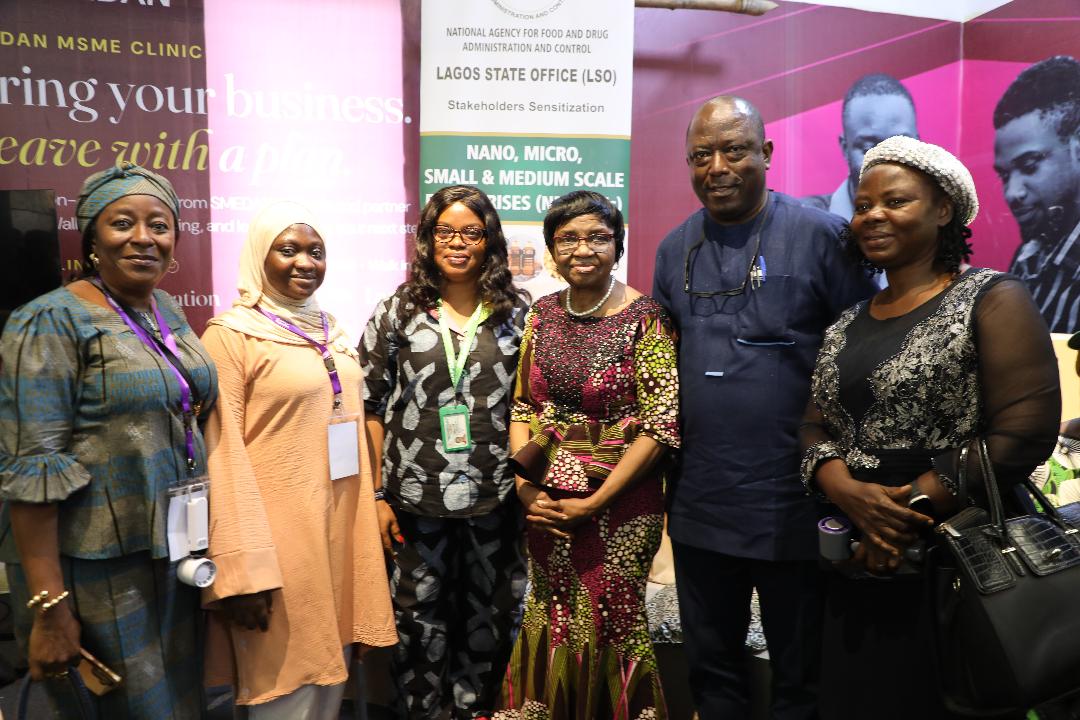
The National Agency for Food and Drug Administration and Control (NAFDAC) has introduced a 50 per cent reduction in product registration fees for companies with five or fewer employees to encourage small businesses to formalise their operations.
The Director-General of NAFDAC, Prof. Mojisola Adeyeye, announced the measure at the SMEDAN-NAFDAC Summit held in Lagos. She said the agency was committed to making product registration easier, faster and more affordable for micro, small and medium enterprises (MSMEs).
Adeyeye explained that NAFDAC’s regulatory responsibilities should not discourage entrepreneurs but help them produce safe and quality goods that can compete in local and international markets.
She acknowledged that many small business owners associate the agency with high charges, bureaucratic delays and cumbersome documentation.
However, she described MSMEs as major drivers of employment, indigenous production and Nigeria’s industrial development, stressing the need to support their growth.
“NAFDAC does not exist to frustrate small businesses but to protect the Nigerian consumer, encourage and guide honest manufacturers to produce safe, wholesome and quality products,” she said.
The Director-General noted that obtaining a NAFDAC registration number gives consumers confidence in the safety and quality of products.
She added that registration also strengthens the credibility of Nigerian brands among international buyers and opens opportunities for businesses seeking to expand beyond the domestic market.
According to her, the agency has introduced several interventions to address the financial and administrative difficulties associated with product registration.
Apart from the 50 per cent reduction in fees for companies with five or fewer employees, NAFDAC has established a Small Business Support Desk to guide entrepreneurs through the registration process.
The agency also allows MSMEs to submit and track applications electronically through its Automated Product Administration and Monitoring System (NAPAMS).
Adeyeye said the platform reduces transportation expenses, improves transparency and limits opportunities for sharp practices.
Other support measures include expedited laboratory analysis, registration through zonal offices, free counselling and approval for similar low-risk products manufactured in common or shared facilities.
Explaining the registration procedure, she said applicants must first obtain the relevant guidelines for their product categories from NAFDAC’s website.
They are required to submit applications and supporting documents through NAPAMS before paying the applicable registration fees.
The agency subsequently inspects manufacturing facilities to determine compliance with Good Manufacturing Practices or Good Hygienic Practices.
Products also undergo laboratory analysis to establish whether they meet the required safety and quality standards. Successful applicants receive marketing authorisation and a NAFDAC registration number.
Adeyeye cautioned small business owners against engaging unrecognised consultants and agents to facilitate registration.
She said incomplete documentation, inadequate product labelling and manufacturing facilities that fail to meet inspection requirements often account for delays.
The Director-General expressed concern that some entrepreneurs had paid agents several millions of naira for services they could obtain directly from the agency at much lower official rates.
“A conversation with us before submission saves time and money,” she said.
She urged manufacturers to approach NAFDAC for guidance before submitting applications, adding that complete documentation, prompt responses to regulatory directives and satisfactory laboratory results would help shorten registration timelines.
On export opportunities, Adeyeye identified processed foods, spices, cocoa and cashew derivatives, shea products, herbal preparations and cosmetics as Nigerian products with significant international market potential.
She said the African Continental Free Trade Area (AfCFTA), which connects a market of more than one billion people, offers enormous opportunities for Nigerian MSMEs.
However, she warned that failure to meet regulatory requirements could prevent local manufacturers from benefiting from the expanding market.
According to her, some Nigerian consignments have suffered rejection at foreign ports because of contamination, poor packaging and the absence of appropriate registration and certification.
She said such incidents cause financial losses to exporters and damage the reputation of Nigerian products.
“Our shared target must be zero rejection of Nigerian exports,” she said.
To improve export competitiveness, Adeyeye said NAFDAC provides export certification, technical support and laboratory testing for registered businesses.
These services include health certificates, certificates of pharmaceutical products and certificates of free sale, depending on the nature of the products and the requirements of importing countries.
She added that the agency provides free or highly subsidised laboratory tests for mycotoxins, pesticide residues and heavy metals.
NAFDAC also guides manufacturers on Good Manufacturing Practices, Good Hygienic Practices and other sanitary requirements necessary for accessing international markets.
Adeyeye urged MSMEs to maintain valid product registrations, begin renewal processes early and uphold quality standards from raw material sourcing to packaging and distribution.
She also advised manufacturers to engage the agency before designing product labels, establishing factories or preparing export consignments.
The Director-General said Nigeria’s economic prospects would depend partly on the ability of small businesses to formalise their operations, improve product quality and compete internationally.
She reaffirmed NAFDAC’s commitment to supporting entrepreneurs while protecting consumers from unsafe and substandard products.
“Compliance is not the end of the entrepreneurial journey; it is the passport that allows a product made in Nigeria to be trusted at home and respected abroad,” she said.
📢 Follow National Periscope on WhatsApp
Get breaking news and updates directly on WhatsApp.
Join WhatsApp ChannelPost Disclaimer
All rights reserved. This material and other digital content on this website are not and do not represent the stance of National Periscope but the statements of newsmakers mentioned therein.
For your detailed news reportage... contact the Editor at Joel2oladele@gmail.com






FG Sets to Revolutionize Healthcare with Local Production Initiative JOEL Read more
NiMet Lists 11 High-Risk States as Meningitis Threat Rises in Read more
Kogi State Government to spend over 7BN to revamp additional Read more
[caption id="attachment_25214" align="alignnone" width="636"] Menstrual pad[/caption] Stakeholders across the health, Read more