


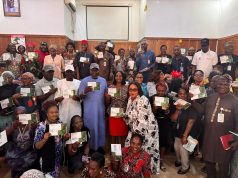
The Federal Government has graduated 87,701 trainees under the first cohort of its Technical and Vocational Education and Training (TVET) initiative, as it begins distributing starter kits to help beneficiaries establish businesses and earn a living.
The Minister of Education, Dr Tunji Alausa, disclosed this on Wednesday at the graduation and starter kit handover ceremony for the first cohort of beneficiaries.
He said the initiative seeks to bridge the gap between skills acquisition and economic empowerment by equipping trainees with practical knowledge and the tools required to become self-employed.
Alausa said the graduates received training in various trades, including welding and fabrication, electrical installation, automobile mechanics, solar photovoltaic installation, fashion design, hospitality, information and communication technology, agriculture and beauty therapy.
He explained that competency-based assessments and certification processes were progressing to ensure beneficiaries obtained nationally recognised skills qualifications.
The minister also disclosed that the second cohort had attracted 1.49 million applications, with 150,000 learners admitted into accredited training centres across the country.
According to him, the figures demonstrate Nigerians’ willingness to acquire practical skills when government provides credible opportunities.
“Our responsibility is to ensure that this enthusiasm is matched by quality training and meaningful prospects after graduation,” he said.
Alausa said the provision of starter kits formed a critical part of the programme because access to equipment often determines how quickly beneficiaries can convert their skills into income.
He noted that fashion designers, welders and solar technicians needed appropriate equipment to establish businesses and serve customers.
He described the starter kits as productive assets designed to support graduates as they move from training into employment and entrepreneurship.
The minister, however, explained that the distribution would continue in phases, subject to the completion of assessment and verification processes.
He stressed that the government would maintain transparency and accountability to ensure that only eligible beneficiaries received the equipment.
Alausa urged the graduates to demonstrate discipline, integrity and professionalism in their respective trades, while maintaining high standards of service delivery.
He also advised beneficiaries receiving starter kits to use the equipment for its intended purpose and maintain it properly.
“A modest beginning can grow into a dependable livelihood and, with sustained effort, an enterprise that employs others,” he said.
The minister said the Federal Ministry of Education would sustain efforts to improve training quality, competency-based assessment and certification, while strengthening collaboration with industries.
He added that qualifications issued under the National Skills Qualification Framework must reflect genuine occupational competence and command the confidence of employers.
Alausa said the government would also strengthen employment tracking, entrepreneurship support and opportunities for further learning.
He noted that the programme’s success would depend not merely on the number of people trained but also on their ability to secure jobs, establish businesses, improve their earnings and create employment for others.
“The lasting value of this initiative will be measured by what happens after training: graduates securing work, establishing businesses, improving their earnings and creating opportunities for others,” he said.
The minister commended the National Board for Technical Education, the National Business and Technical Examinations Board, the Nigerian Education Loan Fund and other collaborating institutions for supporting the programme.
He also acknowledged the contributions of training centres, instructors, assessors, quality assurance personnel and implementation teams.
Alausa attributed the government’s renewed investment in technical and vocational education to President Bola Tinubu’s commitment to human capital development under the Renewed Hope Agenda.
He said Nigeria needed a skilled workforce capable of meeting industrial and societal demands, including technicians, electricians, artisans and entrepreneurs.
The minister called on state governments, community leaders and private-sector organisations to sustain their collaboration with the initiative.
He said employers could provide practical experience and recruitment opportunities, while communities could support graduates establishing businesses.
Alausa reaffirmed the ministry’s commitment to expanding technical and vocational education, describing investment in skills development as essential to building a productive economy.
📢 Follow National Periscope on WhatsApp
Get breaking news and updates directly on WhatsApp.
Join WhatsApp ChannelPost Disclaimer
All rights reserved. This material and other digital content on this website are not and do not represent the stance of National Periscope but the statements of newsmakers mentioned therein.
For your detailed news reportage... contact the Editor at Joel2oladele@gmail.com






The National Commission for Almajiri and Out-of-School Children's Education (NCAOOSCE) Read more
The Minister of Education, Dr Maruf Tunji Alausa, has challenged Read more
[caption id="attachment_25891" align="alignnone" width="960"] NECO logo[/caption] Kano State has emerged Read more
21-year-old undergraduate commits suicide over failed relationship It all unfolded Read more