

Religious Leaders Calls For Ethical Use of AI in Nigeria
FELICIA ONAH, Abuja
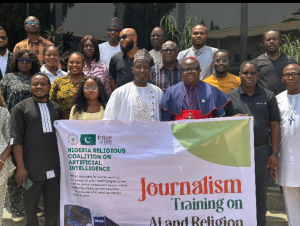
Religious leaders and technology experts have called for stronger ethical standards and regulatory frameworks to guide the growing use of artificial intelligence in Nigeria.
The call was made in Abuja during a Journalism Training on AI and Religion, organised by the Nigeria Religious Coalition on Artificial Intelligence (NRCAI) where Christian and Islamic scholars met with technology stakeholders to examine the moral, social and governance implications of artificial intelligence in the country.
Participants at the gathering acknowledged that while artificial intelligence presents significant opportunities for innovation and development, its deployment must be guided by clear ethical principles to prevent misuse and safeguard society.
Speaking at the event, the General Secretary of the Christian Council of Nigeria, Bishop Evans Onyemara, said the increasing influence of artificial intelligence makes it necessary for Nigeria to develop policies that will guide its application.
“Human beings occupy a unique position in creation and must ensure that technologies like artificial intelligence are used in ways that promote the common good,” Onyemara said.
He explained that from a Christian perspective, humans have the responsibility to manage and organise the world, noting that emerging technologies should therefore be deployed to support human wellbeing rather than create harm.
The cleric warned that Nigeria must not allow the rapid expansion of artificial intelligence to occur without appropriate safeguards, adding that the country should also participate actively in developing AI systems that reflect its social realities and developmental priorities.
“Discussions about artificial intelligence should be guided by ethical considerations that are acceptable across religious and cultural divides,” he added.
Also speaking, the Administrative Secretary of the Jama’atu Nasril Islam, Yusuf Ahmed Bida, said Islamic teachings emphasise the ethical use of technology through principles collectively known as Al-Akhlaq Al-Islamiyyah.
He identified four key foundations that should guide the use of artificial intelligence from an Islamic perspective; Taqwa (God-consciousness), justice and fairness, Amanah (trustworthiness), and Rahmah (compassion).
According to him, these principles emphasise moral accountability, fairness in technological development, and the need to prioritise the wellbeing of society.
“Any technological innovation that harms society or undermines social stability cannot be considered ethical,” Bida said.
In his remarks, the Director of the Institute of Church and Society, Kolade Fadahunsi, urged Nigerian youths to exercise responsibility in their use of emerging technologies.
“Young people make up the largest group of artificial intelligence and social media users in the country,” he said.
Fadahunsi noted that because of their strong presence in the digital space, the behaviour and choices of young people online have a significant influence on public discourse and social stability.
He warned that the rapid spread of information in the digital age increases the risk of misinformation if technology is misused.
“Technological advancement must always be accompanied by a strong sense of ethical responsibility,” he added.
📢 Follow National Periscope on WhatsApp
Get breaking news and updates directly on WhatsApp.
Join WhatsApp ChannelPost Disclaimer
All rights reserved. This material and other digital content on this website are not and do not represent the stance of National Periscope but the statements of newsmakers mentioned therein.
For your detailed news reportage... contact the Editor at Joel2oladele@gmail.com







Yoruba elder statesman berates NIN-SIM linking policy, calls it “severe Read more
Galaxy Backbone (GBB) has brought together banks, fintech companies Read more
NITDA warns Nigerians of malware spread on Facebook A new Read more
MTN Unveils $150m Cloud Platform, Tier 3 Data Centre ESTHER Read more