

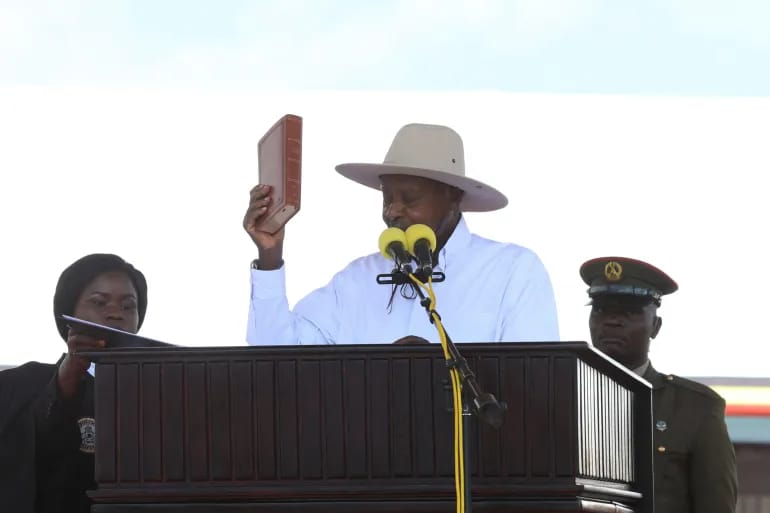
Ugandan President Yoweri Museveni has commenced another five-year tenure after being sworn in for a seventh consecutive term, extending his hold on power to more than 40 years.
The 81-year-old leader took the oath of office on Tuesday during a ceremony held at Kololo in Kampala, where thousands of supporters gathered to witness the inauguration.
Museveni, who first assumed power in 1986 after a guerrilla war, received the instruments of office amid military displays and loud cheers from party loyalists and government officials.
In his address, the Ugandan leader urged citizens to embrace hard work and economic productivity, insisting that wealth creation remained central to the country’s development agenda.
“No more excuses,” Museveni declared as he cited examples of Ugandans who had succeeded through business and entrepreneurship.
His latest inauguration further cements his place among Africa’s longest-serving leaders, with many Ugandans acknowledging that his administration is the only government an entire generation of citizens has ever known.
Despite maintaining a firm grip on the country’s political structure, discussions over succession and transition have continued to dominate political conversations within Uganda and across East Africa.
Attention has increasingly shifted toward Muhoozi Kainerugaba, the president’s son and Uganda’s army chief, who is widely viewed by observers as a possible successor.
Kainerugaba supervised military rehearsals ahead of the inauguration ceremony, a development that further fueled speculation over his growing influence within the country’s power structure.
Museveni’s prolonged rule has drawn mixed reactions over the years, with supporters crediting him for stability and infrastructure development, while critics accuse his government of suppressing opposition voices and shrinking democratic space.
Opposition groups in Uganda have repeatedly raised concerns over electoral fairness, human rights issues, and restrictions on political activities during previous election cycles.
Still, the veteran leader has remained dominant in Uganda’s political landscape, relying on the ruling National Resistance Movement’s extensive grassroots network and the support of state institutions.
The latest swearing-in ceremony comes at a time when several African countries are witnessing renewed debates over constitutional reforms, term limits, and leadership succession.
📢 Follow National Periscope on WhatsApp
Get breaking news and updates directly on WhatsApp.
Join WhatsApp ChannelPost Disclaimer
All rights reserved. This material and other digital content on this website are not and do not represent the stance of National Periscope but the statements of newsmakers mentioned therein.
For your detailed news reportage... contact the Editor at Joel2oladele@gmail.com





Israeli Government Approves Gaza Ceasefire Deal Israel’s cabinet voted to Read more
King Charles stepping back from royal duties after cancer diagnosis Read more
Pope Escapes Two Assassination Attempts in Iraq [caption id="attachment_12407" align="alignnone" Read more
Be patient with Tinubu, Gowon appeals to Nigerians •Urges ECOWAS Read more