

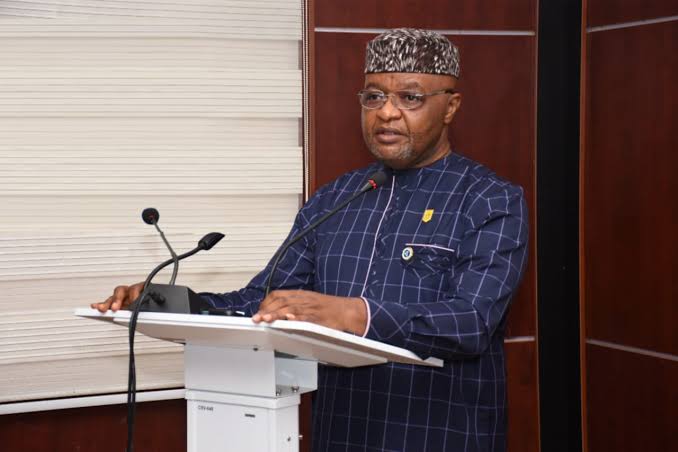
Political analyst and public affairs commentator, Professor Okey Ikechukwu, has said Nigeria’s opposition parties remain poorly positioned to challenge President Bola Tinubu and the ruling All Progressives Congress (APC) in the 2027 general election due to what he described as a lack of strategic planning, grassroots mobilisation and political coordination.
Ikechukwu spoke on Wednesday while delivering a lecture at the 18th National Lecture organised by the Human Rights Writers Association of Nigeria (HURIWA) in Abuja.
The event, themed “Achieving Free and Fair Elections in Nigeria 2027,” brought together political stakeholders, security officials, academics and civil society leaders to discuss the prospects and challenges of credible elections in the country.
According to Ikechukwu, opposition parties have spent too much time lamenting the outcome of the 2023 presidential election instead of developing the structures and strategies required to secure victory in the next electoral cycle.
“The opposition is not preparing to win this election,” he declared.
He argued that electoral success is driven more by organisation, planning and grassroots engagement than by public sentiment and emotional appeals.
Drawing lessons from previous elections, Ikechukwu said political parties seeking power must begin preparations immediately after an election, rather than waiting until the campaign season.
“You lost to this man three years ago. An election is coming a few months from now. What did you do in the three years? You should have started preparation immediately the election ended,” he said.
The political commentator noted that many opposition supporters mistake enthusiasm for electoral strength, stressing that elections are won through effective structures at polling-unit, ward and local government levels.
He maintained that while opposition parties continue to engage in internal disputes and leadership contests, the ruling party has remained focused on consolidating its support base across the country.
“The opposition has not learned why it lost. It had an opponent that was organised and strategic. Instead of building structures, many opposition actors are still making emotional and moral arguments,” he said.
Ikechukwu further observed that opposition leaders have yet to present a united front capable of mounting a serious challenge against the APC in 2027.
He also criticised the tendency of political actors to focus on rallies and media appearances rather than investing in long-term voter mobilisation and grassroots organisation.
According to him, political parties must be prepared to commit resources to voter education, mobilisation and election-day operations if they hope to compete effectively.
The scholar also argued that the high cost of political participation remains a major challenge to democratic development in Nigeria, calling for reforms that would make elective offices more accessible to ordinary citizens.
While acknowledging concerns over electoral transparency, he maintained that opposition parties must take greater responsibility for their shortcomings rather than attributing every defeat to external factors.
Beyond the opposition’s preparedness, Ikechukwu identified vote buying, political manipulation and weaknesses in democratic institutions as factors that continue to undermine the electoral process.
Earlier in his opening remarks, HURIWA National Coordinator, Comrade Emmanuel Onwubiko, warned that vote buying had become one of the gravest threats to Nigeria’s democracy and could evolve into a sophisticated criminal enterprise if left unchecked.
He described the practice as an electoral virus that has steadily spread across the country and increasingly influences election outcomes.
“It’s almost becoming like trading. Votes of Nigerian voters are negotiated, sold and bought. This terrible crime has been going on for quite some time,” Onwubiko said.
He warned that the situation could mirror the evolution of kidnapping in Nigeria, which grew from isolated incidents into a lucrative criminal industry due to inadequate government intervention.
According to him, agencies such as the Independent National Electoral Commission (INEC), the Economic and Financial Crimes Commission (EFCC), the Independent Corrupt Practices and Other Related Offences Commission (ICPC) and the Nigeria Police Force must intensify efforts to tackle vote buying ahead of the 2027 elections.
Onwubiko argued that credible elections would remain difficult to achieve if politicians continue to induce voters with cash and other incentives.
The issue of election security also featured prominently at the event, with the Minister of Defence, General Christopher Musa, warning that insecurity remains a significant threat to the conduct of free and fair elections.
Represented by his Senior Special Assistant on Legal and Public Service Matters, Barrister Aliu Anas, the minister said national security and electoral integrity are inseparable.
“There is a link between security and electoral integrity. National security and electoral integrity are two sides of the same coin of national stability,” he said.
Musa identified insurgency, banditry, communal clashes and the spread of disinformation through digital platforms as major threats capable of undermining the electoral process.
He said the Federal Government had placed election security high on its agenda and was working closely with INEC, the Nigeria Police Force, intelligence agencies and other stakeholders to ensure a peaceful electoral environment.
The minister stressed that tackling insecurity requires a collective effort, urging Nigerians to support security agencies with credible information that could help combat criminal activities.
He also expressed concern over the role of informants who aid criminal groups, describing them as one of the biggest challenges confronting security operations across the country.
The event concluded with calls for stronger institutions, improved election security and greater citizen participation as part of efforts to strengthen Nigeria’s democracy ahead of the 2027 polls.
A highlight of the programme was the presentation of awards to distinguished Nigerians for their contributions to public service and humanity. Among the recipients were the Director-General of the Bureau of Public Procurement (BPP), Dr Adebowale Adedokun, and the Vice-Chancellor of Baze University, Abuja, Professor Abiodun Adeniyi, among others.
📢 Follow National Periscope on WhatsApp
Get breaking news and updates directly on WhatsApp.
Join WhatsApp ChannelPost Disclaimer
All rights reserved. This material and other digital content on this website are not and do not represent the stance of National Periscope but the statements of newsmakers mentioned therein.
For your detailed news reportage... contact the Editor at Joel2oladele@gmail.com


Tinubu revokes nomination of 24-year-old Kashim Imam as FERMA board Read more
Alleged fraud: NNPP leadership petitions EFCC over Kwankwaso, 13 others Read more
Appeal Court Nullifies Judgement On Rivers LG Election The Court Read more
Ganduje reveals Ondo, Anambra as next targets after Edo victory Read more