

The Federal Government has commenced moves to abolish the long-standing separation of junior secondary schools (JSS) from senior secondary schools (SSS), describing the policy as ineffective and partly responsible for the alarming number of children dropping out of school before completing basic education.
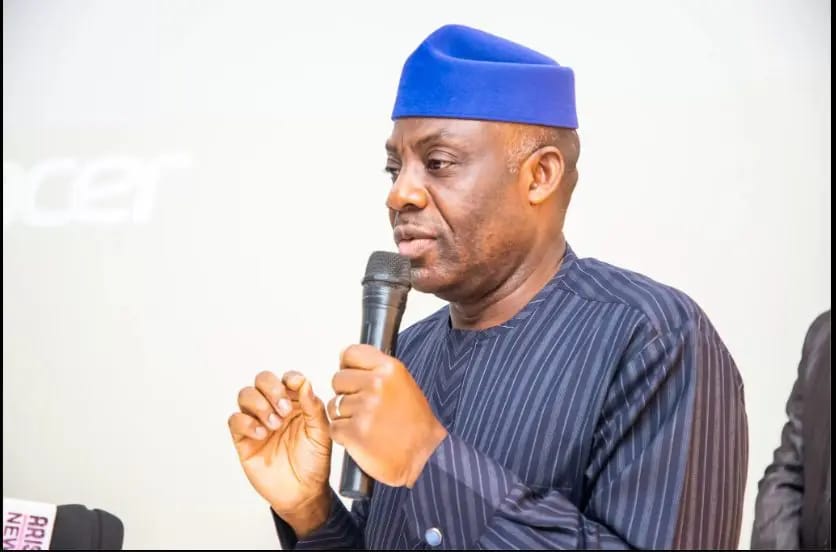
Minister of Education, Dr Tunji Alausa, announced the planned reform on Tuesday in Abuja during the inauguration of the Universal Basic Education Commission (UBEC) Ministerial Implementation and Monitoring Committee, saying the existing structure has failed to improve access to education and would soon be presented to the National Council on Education (NCE) for approval.
According to the minister, more than 20 million Nigerian children are unable to transition from primary school to junior secondary school, a situation he attributed largely to the shortage of junior secondary schools across the country.
Alausa said government findings showed a huge imbalance in the distribution of public schools, with about 80,000 primary schools compared to only about 15,000 junior secondary schools nationwide.
“We have 20 million dropouts from primary school to junior secondary school. Where are those students? We also found we have 80,000 public primary schools and only about 15,000 junior secondary schools. That’s a one-to-eight ratio,” he said.
He explained that while junior secondary schools have become overstretched due to limited availability, many senior secondary schools remain underutilised, making the existing arrangement inefficient.
The minister said the policy separating junior and senior secondary schools, introduced under the 6-3-3-4 education system in the early 1980s, has not achieved its intended objectives.
“This disarticulation policy has failed. We will phase it out. We can’t create positions because we want to create a director-level position for people while we harm our education system. It’s about doing what is best for every Nigerian child,” Alausa said.
He disclosed that the proposal would be submitted to the National Council on Education, the nation’s highest education policy-making body, for deliberation and approval.
According to him, scrapping the policy forms part of broader reforms by the Tinubu administration aimed at expanding access to education, improving retention rates and ensuring more children complete secondary education.
“This government will not fail. We are fixing it,” he added.
The minister’s announcement comes against the backdrop of Nigeria’s persistent education crisis. The country is estimated to have one of the world’s largest populations of out-of-school children, with millions of school-age children; especially those in rural, poor and conflict-affected communities still unable to enrol in or complete basic education.
Education experts have repeatedly linked the problem to inadequate infrastructure, insecurity, poverty, teacher shortages and weak transition rates between primary and junior secondary schools.
Many stakeholders have also criticised the separation of junior and senior secondary schools for creating unnecessary administrative bottlenecks and limiting pupils’ progression, particularly in communities where junior secondary schools are either unavailable or located far from primary schools.
Speaking later at the Federal Ministry of Education and UBEC Roundtable Convening Meeting on Digital Resources Available to Achieve Learning Outcomes, Alausa raised fresh concerns over the country’s worsening learning outcomes, revealing that nearly three out of every four children in basic education cannot read and understand an age-appropriate passage by the age of 10.
He described the country’s learning poverty rate as unacceptable and warned that urgent interventions were needed to reverse the trend.
“Learning poverty means that by the age of 10, a child cannot read and understand an age-appropriate text.
“In Nigeria today, three out of every four children are learning poor. That is simply unacceptable,” he said.
To tackle the challenge, the minister advocated wider deployment of digital learning technologies across schools, insisting that technology offers the fastest route to improving teaching and learning outcomes.
“We don’t have a choice. We have to use technology. It is no longer feasible to continue to do things manually. Digital learning is the future, and we must deploy it to every part of the country, including the most rural communities,” he said.
He urged state governments to maximise digital education platforms already developed by the Federal Government, including the Nigeria Learning Passport, Inspire, Ignite, EduRevamp, E-Learn, the Greenfield Learning Management System and virtual classroom solutions.
According to him, the platforms provide curriculum-based lessons delivered by experienced teachers and can bridge the shortage of qualified teachers in critical subjects such as Mathematics, English Language, Physics and Chemistry.
He explained that schools without specialist teachers could leverage the platforms to connect learners with live or recorded lessons, enabling students to interact with teachers remotely regardless of their location.
Despite the government’s investment, Alausa lamented that the platforms remain grossly underutilised.
He disclosed that the Nigeria Learning Passport currently has about 2.3 million registered users, compared to Nigeria’s estimated 67 million learners in primary, junior secondary and senior secondary schools.
“This is still extremely low. We have invested significant resources in these platforms. If they are not used, then it becomes a wasted investment. We cannot continue to suffer in the midst of plenty,” he said.
The minister commended the United Nations Children’s Fund (UNICEF) for supporting the development of the Nigeria Learning Passport, noting that it proved invaluable during the COVID-19 pandemic and has continued to provide learning opportunities for children affected by insecurity and prolonged school closures.
As part of efforts to strengthen basic education delivery, Alausa inaugurated a ministerial implementation and monitoring committee chaired by **Prof. Rashid Aderinoye** to oversee the completion of UBEC-funded Smart Schools, bilingual schools and alternative schools across the country.
He said the committee would ensure that the projects are completed on schedule, handed over to state governments and opened for learning.
The minister expressed concern that despite huge public investment, many of the schools remain unfinished or have yet to admit learners, describing the situation as an unacceptable waste of scarce public resources.
Earlier, Executive Secretary of UBEC, Dr Aisha Garba, said digital technology has become indispensable to building an inclusive, resilient and future-ready education system.
She disclosed that the commission has established digital learning centres in primary and junior secondary schools, deployed smart interactive boards, strengthened education data systems and introduced digital monitoring and evaluation platforms.
Garba added that UBEC has also inaugurated Digital Champions to support state governments in driving technology adoption and implementing education technology initiatives.
While acknowledging the transformative potential of technology, she maintained that digital tools alone cannot improve education outcomes without effective coordination, strong partnerships, sustained capacity building and the willingness of stakeholders to embrace innovation.
She expressed optimism that collaboration between the Federal Ministry of Education, UBEC, state governments and development partners would accelerate the adoption of digital learning resources and improve learning outcomes across the country.
📢 Follow National Periscope on WhatsApp
Get breaking news and updates directly on WhatsApp.
Join WhatsApp ChannelPost Disclaimer
All rights reserved. This material and other digital content on this website are not and do not represent the stance of National Periscope but the statements of newsmakers mentioned therein.
For your detailed news reportage... contact the Editor at Joel2oladele@gmail.com






Nursing student commits suicide over school’s failed accreditation A 300-level Read more
UNILORIN rusticates 6 final year students, 13 others; gives reasons Read more
The National Youth Service Corps (NYSC) has announced the postponement Read more
Police nab 400-level student caught with local guns Police operatives Read more