

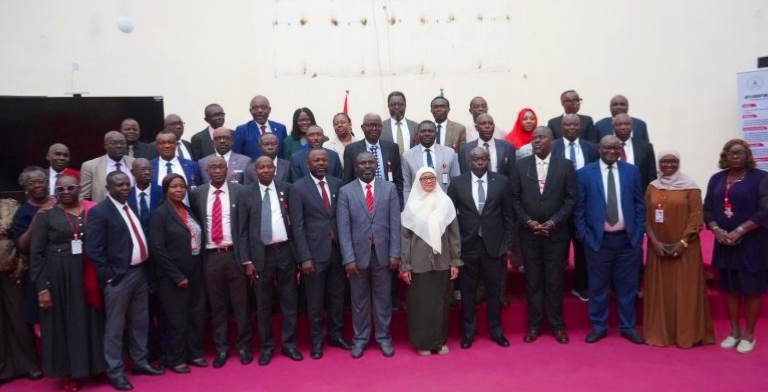
The Independent Corrupt Practices and Other Related Offences Commission (ICPC) has drawn lessons from Indonesia’s anti-corruption experience, particularly its use of strong enforcement, asset declaration and institutional reforms to tackle graft.
The Commission said such comparative learning was necessary as Nigeria seeks to strengthen its anti-corruption architecture and adapt proven strategies to local realities.
This formed the focus of the second edition of the International Diplomatic Dialogue organised by the Anti-Corruption Academy of Nigeria (ACAN), the research and training arm of the ICPC, on Monday at the Commission’s headquarters in Abuja.
The dialogue was themed, “Experience Sharing in Anti-Corruption Strategy: The Indonesian Perspective,” and featured the Indonesian Ambassador to Nigeria, Bambang Suharto, who was represented by the Minister Counsellor for Political Affairs, Mrs Tuty Dityawanty.
In his remarks, chairman of the ICPC, Dr Musa Adamu Aliyu, SAN, said corruption remained a major impediment to sustainable development, economic growth, social justice and public trust in institutions.
Represented by the Secretary to the Commission, Mr. Clifford Okwudiri Oparaodu, Aliyu noted that Nigeria could benefit from Indonesia’s experience, particularly the strategies, institutional and legal reforms, as well as enforcement measures deployed through the country’s Corruption Eradication Commission, known as the Komisi Pemberantasan Korupsi (KPK).
“As Nigeria continues to deepen its anti-corruption efforts, there is much value in learning from comparative experiences, understanding best practices, and identifying innovative approaches that can be adapted to our local realities,” he said.
The ICPC chairman said the diplomatic dialogue was part of efforts to promote international cooperation and evidence-based approaches to corruption prevention, while strengthening a culture of integrity, transparency and accountability in the public and private sectors.
He also disclosed that the Commission had earlier hosted the Kenyan High Commissioner to Nigeria as part of the initiative, adding that it planned to receive other heads of mission in the coming months to share experiences on tackling corruption.
Aliyu urged participants to ensure that the knowledge exchanged at the event translated into practical actions that could strengthen institutions and improve public trust.
He said the lessons should not “end within the walls of this auditorium”, but should inspire stronger partnerships and innovative solutions in the fight against corruption.
Ambassador Suharto said Indonesia’s KPK had achieved notable success in prosecuting high-profile officials, including ministers, governors, lawmakers and judges who were previously considered untouchable.
He, however, acknowledged that corruption remained a challenge in Indonesia, particularly bribery in public services and business licensing.
Suharto said the KPK was established in 2003 with responsibilities covering the coordination and supervision of anti-corruption institutions, investigation and prosecution of corruption cases, prevention of corrupt practices and monitoring of state governance.
He explained that the agency focuses primarily on cases involving law enforcement officials and state apparatuses, as well as corruption cases involving significant losses to public funds.
A major feature of the Indonesian enforcement strategy, he said, was the use of sting operations in suspected bribery cases.
According to him such operations are preceded by intelligence gathering, case-building, validation of investigative information and sufficient preliminary evidence, rather than being based on random instigation or pure entrapment.
The Indonesian Ambassador also highlighted the importance of legal backing and oversight in the use of investigative tools, noting that electronic interception and wiretapping require prior written approval from the KPK’s internal Supervisory Board under the country’s 2019 anti-corruption law.
He said corruption involving the enrichment of oneself, another person or a corporation could attract between four and 20 years’ imprisonment or life imprisonment under Indonesian law.
Beyond prosecution, Suharto identified public confidence as a critical factor in the effectiveness of an anti-corruption institution.
He said the KPK’s prosecution of powerful officials had helped build public trust and demonstrated the possibility of running public institutions without corruption.
“Anti-corruption commission needs support of public,” he said.
Earlier, the Provost of ACAN, Professor Sheriff Ghali Ibrahim, said the diplomatic dialogue was designed to expose Nigerian anti-corruption stakeholders to experiences from other countries and strengthen South-South cooperation in the fight against corruption.
Ibrahim traced Indonesia’s historical influence in the developing world to the 1955 Bandung Conference, which brought together 29 Asian and African governments to discuss peace, economic development and decolonisation.
He said the conference produced principles centred on respect for sovereignty, equality among nations, peaceful settlement of disputes, non-interference and international cooperation.
According to him, the principles remain relevant to contemporary efforts to promote good governance and strengthen cooperation among developing countries.
The ACAN provost also outlined Indonesia’s current anti-corruption framework, noting that the country combines prevention, public education, asset disclosure, financial intelligence, auditing and criminal prosecution.
He identified the National Strategy for Corruption Prevention, known as Stranas PK, as a major framework targeting licensing and commercial systems, public financial management and bureaucratic reform.
Other institutions supporting Indonesia’s anti-corruption architecture include the financial intelligence unit, PPATK; the state auditing bodies, BPK and BPKP; and the Ministry of Administrative and Bureaucratic Reform, PANRB.
Ibrahim said the Indonesian experience demonstrated that the fight against corruption could not depend solely on prosecution, but required coordinated institutional reforms, preventive measures, transparency and public participation.
He described Indonesia as an important partner in South-South cooperation, recalling its historical role in the liberation struggles and solidarity among developing countries.
The dialogue marked another step in ACAN’s effort to use international engagements to broaden Nigeria’s understanding of anti-corruption strategies.
The ICPC leadership said subsequent editions would feature other heads of mission as the Commission seeks to deepen international partnerships and identify practical approaches that can strengthen Nigeria’s fight against corruption.
📢 Follow National Periscope on WhatsApp
Get breaking news and updates directly on WhatsApp.
Join WhatsApp ChannelPost Disclaimer
All rights reserved. This material and other digital content on this website are not and do not represent the stance of National Periscope but the statements of newsmakers mentioned therein.
For your detailed news reportage... contact the Editor at Joel2oladele@gmail.com







Investigator tells court how Emefiele awarded contracts to wife, CBN Read more
Nigeria Customs Service adopts latest technology to curb smuggling Olaitan Read more
SERAP gives NNPCL 7 days to account for alleged missing Read more
EFCC arrests General Overseer over alleged N1.3bn fraud The Economic Read more