

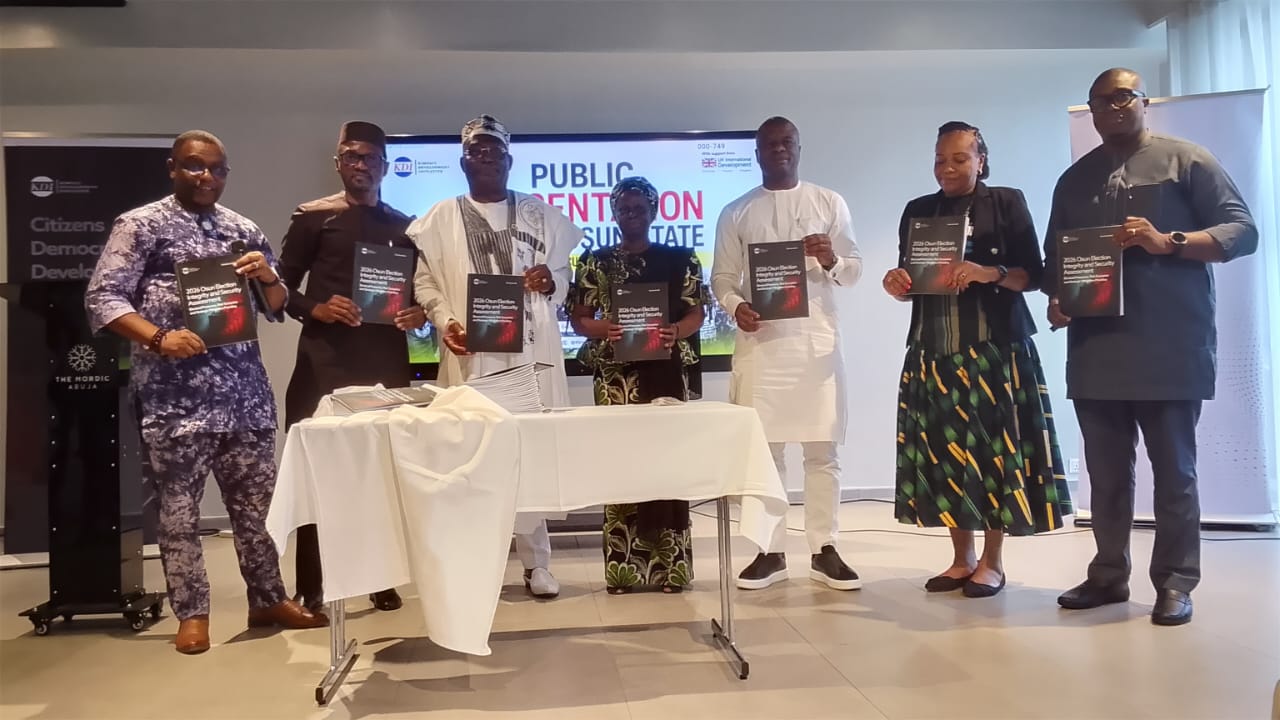
The Kimpact Development Initiative (KDI) has identified 12 local government areas in Osun State as high-risk locations ahead of Saturday’s governorship election, warning that political tensions, voter suppression and operational challenges could undermine the peaceful conduct of the poll.
The organisation, in its Pre-election Security Risk Assessment (ESRA) Public Presentation held in Abuja on Monday, said the affected areas required urgent security and political interventions to prevent electoral pressures from escalating into violence.
The local government areas identified as major focal points for electoral pressures and security concerns are Osogbo, Irewole, Iwo, Boripe, Obokun, Ife North, Ife Central, Ede North, Ede South, Egbedore, Ayedaade and Olorunda.
KDI Executive Director, Bukola Idowu, who presented the assessment at a pre-election security risk assessment stakeholder meeting, said the report was designed as an early-warning and decision-support tool rather than a prediction of violence.
He said the objective was to identify areas where pressure was building, understand the factors making them vulnerable and enable stakeholders to take preventive measures before the identified risks translated into incidents.
According to Idowu, the assessment was particularly significant because the August 15 election would be the last major off-cycle governorship poll before the 2027 general elections and an important test of Nigeria’s evolving electoral framework.
He said, “We have identified 12 local governments that are of high risk, that need both operational security and political intervention so that we can have a peaceful election in those local governments.”
The KDI chief said one of the major concerns was the reliability of election logistics and technology, particularly the functionality of the Bimodal Voter Accreditation System (BVAS).
He urged the Independent National Electoral Commission (INEC) to strengthen its preparations following concerns observed during the recent mock accreditation exercise, stressing that the competitiveness of the Osun election required all aspects of the electoral process to work effectively.
The organisation also raised concerns over the neutrality and professionalism of security agencies, noting that the conduct of security personnel could itself become a trigger for violence if stakeholders perceived them as partisan.
KDI further warned that violence could be deliberately deployed as a strategy to suppress voter participation in particular locations.
Idowu said the concern went beyond physical attacks, as the creation of fear among voters could prevent them from going to the polling units and effectively undermine their constitutional right to participate.
“Violence is not about violence alone. It is strategic in terms of suppressing votes in some areas, and that is one of our concerns, because when you create fear in the heart of people and they could not come out on election day, that is vote suppression,” he said.
The organisation noted that voter turnout in Osun had remained relatively low in recent elections, putting the last turnout at about 43 per cent, and warned that insecurity and intimidation could further depress participation.
The assessment was based on a mixed-method research framework involving 3,275 citizens surveyed across the state’s 30 local government areas.
It also drew from 15 key informant interviews involving political actors, security agencies, traditional institutions, women and youth leaders, civil society organisations, media practitioners and electoral stakeholders.
KDI said it also monitored election-related incidents continuously between October 2025 and August 2026, alongside print, broadcast, online and social media reports, field observations, stakeholder validation and secondary research.
The organisation said its Electoral Pressure Model went beyond conventional hotspot mapping by examining how political, operational, criminal, social, coercive, behavioural and information pressures interacted within different communities.
The report identified intense rivalry among major political parties, localised thuggery and targeted disruptions as key political and security pressures.
It also highlighted concerns over delays in deployment, security-force neutrality and possible failures in election logistics and technology.
The warning comes against the backdrop of KDI’s earlier monitoring, which documented 44 election-related violent incidents across Osun between October 2025 and June 2026, with 13 deaths recorded.
KDI said the August 15 poll would also be closely watched because it would provide an important indication of how electoral institutions, political parties and security agencies would handle the transition towards the 2027 general elections.
Idowu said the election would be the first highly competitive governorship contest in which the new electoral framework signed into law by President Bola Tinubu would be tested, particularly on issues surrounding results management, electronic transmission and the determination of election margins.
“This is a very significant election that we are raising the awareness of stakeholders to see that they do everything within their power to secure that election so that we can have a credible election,” he said.
He urged political parties, security agencies, INEC, civil society organisations, the media and voters to treat the findings as an opportunity for preventive action.
The assessment also warned against the use of misinformation and unverified reports, particularly during voting and collation, saying irresponsible information could heighten tension and provoke violence.
Also speaking, a retired Assistant Inspector-General of Police and National Security Consultant, Abutu Yaro, attributed a significant part of election-related insecurity to the conduct of political actors.
Yaro said political actors were often responsible for sponsoring, funding and directing violence, adding that security agencies could only do so much if politicians deliberately stoked tensions.
“Insecurity does not beat itself. It is beaten by political actors, funded by them, sponsored by them, navigated by them, and designed for their preferred outcome,” he said.
He urged politicians to exercise restraint and patriotism, arguing that ordinary voters had little interest in violence and only wanted to cast their ballots and have their choices respected.
Yaro also called for adequate and timely provision of election logistics, including vehicles, welfare for electoral officials, voting materials and electronic devices.
He warned that prolonged delays at polling units could generate public anger, particularly where voters were forced to remain for several hours without voting materials.
The retired police officer equally cautioned journalists and social media users against disseminating unverified reports during the election.
He urged media practitioners to adhere to professional standards and members of the public to rely on verified information from INEC and the police rather than unverified online platforms.
The KDI assessment is coming amid heightened attention to election security in Osun, with another recent assessment by the National Peace Committee identifying 15 LGAs as vulnerable to election-related violence, including Osogbo and Irewole as the most vulnerable.
KDI, which was founded in 2014, describes itself as a non-partisan organisation focused on democratic development, elections, citizen participation, policy advocacy, research and civic technology. The organisation says it has networks of citizen monitors across Nigeria and has worked on election-security prevention and electoral reform.
Idowu stressed that early warning would only be meaningful if stakeholders converted the evidence into immediate preventive action.
He said the credibility of the Osun election would ultimately be measured not only by whether violence was avoided, but also by whether citizens were able to participate freely, institutions acted impartially and competently, information remained accurate and timely, and the eventual results commanded public confidence.
📢 Follow National Periscope on WhatsApp
Get breaking news and updates directly on WhatsApp.
Join WhatsApp ChannelPost Disclaimer
All rights reserved. This material and other digital content on this website are not and do not represent the stance of National Periscope but the statements of newsmakers mentioned therein.
For your detailed news reportage... contact the Editor at Joel2oladele@gmail.com






Ballot boxes vandalised as Russian presidential election begins The first Read more
[caption id="attachment_24328" align="alignnone" width="650"] Chairman and Executive Director of the Read more
44-year-old Faye wins Senegal Presidential Election 10 days after his Read more
KDI Launches AI Tool For Accurate Electoral Information in Nigeria Read more