

Let me begin with a few provocative hypotheses.
Most Nigerian doctors may, in economic terms, be multimillionaires—based on the value of the services they provide to the Nigerian economy.
If their services were fully priced at their economic value, many could potentially generate revenues far above their current salaries.
A substantial proportion of this potential income is effectively surrendered through free, subsidised, or poorly remunerated services.
If these services were appropriately monetised, some doctors could theoretically generate hundreds of millions of naira annually.
Over several years, the cumulative economic value of their professional services could therefore run into hundreds of millions—or, in some cases, over a billion naira. And therein lies what I call the paradox of the Nigerian health worker.
We routinely describe Nigerian doctors and other health workers as underpaid. That is undoubtedly true when we consider their salaries and formal remuneration. But what if we looked at the equation differently? What if we considered not merely what the Nigerian health worker earns, but the economic value of what he or she produces, provides, subsidises and gives away? That takes us into the fascinating territory of Adam Smith and the basic principles of market economics.
Adam Smith Meets the Nigerian Health System
The classical market argument rests, in part, on several familiar principles.
A key concept is the principle of self-interest. Producers seek returns for their efforts, while consumers seek the best value at the lowest reasonable cost. Now imagine, hypothetically, that the average Nigerian doctor behaved purely as a market participant. The doctor would calculate the value of his or her expertise, time, training, experience and responsibility—and charge accordingly. The patient, meanwhile, would negotiate for the best possible service at the most affordable price. A market would begin to emerge.
But this is not quite how healthcare operates in Nigeria. The Nigerian health worker is often remarkably uncomfortable discussing the monetary value of his or her expertise. There are cultural reasons. There are professional reasons. There are training-related reasons. And perhaps there is also a deeply ingrained perception that healthcare is somehow different from other services—that caring for another human being should not be reduced to a commercial transaction. Consequently, the Nigerian doctor frequently gives away what would ordinarily be considered a valuable professional service. To family, to friends, to colleagues, to neighbours, and sometimes to complete strangers. The irony is that the very qualities that make the health worker socially valuable may simultaneously make the profession economically vulnerable.
Quickly in succession to the concept of self-interest is the equally import is the Adam Smith’s famous “invisible hand” describes how individual decisions, competition and voluntary exchange can collectively influence the production, pricing and distribution of goods and services. But healthcare does not behave like an ordinary commodity market. A patient cannot simply decide to postpone a heart attack because the price of treatment is too high. A doctor cannot easily tell a critically ill patient to return when the market price becomes favourable. And in Nigeria, the healthcare market is further complicated by weak insurance penetration, substantial out-of-pocket expenditure, limited purchasing power, public-sector constraints and significant informal provision of care. The result is a market that is high in demand but weak in its ability to translate that demand into appropriate remuneration for providers. Countries that have developed stronger medical tourism ecosystems—including the UAE, India, Türkiye and Egypt—demonstrate what can happen when healthcare financing, infrastructure, pricing, quality assurance and international demand begin interacting within a more mature market. Nigeria has enormous human capital. But the market architecture required to properly value that human capital remains underdeveloped.
Where the Nigerian Paradox Becomes Most Interesting, when one reviews the dynamics of price adjustment in relation to market forces.
The basic economic principle is straightforward: When demand exceeds supply, prices should generally rise. If there are too few doctors serving a very large population, one might reasonably expect doctors to command a premium. Nigeria provides an interesting counterexample. With a population of roughly 240 million and approximately 55,000 doctors as a working assumption, the crude national ratio would be approximately: 1 doctor: 4,360 people. That is vastly different from the commonly cited WHO benchmark of approximately 1 doctor to 600 people. Of course, this calculation has significant limitations. The 55,000 figure may not represent currently active practising doctors. Doctors are unevenly distributed across the country, with substantial concentration in urban centres. Furthermore, doctor-to-population ratios alone do not capture nurses, community health workers, specialists, facilities, geography, disease burden or the quality and availability of services.
Nevertheless, the broad message remains compelling:
Nigeria has a major supply-side deficit in healthcare professionals. So why doesn’t scarcity translate into substantially higher remuneration? That is the paradox.
The Nigerian Doctor Often Provides More—and Charges Less. Does the average Nigerian health worker attend to a large number of patients? Arguably, yes. Does the system consistently compensate that health worker proportionately for the volume, complexity and value of the services provided? Not necessarily. And this is where the economics become particularly interesting.
A Nigerian doctor may see patients in a public hospital, provide additional advice to colleagues, answer health questions from relatives, review laboratory results sent through WhatsApp, offer informal consultations to friends, assist someone who cannot afford treatment, and provide emergency care outside formal working arrangements. Much of this activity may never appear as a properly priced transaction. It therefore disappears from the health worker’s income statement—even though it represents real economic value.
The Hidden Subsidy
Nigeria’s health workers may therefore be providing one of the largest informal subsidies in the Nigerian economy.
The subsidy comes in several forms:
Free consultations.
Heavily discounted professional services.
Unpaid additional hours.
Informal consultations.
Free advice to family and friends.
Emergency interventions outside formal remuneration structures.
Professional services delivered within poorly funded public institutions.
Absorption of system inefficiencies through personal effort.
The health worker effectively absorbs part of the cost of the health system. The patient receives a service. The system benefits. Society benefits. But the professional frequently does not receive a corresponding financial return. This is where the term “underpaid” becomes inadequate. The deeper problem may be that the Nigerian health system systematically undervalues and under-monetises professional healthcare services.
One prominent maze is the a troubling out of pocket paradox. This is particularly important in a country where out-of-pocket expenditure remains a major source of healthcare financing. One might assume that if millions of Nigerians are paying directly for healthcare, doctors should be financially better positioned. But the existence of out-of-pocket expenditure does not automatically mean that healthcare professionals are being appropriately remunerated.
The financing chain matters. Who pays? How much do they pay? Who receives the payment? What proportion reaches the provider? How long does reimbursement take? What are the administrative costs? What happens when the patient cannot pay? And what happens when the health worker provides the service anyway? Without fixing these financing dynamics, simply increasing the number of patients will not necessarily improve the economic position of the health worker.
The Consequence: Everyone Loses
The current model creates a peculiar situation. Where everyone is potentially handed the short end of the stick. The patient may receive fragmented or inconsistent care. The health worker remains poorly remunerated despite high workload. The health institution struggles with inadequate financing. The government bears increasing pressure to retain professionals. And the country loses highly trained personnel through migration—what we commonly call Japa.
The irony is profound. Nigeria invests in training doctors, nurses, pharmacists, laboratory scientists and other professionals. The professional then acquires experience. Demand for that expertise increases. But due to environmental dynamics which makes existing frameworks incapable of appropriately rewarding that expertise, the system frequently allows the professional to become increasingly frustrated. Eventually, the professional leaves. The country loses the investment. And another country benefits from the human capital Nigeria helped create.
I believe that better health financing frameworks, present a potentially practical promise of precipitating a reverse japa. Not overnight. And certainly not through salaries alone. Nigeria needs a more mature healthcare financing architecture that properly connects: patient demand → healthcare financing → service utilisation → provider remuneration → quality improvement → professional retention.
If healthcare services were better financed and appropriately valued, remuneration could improve. If remuneration improves, professional satisfaction could improve. If professional satisfaction improves, migration pressures could reduce. And, theoretically, Nigeria could eventually experience something even more interesting ‘reverse japa’.
Professionals who left may begin to see reasons to return. The Nigerian health worker abroad may start asking: “What is happening back home?” “Is the system finally paying for expertise?” “Can I build a sustainable practice there?” “Can I return and still have a good professional life?” That is the kind of health-system transformation worth pursuing.
So, are Nigerian Doctors actually millionaires and potentially billionaires? Of course, this is where I deliberately stretch the argument. If we define wealth purely by money actually received, then the average Nigerian doctor is certainly not a billionaire. But if we define wealth by the economic value of professional services capable of being produced over a career, the picture becomes very different. A doctor who provides thousands of consultations, diagnoses, procedures, emergency interventions, preventive services, counselling sessions, referrals and other professional services over many years generates enormous economic and social value. Much of that value is never fully monetised.
In other words, the Nigerian health worker may be financially poor while simultaneously being economically valuable. And perhaps that is the real paradox. So, next time somebody starts compiling a list of Nigerian billionaires, perhaps I should submit my name, and please add my colleagues too. We may not have the cash. We may not have the houses. We may not have the cars. We may not even have the bank balance. But apparently, we have been giving away billions’ worth of professional value for years.
Perhaps we are not poor doctors after all. Perhaps we are just extremely generous billionaires.
Disclaimer
This is not a policy statement, an economic model, or a claim about the actual income of Nigerian doctors. It is a deliberately provocative reflection on the disconnect between the economic value of healthcare work and the financial remuneration received by health professionals in Nigeria.
Perhaps this is only the beginning of a much bigger conversation
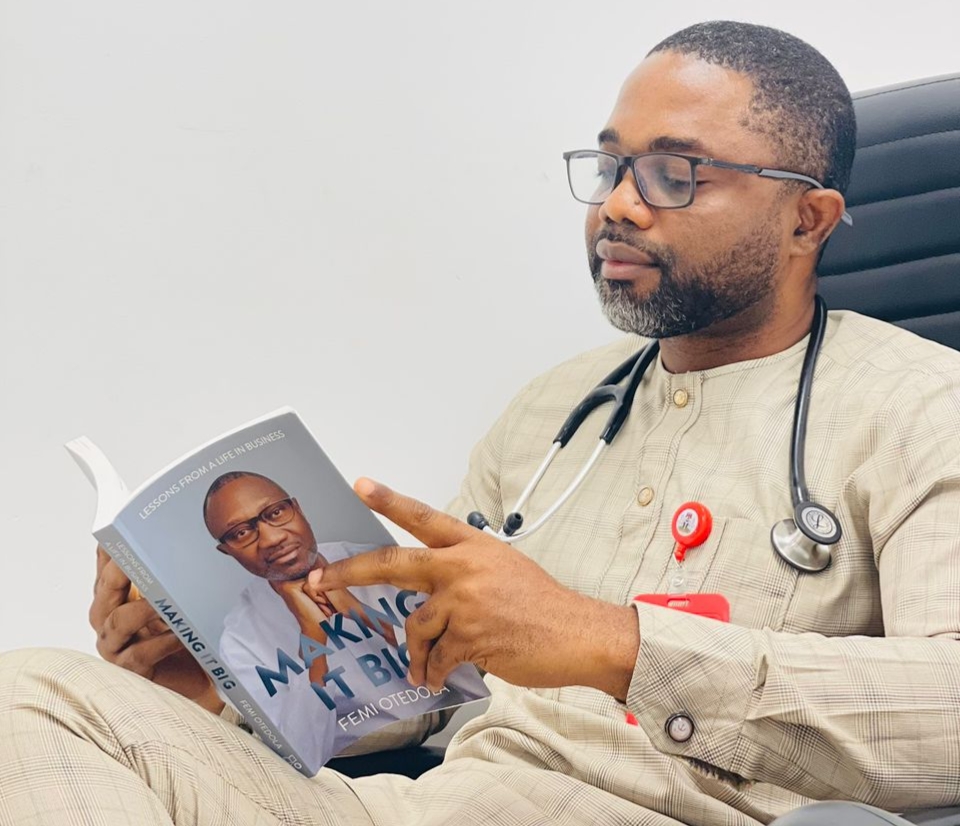
Dr. Agbor Neji Ebuta
Consultant Family Physician and Public Health Strategist.
Has post-graduate degrees in family medicine, public health and public administration.
Serves unremurated as the Vice President of the Medical Initiative for Africa.
📢 Follow National Periscope on WhatsApp
Get breaking news and updates directly on WhatsApp.
Join WhatsApp ChannelPost Disclaimer
All rights reserved. This material and other digital content on this website are not and do not represent the stance of National Periscope but the statements of newsmakers mentioned therein.
For your detailed news reportage... contact the Editor at Joel2oladele@gmail.com






Buhari, the Man with Organic Loyalists By JOEL OLADELE, Abuja Read more
JAMB’s Shift from Servers to Flash Drives: Innovation or a Read more
By Abdulkadir Ibrahim [caption id="attachment_21925" align="alignnone" width="1280"] Director General, National Read more
-𝗠𝘆 𝗥𝗲𝘀𝗽𝗼𝗻𝘀𝗲 𝘁𝗼 𝗚𝗮𝗯𝗿𝗶𝗲𝗹 𝗧𝗼𝗺𝗼𝗻𝗶, 𝗦𝗽𝗲𝗮𝗸𝗲𝗿, 𝗜𝗬𝗖 𝗘𝗮𝘀𝘁𝗲𝗿𝗻 𝗭𝗼𝗻𝗲 𝑩𝒚 Read more