

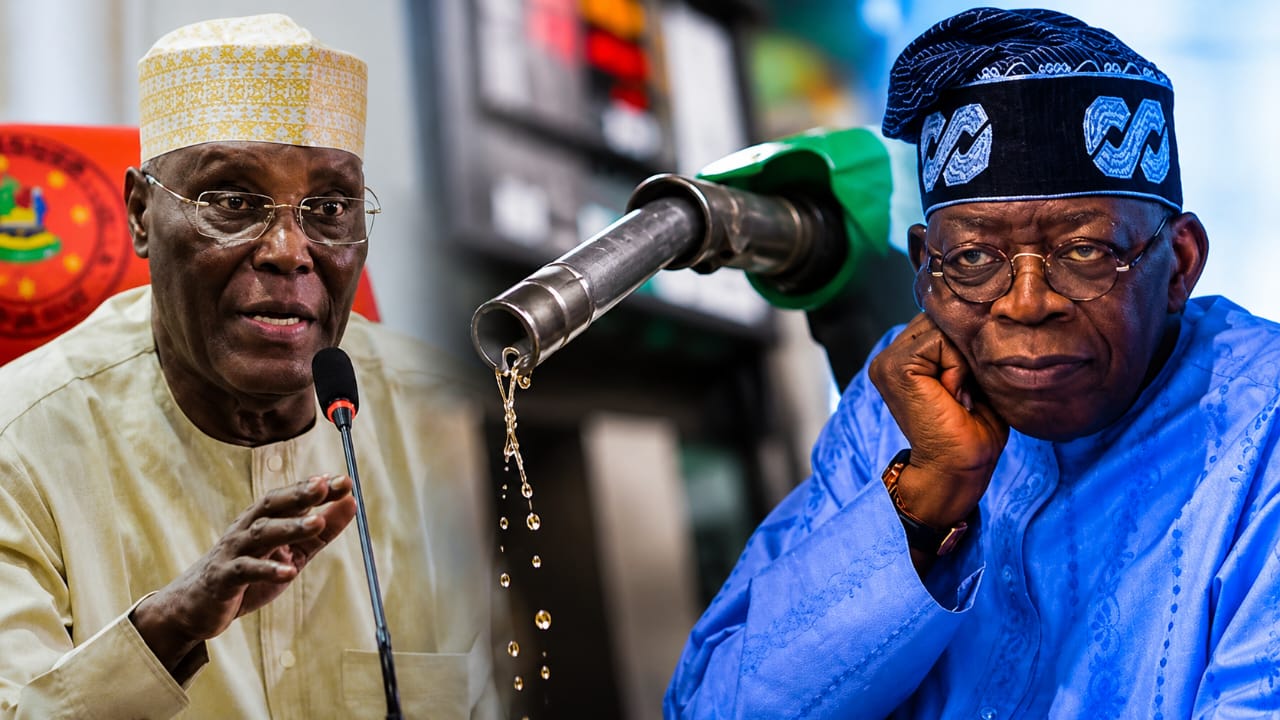
Few economic policies have generated as much political argument in Nigeria as fuel subsidy. Three years after President Bola Ahmed Tinubu announced its removal, the issue is back at the centre of the emerging 2027 presidential contest, this time with former Vice President Atiku Abubakar promising to restore it if elected.
Atiku’s declaration on Wednesday was striking, not only because of its political implications, but because it represents a significant departure from the position he took before the 2023 presidential election.
As a presidential candidate of the Peoples Democratic Party (PDP) in 2023, Atiku was among the leading contenders who supported the removal of petrol subsidy. His argument then was that the policy was unsustainable and that the resources could be better deployed to productive sectors of the economy.
Tinubu went even further. On May 29, 2023, in his inaugural address, he announced, in words that immediately became the defining headline of his first day in office, “Subsidy is gone.”
The declaration was followed by an immediate rise in petrol prices and a chain reaction that affected transportation, food, household expenses and the cost of doing business. For many Nigerians, the reform has remained synonymous with hardship.
Yet, for the Tinubu administration, subsidy removal is the foundation of a broader economic reform programme aimed at freeing government resources, improving fiscal stability and attracting investment.
The debate has now entered a new phase.
Atiku, the presidential candidate of the African Democratic Congress (ADC), said on Wednesday that he would restore the subsidy if elected president in 2027. He questioned what had happened to the resources previously spent on subsidy and asked whether the savings had translated into better healthcare, education and security.
“If I win the presidential election, I will restore the subsidy. And anyone who stole Nigeria’s subsidy funds must return the money,” Atiku said.
It was the kind of promise that could easily resonate with Nigerians struggling with the cost of living. But it also immediately raised a fundamental question: Is the return of fuel subsidy really the economic alternative Nigeria needs?
President Tinubu did not think so.
Speaking on Thursday at the State House while receiving Osun State Governor Ademola Adeleke, the President took a swipe at Atiku’s proposal, describing it as evidence of what he called “serious ignorance on governance and economy.” He defended the decision to end the subsidy, arguing that Nigeria’s financial situation before his administration made reform unavoidable.
Tinubu pointed to the condition of state finances before he assumed office, saying 27 states were unable to meet salary obligations. His argument was essentially that continuing to spend huge sums subsidising petrol was no longer sustainable when government had other pressing obligations.
Atiku, however, fired back.
Rather than retreat from his position, the former vice president accused the Tinubu administration of removing the subsidy while leaving what he described as racketeering in the petroleum sector and transferring the burden to Nigerians. He maintained that his proposed intervention would ensure accountability and that the subsidy would “follow the barrel” under a system where every subsidised barrel could be traced.
Then came the political response from the ruling party.
APC National Publicity Secretary Felix Morka accused Atiku of abandoning his 2023 position for political reasons. He described the proposal as “desperation of the most pitiful kind” and an indication that the former vice president was out of touch with Nigeria’s economic realities and the need for reform.
Morka also accused Atiku of failing to present an alternative economic policy and of resorting to what he called “misplaced populism” in the hope of gaining electoral advantage.
But beyond the political exchanges between Atiku, Tinubu and the APC lies a more important question that Nigerians should be asking as the 2027 election approaches: what has Nigeria actually gained from subsidy removal, and what should happen to those gains?
On Wednesday, Finance Minister and Coordinating Minister of the Economy, Taiwo Oyedele, provided perhaps the clearest financial picture yet.
He said subsidy savings mobilised N15.8 trillion in resources for the Federation between June 2023 and December 2025. The Federal Government received N5.4 trillion of the amount, while N10.4 trillion was shared among states and local governments.
But there is an important qualification.
Oyedele said the N15.8 trillion was not money that simply landed in the Federation Account as a single pot labelled “subsidy savings”. The reforms created additional fiscal space through increased revenues and other effects, while the government also faced significantly higher expenditure.
According to the minister, the Federal Government recorded N30.64 trillion in incremental expenditure during the period, including N9.39 trillion on wage adjustments, minimum wage increases and allowances, N9.37 trillion on external debt servicing and N6.5 trillion on strategic infrastructure.
This explanation matters because it addresses one of the strongest criticisms of subsidy removal: if Nigeria has saved trillions of naira, why do ordinary Nigerians not feel significantly better off?
That is a legitimate question.
Economic reforms are not supposed to be judged only by spreadsheets. They must eventually translate into better lives.
A government can point to improved public finances, stronger reserves, increased revenue or investor confidence, but the average Nigerian also wants to know whether transport is affordable, food is within reach, electricity is reliable, jobs are available and businesses can survive.
The World Bank and other international institutions have generally supported Nigeria’s reforms as necessary to restore fiscal and economic stability, while also acknowledging the significant short-term costs to households. Reuters reported this week that the reforms helped strengthen public finances and attract investment but intensified a severe cost-of-living crisis in the short term.
That is the dilemma Tinubu must confront before 2027.
The President may have been right to remove the subsidy. But removing it was only the beginning. The harder task is demonstrating that the resources freed by that decision are being used in ways that Nigerians can see and feel.
This is where the 2027 campaign should move beyond the simplistic argument of “subsidy is gone” versus “subsidy will return.”
If Atiku believes subsidy should return, he should tell Nigerians how much it will cost, where the money will come from and how he intends to prevent the abuses associated with the old system.
If he believes the problem was not subsidy itself but the way it was managed, then he should explain how his proposed system will be different.
And if the Tinubu administration believes its reform is working, it must provide more than figures. It must show Nigerians where the money has gone and what measurable improvements have resulted from it.
There is little doubt that subsidy became a drain on public finances. For years, the country spent enormous resources keeping petrol prices artificially low while other sectors struggled for funding. The system also became notorious for allegations of corruption, questionable import claims and opaque accounting.
Tinubu’s “Subsidy is gone” declaration therefore broke a cycle that successive administrations had struggled to end.
But Nigerians should not be asked to celebrate a reform simply because it was difficult.
They deserve results.
The biblical Moses analogy may be useful here. Tinubu has not taken Nigeria to the promised land. The journey has been painful and, for many families, unbearably so. But the country did leave what had become an unsustainable subsidy system.
The danger now is that political desperation could turn the hardship created by reform into an invitation to return to the old arrangement without answering the fundamental question of sustainability.
Atiku is entitled to change his mind. Politicians, like everyone else, can reassess policies when circumstances change. But a change of position on an issue as consequential as fuel subsidy requires a convincing explanation, not merely an electoral promise.
The 2027 presidential election should therefore not be reduced to a referendum on whether Nigerians want cheap petrol.
It should be a contest over what kind of economy Nigerians want.
If a candidate believes subsidy removal was wrong, let him explain why. If another believes it was necessary, let him demonstrate what has been achieved with the resources freed by it. If someone has a better model, Nigerians should hear it.
What the country does not need is a return to yesterday disguised as a solution to today’s problems.
Tinubu’s reforms deserve scrutiny. His administration is not beyond criticism, and the hardship suffered by Nigerians cannot be waved away as the inevitable price of progress. But the answer to an imperfect reform should be a better reform, not necessarily a reversal.
The real test for Atiku, or any other presidential contender, is therefore not whether he can promise to restore subsidy. It is whether he can offer Nigerians a credible economic alternative that is better than what exists today.
The 2027 election should therefore be more than a contest of promises designed to exploit public frustration or the gullibility of some voters. Anyone seeking to lead Nigeria at this critical moment must look beyond political desperation, tokenism and easy populist slogans.
The country needs a leader driven by a genuine passion to transform its economy, improve the lives of its people and build institutions that can deliver lasting prosperity.
We must be careful not to mistake the pain of reform for a reason to return to an unsustainable past.
What Nigeria needs in 2027 is not a leader promising to take us back, but one with the courage, vision and capacity to show us the way forward.
Joel Oladele is a journalist. He writes from Abuja and can be reached on: 08063138250 or dellyjoe85@gmail.com
📢 Follow National Periscope on WhatsApp
Get breaking news and updates directly on WhatsApp.
Join WhatsApp ChannelPost Disclaimer
All rights reserved. This material and other digital content on this website are not and do not represent the stance of National Periscope but the statements of newsmakers mentioned therein.
For your detailed news reportage... contact the Editor at Joel2oladele@gmail.com




The Nigeria Democratic Congress (NDC) has made a fresh push Read more
[caption id="attachment_24483" align="alignnone" width="1200"] Minister of Interior, Olubunmi Tunji-Ojo[/caption] The Read more
FG Partners Union Bank to Accelerate Nigeria's Economic Growth JOEL Read more
Rivers Crisis: “Fubara was ambushed, intimidated” – Edwin Clark reacts Read more