

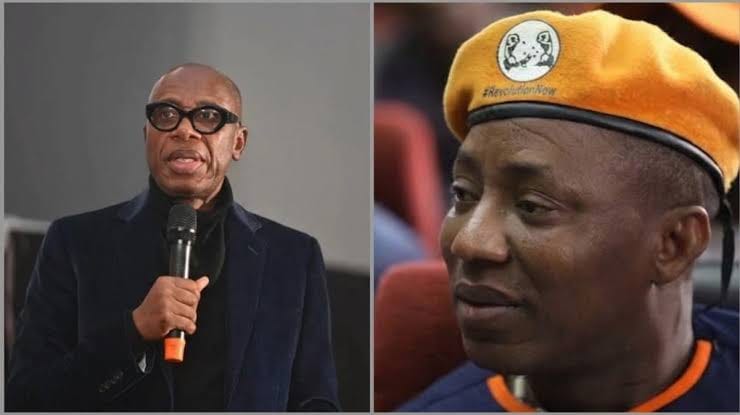
The debate over Nigeria’s petrol subsidy removal took a heated turn at the ongoing Nigerian Bar Association (NBA) conference in Port Harcourt, Rivers State, as presidential candidates and senior politicians sharply disagreed over the policy and its impact on Nigerians.
The disagreement involved African Action Congress (AAC) presidential candidate, Omoyele Sowore; African Democratic Congress (ADC) vice-presidential candidate and former Rivers State governor, Rotimi Amaechi; and Nigeria Democratic Congress (NDC) presidential candidate, Peter Obi.
The politicians clashed during a panel session on state affairs and economic policy, with Sowore questioning the rationale behind successive governments’ decision to remove fuel subsidy, while Obi defended subsidy removal but faulted the management of the resources saved from the policy.
Amaechi, who challenged several of Sowore’s claims, defended his record in public office and argued that politicians should be judged by their achievements.
Sowore opened the confrontation by accusing political leaders of repeatedly changing their positions on fuel subsidy while ordinary Nigerians continued to bear the consequences of the policy.
“You’re the only one who has been consistent about non-removal of fuel subsidy. It has been me. And it took Amaechi and his principal almost 10 years to catch up with me,” Sowore said.
He questioned the beneficiaries of subsidy and argued that the policy, if properly managed, should provide relief to ordinary Nigerians rather than wealthy individuals and political interests.
“The question about subsidy is, who are you subsidising? You are subsidising the elites. You are subsidising the governors,” he said.
Sowore also criticised the repeated removal of subsidy over the years, saying Nigerians had been promised better economic conditions each time the policy was withdrawn.
“I was a student in 1989, they removed subsidy. In 1990, they removed subsidy. They said Nigeria will be better. We are in 2026, they are still removing subsidy,” he said.
He accused political leaders of failing to demonstrate what the country had achieved with the resources previously allocated to subsidy and urged Nigerians not to accept what he described as misleading explanations from politicians.
Sowore also challenged Amaechi over his record as governor of Rivers State and Minister of Transportation, particularly on the railway projects executed during his tenure.
“When it comes to subsidy, transportation policy is important. We have a former governor of Rivers State here, Amaechi, who built a rail line that went nowhere,” Sowore said.
Amaechi immediately rejected the criticism.
“Stop lying. Stop lying, Sowore. I said, judge us by our achievements,” the former governor retorted.
Defending his record, Amaechi pointed to projects undertaken during his tenure as governor and as Minister of Transportation, including roads, primary schools and railway projects.
He challenged lawyers from Rivers State to show Sowore some of the projects executed by his administration and asked lawyers from Ogun and Kaduna states to attest to the operation of railway projects in their respective states.
The exchange became more heated when Sowore attempted to interject, prompting Amaechi to tell him, “Moreover, Sowore, when politicians are talking, close your mouth.”
Amaechi also turned his criticism towards Obi, questioning the performance of the former Anambra State governor in the areas of education and healthcare.
He cited industrial actions by lecturers and doctors during Obi’s tenure as governor, arguing that his record should also be subjected to scrutiny.
“Peter Obi did not subsidise education in his state. Lecturers and doctors went on strike for 13 months. You may like him as a person, but he did not perform as a governor. That is the truth,” Amaechi said.
Despite his criticism of the current approach to subsidy removal, Amaechi said he would not support a policy that returned benefits primarily to wealthy Nigerians.
“I will not remove subsidy because the poor in Nigeria need to be subsidised instead of the rich. We are already subsidising them with waivers. We have a duty to return power to the people,” he said.
Obi, who later took the floor, adopted a different position from Sowore, saying he supported the removal of fuel subsidy but disagreed with how the policy had been implemented and how the resulting resources had been managed.
“I subscribe and I maintain that you need to remove subsidy. Mismanagement of the proceeds should not be the reason for not removing it,” Obi said.
According to him, the problem was not necessarily the decision to remove subsidy but the failure to channel the resources released by the policy into areas that would directly improve the lives of Nigerians.
“What we would have done is that when we remove subsidy, we would have given the people alternative usage for the subsidy,” he said.
Obi argued that the resources recovered from subsidy removal could have been invested in critical sectors, particularly primary healthcare.
“What we have today is that the removal and the attendant resources being recovered are also being mismanaged and stolen,” he said.
He illustrated his proposed approach with an allocation from the savings attributed to subsidy removal, saying a small percentage could significantly improve healthcare infrastructure across the country.
“Assuming we use five per cent of the N16 trillion recovered to address our primary healthcare… it would cost about N800 billion,” Obi said.
He proposed using the money to support primary healthcare at ward level, arguing that allocating N100 million to each ward would substantially transform basic healthcare delivery across the country.
The exchanges highlighted the sharp differences among the politicians over one of the most contentious aspects of Nigeria’s economic reforms.
While Sowore argued against subsidy removal and called for a system that protects ordinary Nigerians, Obi supported its removal but demanded greater accountability over the resulting savings. Amaechi, meanwhile, defended the need to return political power to Nigerians while challenging his opponents to assess public office holders based on their records.
The debate came as the economic and political implications of petrol subsidy removal continue to dominate national discourse ahead of the 2027 general elections.
📢 Follow National Periscope on WhatsApp
Get breaking news and updates directly on WhatsApp.
Join WhatsApp ChannelPost Disclaimer
All rights reserved. This material and other digital content on this website are not and do not represent the stance of National Periscope but the statements of newsmakers mentioned therein.
For your detailed news reportage... contact the Editor at Joel2oladele@gmail.com

President Bola Ahmed Tinubu currently enjoys the strongest route to Read more
JOEL OLADELE, Abuja [caption id="attachment_21484" align="alignnone" width="1080"] Akwa Ibom State Read more
[caption id="attachment_21547" align="alignnone" width="800"] Rabiu Musa Kwankwaso[/caption] Former Kano State Read more
The conspiracy is political – Bwala reacts to rumored plan Read more