
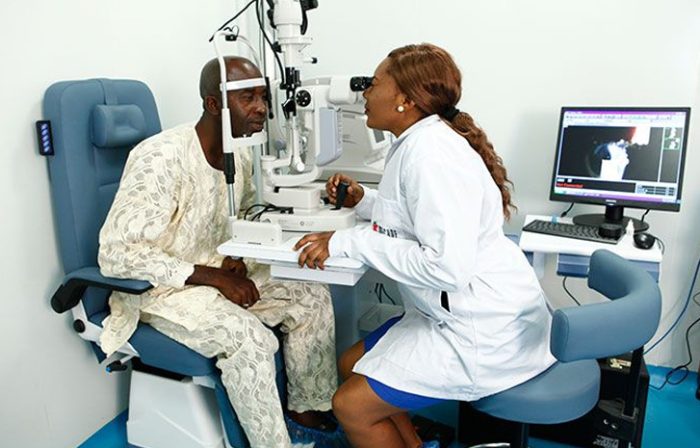
The Federal Government has activated more than 1,400 primary healthcare centres(PHCs) across Nigeria to provide basic eye care services and tackle avoidable blindness.
The Minister of State for Health and Social Welfare, Dr Iziaq Adekunle Salako, disclosed this on Thursday in Abuja at an event marking the 2026 World Sight Day.
The event, themed “The Value of Vision: Investing in People, Productivity and Nigeria’s Future,” focused on expanding access to eye care and integrating essential services into primary healthcare.
Represented by the Director of E-Health Division, Mrs Doris Afam-Aneke, Salako said the initiative would take eye care closer to underserved communities.
He disclosed that the government had also trained more than 3,000 healthcare workers across 16 states to provide basic eye care services at community level.
According to him, the trained workers can detect eye conditions early, educate communities and refer patients who need specialised treatment.
“A major pillar of our eye health strategy has been the integration and expansion of primary eye care services across the country,” Salako said.
He stressed that sustainable progress would depend on making essential eye services available at the level closest to Nigerians.
The minister added that integrating eye care into PHCs had strengthened frontline facilities to prevent, detect and manage common eye conditions.
Meanwhile, the government has distributed more than 1.5 million pairs of prescription spectacles to Nigerians in 16 states through the Effective Spectacle Coverage Initiative, known as Jigi-Bola 2.0.
Salako said preparations were at an advanced stage to extend the programme to 10 more states, particularly to address uncorrected refractive errors.
The government has also screened more than 1.5 million school-age children for visual problems under its school eye health programme.
Those requiring treatment, he said, were linked to appropriate care.
In addition, four vision centres are being established in Enugu, Edo, Sokoto and Nasarawa states to strengthen secondary eye care and improve referral services.
Salako reaffirmed the government’s commitment to reducing avoidable blindness, announcing plans to conduct 25,000 free cataract surgeries nationwide by the end of 2027.
He said better vision would improve learning, productivity and the overall quality of life.
The minister also disclosed that Nigeria would co-host the first Global Summit on Eye Health on November 2 in Antigua and Barbuda.
He described the summit as an opportunity for Nigeria to contribute to global efforts to integrate eye health into universal health coverage.
Salako said the National Eye Care Commitment would focus on primary eye care, affordable spectacles, cataract surgery, workforce development and removing barriers to treatment.
The National Coordinator, National Eye, Ear and Sensory Functions Health Programme, Dr Oteri Okolo Eme, said more than 80 per cent of visual impairment in Nigeria was avoidable.
She therefore described primary eye care integration as a major priority in the country’s health strategy.
Eme disclosed that the government had established national master trainers across the six geopolitical zones and trained about 4,000 primary healthcare workers.
She added that more than 2,200 other health workers had received specific training in primary eye care, while state-level trainers and facilitators had also received training.
The coordinator said the government was also developing protocols for newborn eye screening to detect conditions that could cause visual impairment early.
“We are protecting our children and future generations. We are in the process of developing protocols for newborn screening because we believe that if we detect causes of visual impairment early, we will be able to address them,” she said.
Eme also called for dedicated government funding for eye health and urged Nigerians to undergo regular eye examinations.
She appealed to development partners, the private sector, teachers, health workers and the media to support efforts to improve eye health nationwide.
The Executive Secretary of the National Commission for Persons with Disabilities, Chief Ayuba Gufwan, said investment in eye health was an investment in people.
He noted that accessible eye care and adequate support for persons with visual impairment would improve participation in education, employment and community life.
The Chief Medical Director of the National Eye Centre, Kaduna, Dr Amina Hassan Wali, also called for stronger partnerships and greater public awareness.
She urged Nigerians to seek early treatment for eye problems and undergo regular examinations.
“Let us work together to ensure that no one is left behind and that everyone can enjoy the gift of sight,” Wali said.
The event ended with the unveiling of the National Eye Health Commitments ahead of the global summit.
📢 Follow National Periscope on WhatsApp
Get breaking news and updates directly on WhatsApp.
Join WhatsApp ChannelPost Disclaimer
All rights reserved. This material and other digital content on this website are not and do not represent the stance of National Periscope but the statements of newsmakers mentioned therein.
For your detailed news reportage... contact the Editor at Joel2oladele@gmail.com





 across Nigeria to provide basic eye care services and tackle avoidable blindness.)
NAFDAC alerts Nigerians on substandard, contaminated syrup The National Agency Read more
Cross River Confirms COVID-19 Case as Health Authorities Activate Emergency Read more
Climate change: Expert X-rays effects on mental health, recommends remedies. Read more
Lagos residents raise concern over 100% increase in condom's price Read more