

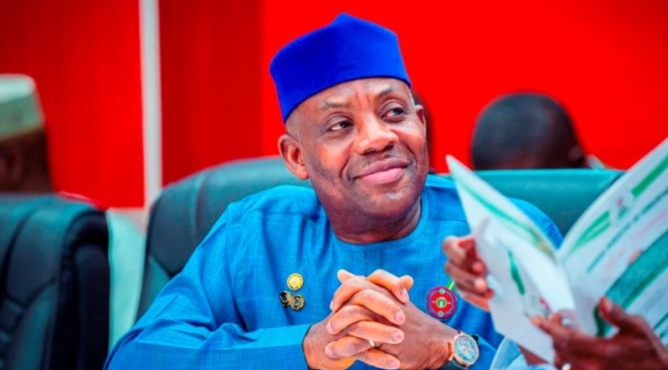
The Federal Government has unveiled the Tertiary Institutions National Laureate Prize, with an annual prize pool of about N365 million to reward outstanding research, innovation and intellectual excellence across Nigeria’s tertiary institutions.
The Minister of Education, Dr. Maruf Olatunji Alausa, announced this on Wednesday at a press briefings in Abuja, saying the initiative was designed to strengthen Nigeria’s culture of scholarship and create a clearer pathway from academic research to innovation, commercialisation and national development.
Alausa said the prize would recognise exceptional academic work at undergraduate, Master’s and doctoral levels, particularly research with strong potential for industrial application and solutions to national challenges.
He said the initiative was part of the Federal Government’s efforts under President Bola Ahmed Tinubu’s Renewed Hope Agenda to reposition education as a driver of economic transformation.
The prize is being jointly implemented by the Federal Ministry of Education and the Nigeria Education Repository and Databank (NERD).
According to the minister, the prize pool will cover different categories of outstanding academic work, including undergraduate dissertations with commercial potential, exceptional Master’s theses and PhD research with clear industrial and developmental applications.
Special prizes will also be awarded in critical areas such as Engineering and Technology, Medicine and Health Sciences, Arts and Social Sciences, Agriculture, Law and Teaching Innovation.
Alausa said some of the special awards would be named after distinguished Nigerians whose contributions represented exceptional service to the country.
One of them, he disclosed, would be the Dr Stella Adadevoh Prize for Medicine and Medical Innovation, in recognition of the late physician’s role in containing the 2014 Ebola outbreak in Nigeria.
The minister said the prize was not intended to be another conventional awards programme but a deliberate effort to change how Nigerians perceive academic achievement and innovation.
“Scholarship matters; research matters; innovation matters; and intellectual excellence deserves a prominent place in our national consciousness,” he said.
Alausa said the government wanted students and researchers to see a direct link between academic work and opportunities for innovation, enterprise creation and national development.
He explained that an undergraduate developing a commercially viable innovation should know that such work could attract national recognition, while Master’s and doctoral researchers should see a pathway for their research to move beyond academic publications into practical applications.
The minister stressed that the credibility of the programme would depend largely on the integrity of its selection process.
He said the government had directed that the process be transparent, competitive and merit-driven, with safeguards against political, institutional or personal influence.
“Excellence must be the determining factor,” Alausa said.
He added that submissions would conform to the National Policy on the Nigeria Education Repository and Databank, which, he said, would strengthen the integrity, accessibility and preservation of Nigeria’s intellectual output.
The minister said the initiative was necessary because Nigeria had not sufficiently celebrated the researchers, academics and young innovators developing solutions to the country’s developmental challenges.
He noted that universities and other tertiary institutions were producing research capable of addressing national problems, but much of such work often remained within academic circles without reaching the marketplace or industry.
Alausa said the government was therefore seeking to build an education system that would produce not only graduates and certificates but also solutions, innovations, enterprises and measurable economic value.
“The most successful nations of the 21st century will not necessarily be those endowed with the greatest natural resources. They will be those that can systematically transform knowledge into solutions, research into enterprise, and intellectual capital into economic and industrial value,” he said.
The minister said the National Laureate Prize would complement broader reforms aimed at making Nigeria’s education system more responsive to the country’s economic and developmental needs.
He said the initiative would also encourage young Nigerians to pursue research and innovation while helping to build the human capital required to improve Nigeria’s competitiveness globally.
Alausa expressed confidence that the programme would establish a culture in which intellectual achievement attracts the same level of national recognition as other forms of excellence.
He said the government remained committed to creating an education system that develops the knowledge, skills, creativity and innovation required to drive sustainable economic growth.
📢 Follow National Periscope on WhatsApp
Get breaking news and updates directly on WhatsApp.
Join WhatsApp ChannelPost Disclaimer
All rights reserved. This material and other digital content on this website are not and do not represent the stance of National Periscope but the statements of newsmakers mentioned therein.
For your detailed news reportage... contact the Editor at Joel2oladele@gmail.com






The Joint Admissions and Matriculation Board (JAMB) and key stakeholders Read more
Kidnapped Sokoto students regain freedom after 13 days The 15 Read more
[caption id="attachment_23750" align="alignnone" width="1080"] Minister of Education, Dr Tunji Alausa[/caption] Read more
SUG demands apology from EFCC over arrest of OAU students Read more