
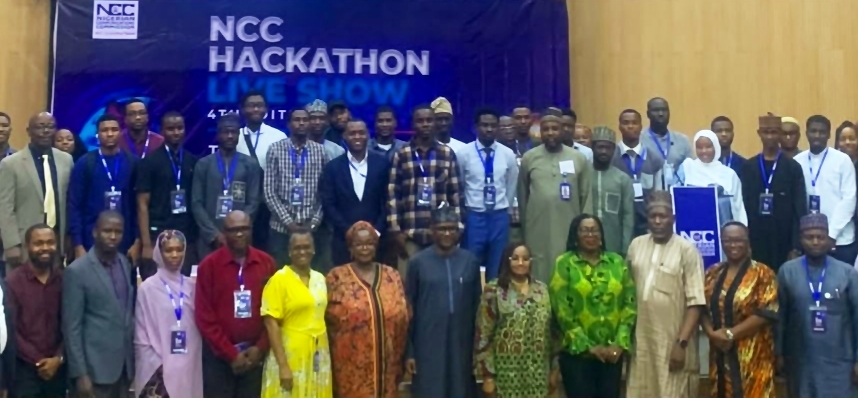
The Nigerian Communications Commission (NCC) has turned the spotlight on technology solutions capable of improving digital access for Persons with Disabilities (PWDs), as 20 innovators compete at its 2026 Hackathon Live Show in Abuja.
The fourth edition of the competition, held on Wednesday, is themed “Technology Without Barriers: Innovative Solutions for Persons with Disabilities.”
The initiative is aimed at developing practical and affordable digital tools that can help PWDs overcome barriers to communication, employment, education, healthcare and other essential services.
Speaking at the event, the Executive Commissioner, Stakeholder Management, NCC, Rimini Makama, said the hackathon reflected the Commission’s broader commitment to ensuring that technological advancement translates into opportunities for all Nigerians.
Makama, who was represented by the Director, Zonal Operations, NCC, Usman Malah, said innovation should be measured not only by its sophistication but by its impact on people’s lives.
She said the Commission was particularly interested in solutions that could address the difficulties faced by PWDs and other underserved groups while strengthening indigenous technology development.
According to her, many Nigerians still encounter barriers when accessing communication services, financial platforms, healthcare, education, employment and government services.
She therefore urged the contestants to develop solutions that were simple, affordable and capable of reaching large numbers of users.
“Do not simply focus on developing impressive technologies. Focus on creating solutions that are simple to use, affordable to deploy, scalable across communities, and capable of improving the quality of life of millions of Nigerians,” she said.
The Director, Digital Economy Department of the NCC, Helen Obi, said the competition was designed to demonstrate that digital services could be developed without making high-speed internet or sophisticated mobile devices prerequisites for access.
She said the Commission was looking for innovations capable of operating in low-bandwidth or offline environments, adding that some of the proposed solutions were designed to work even where users had limited or no access to mobile data.
Among the areas being explored by the contestants are artificial intelligence-powered speech-to-text applications, real-time sign language translation, voice-based complaint systems and accessible customer-care services.
Other areas include accessible USSD platforms, image-to-voice navigation, environmental description tools and digital platforms for connecting PWDs with employment opportunities.
Obi said the hackathon was limited to residents of the Federal Capital Territory in the latest edition, with participants drawn from various fields of the technology ecosystem.
She said the competition was open to young innovators between 18 and 35 years, including software developers, designers, researchers, students, entrepreneurs and PWDs.
The contestants are expected to present functional prototypes, demonstrate their solutions and provide business models, market strategies and technical documentation.
The judging process, according to Obi, would consider innovation, accessibility, relevance, technical feasibility, scalability, affordability and sustainability, among other criteria.
Indigenous value addition, quality of presentation and demonstration, as well as the capacity of the teams to execute their ideas, would also form part of the assessment.
She disclosed that the Commission’s Digital Economy Department had developed an internal software application to allow judges to score contestants in real time.
The hackathon, she said, was also aligned with the NCC’s mandate to promote universal access to communications services and the Federal Government’s digital economy objectives.
Beyond the competition, the Commission expects the programme to stimulate the creation of new technology ventures, strengthen local intellectual property and encourage partnerships between government, private sector players, academia and innovators.
The initiative is also expected to provide promising solutions with opportunities for further development, pilot deployment and possible scale-up.
The NCC said the broader objective was to ensure that Nigeria’s digital transformation remained inclusive by creating technologies that respond to the realities of people who are often excluded from mainstream digital services.
📢 Follow National Periscope on WhatsApp
Get breaking news and updates directly on WhatsApp.
Join WhatsApp ChannelPost Disclaimer
All rights reserved. This material and other digital content on this website are not and do not represent the stance of National Periscope but the statements of newsmakers mentioned therein.
For your detailed news reportage... contact the Editor at Joel2oladele@gmail.com






The Nigerian Communications Commission (NCC) and the Rural Electrification Agency Read more
President Bola Ahmed Tinubu has signed the National Identity Management Read more
NITDA Deepens Push for Inclusive Digital Access for PWDs FELICIA Read more
ICPC partners NITDA to fight corruption with technology The Independent Read more