

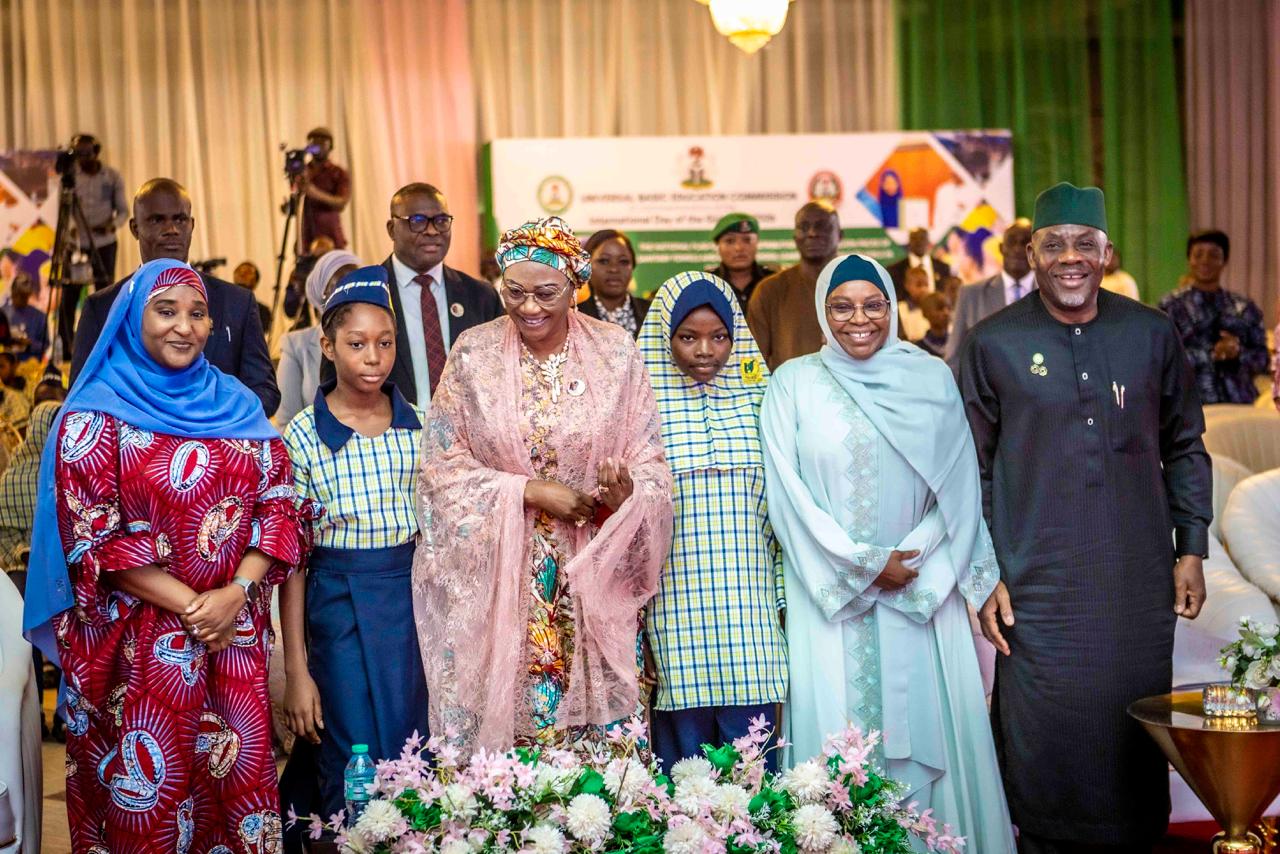
The Universal Basic Education Commission (UBEC) has launched the distribution of two million packs of sanitary towels and learning materials to girls in public basic schools nationwide to improve attendance and prevent school dropout.
The First Lady, Senator Oluremi Tinubu, flagged off the initiative, tagged “Flow with Confidence 2.0: Keeping Every Girl in School”, on Monday at the State House Banquet Hall, Presidential Villa, Abuja, as part of activities marking the 2026 International Day of the Girl Child.
Speaking at the ceremony, UBEC Executive Secretary, Dr Aisha Garba, said the programme would address challenges that prevent girls, particularly those from disadvantaged backgrounds, from attending school regularly.
She explained that limited access to sanitary products often affects girls’ confidence and participation in classroom activities, making menstrual health an important factor in efforts to improve school retention.
“This programme reflects our shared commitment to ensuring that the barriers to girl child education are adequately addressed in line with the Renewed Hope Agenda,” Garba said.
“Our message is clear: no girl child should have to choose between her dignity and her education,” she added.
Under the initiative, girls in public basic schools across the 36 states and the Federal Capital Territory (FCT) will receive sanitary towels alongside school bags, shoes, exercise books, mathematics textbooks and writing materials.
Garba described the intervention as an investment in the education, confidence and future of Nigerian girls. She said it aligned with President Bola Tinubu’s Renewed Hope Agenda, which places education and human capital development among the priorities of national development.
She commended the First Lady, the Minister of Education, Dr Maruf Tunji Alausa, and the Minister of State for Education, Professor Suwaiba Sa’id Ahmad, for supporting efforts to improve girls’ access to education.
The UBEC chief recalled that Tinubu launched the original Flow with Confidence programme on October 2, 2025. The initiative provided a one-year supply of disposable sanitary pads to 370,000 schoolgirls in rural communities across the country.
She said the second phase would expand the programme’s reach and strengthen efforts to prevent menstrual hygiene challenges from disrupting girls’ education.
Garba also highlighted other basic education interventions undertaken by UBEC under the current administration. She disclosed that the commission had facilitated the construction of more than 4,000 classrooms nationwide in less than three years.
According to her, UBEC has also supported the provision of water and sanitation facilities, learning materials, teacher development programmes and digital technology in public schools.
She further disclosed that more than three million pupils benefited from back-to-school materials in the preceding year. The commission, working with relevant agencies and stakeholders, had also supported efforts to return approximately 700,000 out-of-school children to classrooms.
Garba said the interventions reflected the commission’s commitment to improving learning conditions and expanding access to basic education, particularly for children facing economic and social disadvantages.
She also announced a scholarship intervention under UBEC’s Learners Retention Support Programme, which targets 100,000 learners in its first phase.
Each beneficiary is expected to receive N20,000 under the N2 billion programme. The grants aim to ease financial difficulties that often affect school attendance and force vulnerable children to abandon their education.
The UBEC executive secretary urged state governments, State Universal Basic Education Boards (SUBEBs), traditional rulers, religious leaders, parents, teachers and development partners to ensure transparent distribution of the materials and financial assistance.
In her address, Tinubu commended UBEC for expanding the sanitary towel programme and providing additional learning materials to schoolgirls.
She noted that keeping girls in school required deliberate efforts to tackle challenges affecting their education, particularly in rural communities where limited access to sanitary products could contribute to absenteeism.
The First Lady reaffirmed her commitment to ensuring that Nigerian girls pursued their education with dignity, confidence and the support needed to fulfil their potential.
She also urged State First Ladies, commissioners for education and SUBEB chairmen to ensure accountability in the implementation of the scholarship programme. Tinubu called on traditional rulers, religious leaders and community stakeholders to help eliminate the stigma associated with menstruation.
The Minister of Education, Alausa, described the initiative as an important step towards securing the education and future of Nigerian girls.
He commended Tinubu for championing girls’ education and said the administration’s education reforms sought to widen access to learning and remove barriers that prevent children from completing their studies.
Alausa also acknowledged the contributions of Sa’id Ahmad, UBEC leadership and other stakeholders. He urged students to take advantage of government interventions, remain committed to their studies and prepare to contribute to national development.
Similarly, the Minister of State for Education, Sa’id Ahmad, said the programme demonstrated the Federal Government’s commitment to protecting girls’ dignity, promoting menstrual health and improving school attendance.
She encouraged girls to remain focused on their education, work hard and believe in their ability to achieve their ambitions.
Garba assured parents and education stakeholders that UBEC would continue to work with the Federal Ministry of Education, state governments, SUBEBs and development partners to improve access to quality basic education.
She said the commission would sustain investments in school infrastructure, learning resources and teacher development while strengthening interventions to improve enrolment, attendance and retention among vulnerable learners.
Addressing the beneficiaries, Garba said: “To our beautiful daughters, your dreams matter, your voices matter, and your future deserves every opportunity we can give you.”
She maintained that poverty, menstrual hygiene challenges and other preventable barriers should not deny any Nigerian girl an education.
The commission said its continued interventions would support national efforts to keep girls in school and improve their prospects through education.
📢 Follow National Periscope on WhatsApp
Get breaking news and updates directly on WhatsApp.
Join WhatsApp ChannelPost Disclaimer
All rights reserved. This material and other digital content on this website are not and do not represent the stance of National Periscope but the statements of newsmakers mentioned therein.
For your detailed news reportage... contact the Editor at Joel2oladele@gmail.com




Out-of-school Children: Tinubu to recruit teachers, build more schools President Read more
Makinde reopens 23 schools in Oyo after 10-year shutdown The Read more
Sexual assault: Court remands suspended UNICAL Prof pending bail A Read more
[caption id="attachment_20915" align="alignnone" width="1080"] Enitonna High School Alumni Association logo[/caption] Read more