

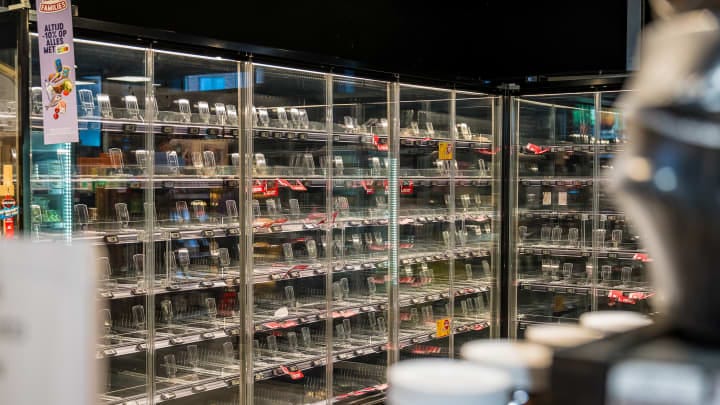
Cyberattacks targeting supermarkets across Europe have disrupted refrigeration systems, forcing several retailers to discard spoiled food after hackers remotely raised temperatures in fridges and freezers.
The attacks affected supermarkets in Belgium, Luxembourg, Sweden, Finland and Estonia, raising fresh concerns about the vulnerability of critical infrastructure to cyber threats.
In one reported incident of cyberattacks, temperatures inside a supermarket refrigerator climbed to 50 degrees Celsius, while other stores suffered significant food losses.
Dutch supermarket group Ahold Delhaize confirmed that dozens of its Delhaize stores in Belgium and Luxembourg experienced refrigeration problems on Monday.
The company told CNBC that the incident affected its refrigeration systems and forced some stores to dispose of food. It, however, said the situation had returned to normal, with all affected outlets fully operational.
Other retailers also reported attacks. Colruyt Group said hackers targeted five of its Spar stores in Belgium, while French retail giant Carrefour confirmed that 15 Belgian outlets suffered disruptions.
French supermarket chain Intermarché also reported attacks on 15 of its 153 stores in Belgium.
The company said its security measures helped contain most of the incidents quickly, although some outlets recorded stock losses.
An Intermarché spokesperson said the damage remained limited compared with an earlier attack in October.
IKEA also confirmed that a cyber incident affected refrigerators and freezers at its Mons store in Belgium between Sunday and Monday.
Although the store remained open, the company began inspecting the affected equipment and food products. It also initiated checks across its other Belgian outlets.
IKEA said the incident had limited effects on its restaurant and Swedish Food Market operations, while investigations continued to establish what happened.
Meanwhile, Sweden’s largest grocery retailer, ICA, confirmed an incident involving refrigeration systems at a limited number of stores.
The company said the affected outlets operated on networks outside its central systems and that it was helping them manage the disruption.
Finnish supermarket operator Kesko, Irish grocery chain SuperValu and Estonian retailer One Selver also reported problems with their refrigeration systems.
The European Commission said it had contacted national authorities and convened an emergency meeting of its interinstitutional task force.
The meeting involved the European Union Agency for Cybersecurity (ENISA), Europol and relevant Commission departments to examine the incidents.
The latest attacks have also revived concerns over a similar wave of cyber incidents that struck hundreds of French supermarkets in October.
That attack caused refrigeration units to overheat, food to spoil and fires to break out in some locations.
Les Mousquetaires, the owner of Intermarché, said at the time that it expected losses running into several million euros.
European Commissioner for Agriculture and Food, Christophe Hansen, had warned that food security required greater attention at every level.
He said the weaponisation of food had become a reality.
The incidents have also drawn attention to suspected cyberattacks against food storage facilities at six United States military bases in late August.
Reuters reported in October that the Pentagon was treating the incidents as suspected hacking and coordinating investigations with French authorities.
In one case, hackers allegedly raised a freezer’s temperature overnight, leaving large quantities of food thawed and damaged by morning.
Despite the growing concerns, no individual or group has claimed responsibility for the latest supermarket attacks.
Cybersecurity experts say investigations must establish whether the incidents involve ordinary cybercriminals or actors pursuing wider political and strategic objectives.
Rafe Pilling, senior director of threat intelligence at Sophos Counter Threat Unit, said the psychological impact of empty supermarket refrigerators could extend beyond the immediate financial losses.
He noted that empty shelves could create public anxiety because consumers readily associate food shortages with wider social disruption.
Pilling said the visibility of the attacks could therefore matter as much to the perpetrators as the financial damage.
Fredrik Blix, a strategic cybersecurity adviser at Visente AB, said the attacks did not necessarily require sophisticated hacking techniques.
He explained that some refrigeration control units remained directly accessible through the internet, with support login credentials that researchers had previously identified.
According to Blix, the equipment vendor released a security update in August. However, thousands of units had not received the update, while some older models could not support it.
He described the attackers’ silence as a significant clue, suggesting they might have targeted the systems either to demonstrate their capabilities or to create unease in countries supporting Ukraine.
However, investigators have yet to establish the motive behind the attacks.
Pilling warned that businesses and public institutions faced similar risks because banks, government agencies, manufacturers, utilities and retailers increasingly depend on remotely managed systems.
He said attackers did not always need advanced capabilities to disrupt essential services if they could access poorly secured systems controlling physical infrastructure.
Although there is no evidence that artificial intelligence played a role in the supermarket attacks, Pilling warned that criminals could increasingly deploy AI to organise and execute cyberattacks.
He said AI could eventually become a routine tool for coordinating attacks rather than an exceptional feature of cybercrime.
Separately, the United Kingdom’s National Cyber Security Centre warned on Tuesday that critical national infrastructure must prepare for ransomware attacks involving AI-powered malware.
The agency said such attacks would become increasingly likely over the next two years.
Its chief executive, Richard Horne, criticised organisations for years of inadequate investment in technology security.
He urged leaders to make cybersecurity and resilience fundamental priorities rather than afterthoughts.
📢 Follow National Periscope on WhatsApp
Get breaking news and updates directly on WhatsApp.
Join WhatsApp ChannelPost Disclaimer
All rights reserved. This material and other digital content on this website are not and do not represent the stance of National Periscope but the statements of newsmakers mentioned therein.
For your detailed news reportage... contact the Editor at Joel2oladele@gmail.com







Explosions reported near US Consulate in Iraq; Iran claims responsibility Read more
Gaza residents in dire straits, again, as Israel’s renewed assault Read more
US Supreme Court asked to rule on whether Trump has Read more
US sends warships to aid Israel as Iran attack looms Read more