

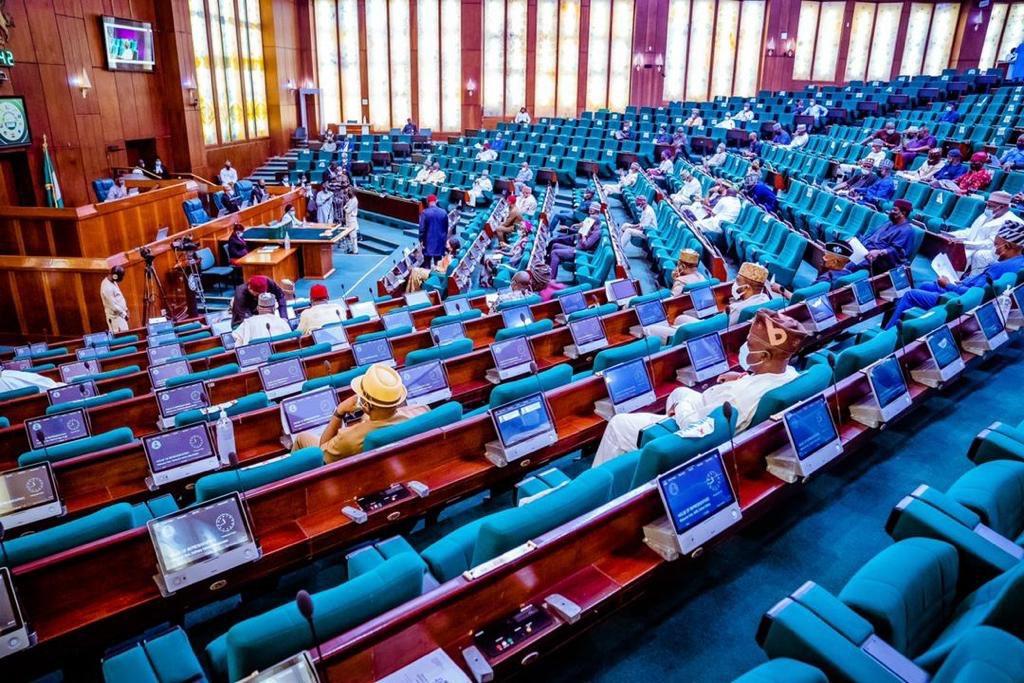
The House of Representatives has approved President Bola Tinubu’s requests to secure external loans totalling $28.22 billion and €1.045 billion to fund infrastructure and other development projects across the country.
The approval followed the consideration of two separate proposals submitted by the President to the National Assembly, covering supplementary borrowing for 2026 and 2027, as well as additional financing under the 2026 Appropriation Act.
The first proposal, covering the 2026–2027 Supplementary External Borrowing (Rolling) Plan, seeks $20.52 billion and €1.045 billion in external financing.
The second request seeks approval to borrow N10.79 trillion, equivalent to $7.707 billion, to finance projects captured in the 2026 budget.
Lawmakers approved the requests during Wednesday’s plenary after considering reports submitted by the House Committee on Aids, Loans and Debt Management.
Deputy Speaker Benjamin Kalu presided over the Committee of Supply, where members considered the proposals. The committee’s chairman, Abubakar Nalaraba, presented the reports and urged lawmakers to endorse the requests.
In his communication to the House, Tinubu said the supplementary borrowing plan was designed to support his administration’s reform programme, stimulate economic growth and address critical development needs.
He explained that the projects were selected following technical and economic assessments, with emphasis on their potential contributions to national development.
According to the President, the proposed interventions would generate employment, improve skills acquisition, support entrepreneurship, tackle poverty and strengthen food security.
He added that the projects would be implemented across the 36 states and the Federal Capital Territory.
Tinubu identified Nigeria’s infrastructure deficit and the enormous financial requirements for addressing it as key reasons for seeking additional external financing.
He maintained that the country could not meet its development needs without mobilising substantial resources through carefully structured borrowing arrangements.
“In light of the need for significant infrastructure investment in the country and the vast financial resources needed to address this gap, it has become essential to pursue prudent external borrowing to close the financial shortfall,” he said.
The President said the funds would be channelled mainly into electricity, transportation, healthcare and other strategic sectors.
He also emphasised the importance of securing timely disbursement and ensuring effective execution of the projects to deliver the expected benefits.
On the proposed N10.79 trillion borrowing, Tinubu outlined several funding channels available to the Federal Government.
These include Eurobond issuance, concessional and commercial facilities from multilateral and bilateral institutions, International Monetary Fund facilities, bridge financing, syndicated loans and direct borrowing from international financial institutions.
He described Eurobond issuance as an important option because of the relatively shorter period required to complete the process.
However, the President said the government would explore the available financing options concurrently, subject to their costs, benefits and the time needed to access the funds.
The proposed borrowing is expected to support capital expenditure in infrastructure, defence and security, agriculture, healthcare, power, transportation and education.
As part of its approval, the House imposed conditions aimed at ensuring transparency and accountability in the management of the loans.
Lawmakers authorised the Federal Government to raise the approved funds through any one or a combination of the financing options presented by the President, provided it secures the most favourable terms.
The House also directed the Debt Management Office (DMO) to submit periodic reports to the National Assembly detailing completed financing arrangements.
The reports are expected to contain information on the amounts raised, sources of funds, interest rates, repayment schedules, fees and other relevant conditions attached to the loans.
Similarly, the House Committee on Local and Foreign Debts was mandated to maintain continuous oversight of the borrowing programme.
The committee is expected to monitor the financing arrangements, disbursements, utilisation of the proceeds and compliance with the conditions attached to the legislative approval.
The measures are intended to ensure that the Federal Government accounts for the borrowed funds and applies them to the projects for which the National Assembly granted approval.
📢 Follow National Periscope on WhatsApp
Get breaking news and updates directly on WhatsApp.
Join WhatsApp ChannelPost Disclaimer
All rights reserved. This material and other digital content on this website are not and do not represent the stance of National Periscope but the statements of newsmakers mentioned therein.
For your detailed news reportage... contact the Editor at Joel2oladele@gmail.com

[caption id="attachment_25565" align="alignnone" width="894"] National Assembly (NASS) Complex[/caption] The National Read more
Fubara declares Amaewhule-led Rivers State House of Assembly as non-existent Read more
Akpabio's Response to Natasha's Petitions Shows No Skeleton to Hide- Read more
Lagos House Of Assembly Speaker Obasa Impeached, Miranda Takes Over Read more