

INEC Seeks Improved Facilities for Polling Units, Urges NBS Support
JOEL OLADELE, Abuja
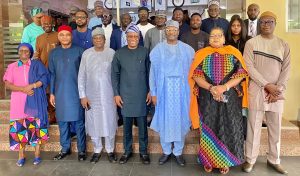
The Independent National Electoral Commission (INEC) has raised concerns over the poor state of facilities used as polling units and ward collation centres nationwide, urging the National Bureau of Statistics (NBS) to capture these gaps in its national data to aid policy interventions.
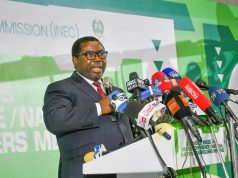
INEC Chairman, Prof. Mahmood Yakubu, made the appeal yesterday in Abuja when he received the Statistician-General of the Federation, Prince Adeyemi Adeniran, on a courtesy visit to the Commission.
Yakubu explained that most of the country’s 176,000 polling units and collation centres are located in public buildings, particularly state-owned primary and secondary schools, but lack basic infrastructure to support electoral staff and voters.
“Over the years, stakeholders, especially the National Youth Service Corps (NYSC) and groups representing persons with disability, have appealed to the Commission to improve these facilities by providing electricity and water for ad hoc staff, as well as access facilities such as ramps for citizens with special needs during elections and voter registration,” he said.
He stressed that the NBS, as custodian of the national statistical system, should include such gaps in its periodic publications and engagements with the National Economic Council (NEC), where all state governors participate.
“Let these facilities which train our youths at the foundation and intermediate levels of the education system be beneficiaries of the widely proclaimed dividends of democracy,” Yakubu added.
The INEC Chairman further recalled how the Commission had previously partnered with other national institutions beyond election duties, citing the deployment of INEC vehicles during the COVID-19 pandemic to assist the Nigeria Centre for Disease Control (NCDC) with surveillance and contact tracing.
“We are always willing to partner with national agencies within the confines of the law while maintaining our independence,” he said.
In his remarks, Statistician-General Adeniran lauded INEC for its transparency and professionalism in managing elections, describing the Commission as one of the most credible national institutions.
“It is a quality team that you have, Honorable Chairman. What you have been doing is what we continue to commend all over the country,” he said.
He explained that the NBS coordinates the largest statistical system in Africa, comprising federal and state MDAs, research institutions, and universities, all working under a harmonised framework. According to him, this coordination ensures that official data across the government is consistent, reliable, and free from contradictions.
“We have a consultative committee that brings together all producers of official statistics twice every year to align methodologies and prevent duplication of effort or wastage of resources. This is how we keep the national statistical ecosystem credible,” Adeniran said.
The Statistician-General stressed that NBS data goes far beyond government use.
“Our statistics are used by the private sector, by international development partners such as the World Bank, IMF and UNICEF, and by NGOs. They rely on our figures to design programmes, make policies, and evaluate impact. This is why accuracy and consistency are at the heart of our work,” he explained.
He identified three main streams of data collection by the Bureau: household surveys, establishment surveys that cover businesses and enterprises, and administrative statistics generated by government institutions. It is in this third stream, he noted, that INEC’s contribution is most significant.
“INEC generates vital data through its electoral processes and its vast network of facilities nationwide. Integrating such information into the national statistical system will not only enrich our database but also make it available for wider national development purposes,” he said.
Adeniran also revealed that NBS has developed an Integrated System of Administrative Statistics (ISAS), which already links data from 15 ministries, departments, and agencies in real time. “By bringing INEC onto this platform, we will not only be able to use its data seamlessly, but INEC itself will also have access to data from other agencies to aid its planning and logistics. It will be a mutually beneficial partnership,” he assured.
The Statistician-General noted the importance of collaboration between INEC and NBS, stressing that both institutions share similar challenges of logistics, nationwide reach, and public trust.
“Just like elections, data collection requires massive fieldwork, coordination across all states and remote communities, and painstaking accuracy. Our challenges are alike, and our partnership is therefore natural,” he stated.
📢 Follow National Periscope on WhatsApp
Get breaking news and updates directly on WhatsApp.
Join WhatsApp ChannelPost Disclaimer
All rights reserved. This material and other digital content on this website are not and do not represent the stance of National Periscope but the statements of newsmakers mentioned therein.
For your detailed news reportage... contact the Editor at Joel2oladele@gmail.com




INEC Defers Voter Revalidation Exercise Until After 2027 Polls JOEL Read more
The Court of Appeal in Abuja has set aside the Read more
By-elections: INEC suspends Plateau officer, thugs kill one in Kaduna Read more
Bayelsa, Imo, Kogi polls: INEC expresses fear over insecurity. •Decries Read more