
ICEGOV 2025: NITDA adopts global best practices to boost digital economy
…508 participants share insights on innovation in digital governance
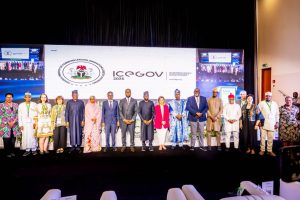
The National Information Technology Development Agency (NITDA) has pledged to implement key recommendations and global best practices from the 18th International Conference on Theory and Practice of Electronic Governance (ICEGOV 2025) to accelerate Nigeria’s digital transformation and strengthen its governance framework.
The week-long global conference, which opened on Monday and concluded on Friday in Abuja, brought together 508 participants, including 369 delegates, 308 authors, and 102 international participants from 51 countries. The event featured 151 academic and policy papers, out of which seven were accepted after a rigorous peer review process.
Held under the theme, “Shaping the Future of Digital Governance through Cooperation, Innovation, and Inclusion,” ICEGOV 2025 was jointly organized by the United Nations University Operating Unit on Policy-Driven Electronic Governance (UNU-EGOV) and NITDA, under the patronage of the Federal Ministry of Communications, Innovation and Digital Economy.
Speaking at the closing ceremony, the Special Assistant to the NITDA Director General on Innovation and Research, Lukman Lamid, said the conference aligns with President Bola Tinubu’s vision of improving governance and diversifying the economy through digital innovation.
“Having gathered experts and stakeholders from around the world for five days to develop research-based recommendations that can shape the future of digital governance is a major achievement. We at NITDA are committed to implementing some of these recommendations and best practices to ensure real impact on Nigeria’s digital economy,” Lamid said.
He noted that the agency plans to leverage outcomes from the conference to strengthen existing policy frameworks, expand broadband infrastructure, and enhance digital public infrastructure.
“We are building digital public infrastructure in Nigeria and working to strengthen broadband access. The Ministry of Communications, Innovation and Digital Economy is rolling out a 95,000-kilometre fibre optic project by 2027. This will ensure last-mile connectivity and broaden internet access, which will, in turn, stimulate economic growth,” Lamid added.
Director of UNU-EGOV, Delphine Soares, commended Nigeria’s growing commitment to digital transformation, noting that the country has become an active contributor to global digital governance conversations.
“The impact of this conference is visible at multiple levels from knowledge exchange and policy dialogue to strengthening networks and partnerships.
“Nigeria’s engagement shows the country’s steady progress in digital governance, which is evident from the number and quality of papers submitted and the enthusiasm of participants,” she said.
Similarly, Tomasz Jelowski of Gdańsk University of Technology, Poland, highlighted the importance of the conference in connecting researchers and policymakers from both the Global North and South.
“ICEGOV provides a unique platform that links research with policymaking, especially for developing countries. We hope this edition helps strengthen collaboration between African researchers and their counterparts across the world,” Jelowski stated.
The Program Chair for ICEGOV 2025 and Canada Research Chair in Governance and AI at Caltech University, Prof. Kure Sadegu Egaojo, said hosting the conference in Nigeria indicates the country’s readiness to lead the digital governance discourse in Africa.
“The government has provided a platform for dialogue on how emerging technologies like AI can transform governance. Africa must take ownership of its digital agenda by adapting global ideas to local realities and using technology to improve governance, economy, and citizens’ quality of life,” he said.
The ICEGOV conference, first established by the United Nations University in 2007, has become a leading international forum for academia, governments, civil society, and industry to exchange insights on how digital technologies can enhance governance and sustainable development.
📢 Follow National Periscope on WhatsApp
Get breaking news and updates directly on WhatsApp.
Join WhatsApp ChannelPost Disclaimer
All rights reserved. This material and other digital content on this website are not and do not represent the stance of National Periscope but the statements of newsmakers mentioned therein.
For your detailed news reportage... contact the Editor at Joel2oladele@gmail.com





MTN Nigeria has dismissed allegations of data “theft” by subscribers, Read more
The Nigerian Communications Commission (NCC), the United Nations Educational, Scientific Read more
CSO Demands Reversal of Telecom Tariff Hike The Grassroots Centre Read more
ICT Sector Contributes 15.97% To Nigeria’s Q3 GDP The Information Read more