

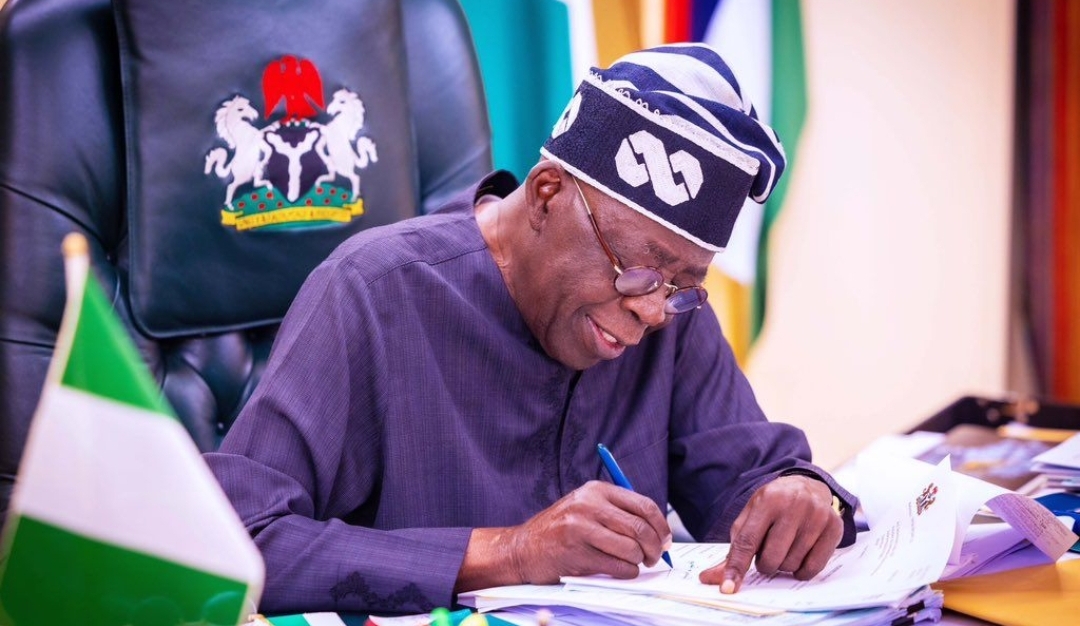
President Bola Tinubu has defended his administration’s decision to remove fuel subsidy, saying the policy rescued Nigeria from looming bankruptcy and laid the foundation for the country’s ongoing economic recovery.
The President spoke on Friday at his Ikoyi residence in Lagos while hosting governors from across the country who paid him a Sallah visit and joined him in marking the third anniversary of his administration.
According to a statement issued by his Special Adviser on Information and Strategy, Bayo Onanuga, Tinubu told the governors that although the subsidy removal sparked controversy and resistance at the outset, the reform had prevented a fiscal crisis and opened up new opportunities for growth.
“It was challenging at the time, but we survived. We faced litigation and accusations. We survived them. Instead of bankruptcy, Nigeria has survived. The economy has recovered. It is growing. Agriculture is booming,” the President said.
Among those present at the gathering were governors from Lagos, Nasarawa, Jigawa, Sokoto, Kebbi, Taraba, Niger, Ekiti, Delta, Ondo, Edo, Adamawa, Benue, Enugu, Ogun and Kogi states, alongside the deputy governors of Borno and Kano states.
Tinubu maintained that the subsidy regime had become unsustainable, consuming huge public resources while offering limited benefits to the majority of Nigerians. He noted that funds previously spent on subsidy payments were now being redirected to infrastructure development, agriculture, social investment programmes and other critical sectors.
The President commended state governors for helping to manage public expectations during the difficult transition period, saying their support helped sustain confidence in the reform agenda.
“I’m glad governors are no longer borrowing from the federal government and asking for interventions and not knowing how to survive, how to pay salaries, no more,” he said. “You persuaded our people to be patient and endure these three years of painful reform, during which we put the economy on a reset. Today, the benefits are showing.”
He pointed to improvements in key economic indicators, ongoing road construction projects and renewed investments in housing and agriculture as signs that the economy was gradually stabilising.
Tinubu also highlighted the potential of the Sokoto-Badagry Highway corridor, describing it as a strategic asset that could support irrigation, food production and electricity generation through the construction of dams along the route.
Vice President Kashim Shettima, in his remarks, praised the President for taking what he described as difficult but necessary decisions that previous administrations had avoided for decades.
“You chose not to postpone the surgery. You chose not to massage the wound. You chose to confront the contradictions that have held this country hostage for 50 years,” Shettima said.
Speaking on behalf of the Nigeria Governors’ Forum, Kwara State Governor AbdulRahman AbdulRazaq said the subsidy removal and accompanying fiscal reforms had significantly improved the financial standing of states.
He noted that many states which previously relied on loans and bond issuances to meet salary obligations were now experiencing greater fiscal stability and reducing their debt burdens.
“I think the nation was shocked by the audacity of Mr President to implement that serious policy, but today, it has benefited immensely from that policy,” AbdulRazaq said.
The governor also appealed for an upward review of the national minimum wage, urging the Federal Government to consider increasing it to at least N100,000.
Chairman of the Progressive Governors Forum and Governor of Imo State, Hope Uzodinma, described Tinubu’s performance as transformative, saying governors had independently assessed the administration and were satisfied with its direction.
“We have assessed your performance, Mr President, and I’m happy to announce that we have scored it 100 per cent,” Uzodinma declared.
Lagos State Governor Babajide Sanwo-Olu, who hosted the meeting, thanked his colleagues for their continued support for the President and urged them to sustain the momentum as the country moves towards another election cycle.
The removal of fuel subsidy, announced by Tinubu during his inauguration on May 29, 2023, remains one of the most far-reaching economic reforms undertaken by his administration. While the policy triggered a sharp rise in fuel prices and increased cost-of-living pressures, the Federal Government has consistently argued that it was necessary to stabilise public finances, boost revenue available to states and create room for long-term economic growth.
📢 Follow National Periscope on WhatsApp
Get breaking news and updates directly on WhatsApp.
Join WhatsApp ChannelPost Disclaimer
All rights reserved. This material and other digital content on this website are not and do not represent the stance of National Periscope but the statements of newsmakers mentioned therein.
For your detailed news reportage... contact the Editor at Joel2oladele@gmail.com

APC fires back at Gov Mutfwang over alleged printing, sharing Read more
Tinubu Splits Nigerian Aviation College Into Six Campuses Across Geo-political Read more
2027 Presidency: Four APC politicians that might work against Tinubu Read more
Fayose debunks rumoured resignation from PDP. Former Governor of Read more