

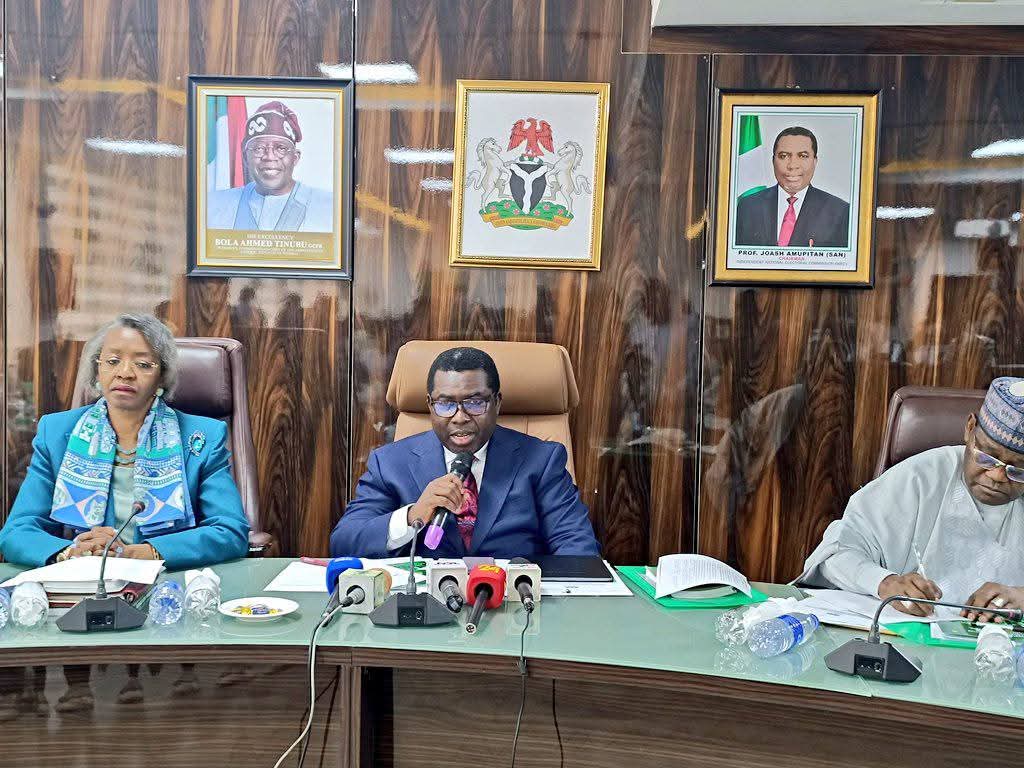
The Independent National Electoral Commission (INEC) has expressed concern over recent conflicting court rulings on its authority to determine election timetables, warning that the judgments could create uncertainty in preparations for the 2027 general elections if not resolved at the appellate level.
The Commission said it has already filed appeals to obtain authoritative judicial interpretation, even as it reaffirmed its commitment to conduct the 2027 elections in line with the Constitution, the Electoral Act, and valid court decisions.
INEC Chairman, Prof. Joash Amupitan, raised the issue on Tuesday in Abuja during the Second Quarterly Consultative Meeting with leaders of political parties, where he noted that recent rulings by the Federal High Court had produced differing interpretations of the Commission’s powers.
According to him, while one judgment questioned aspects of INEC’s timetable for the 2027 polls, another affirmed the Commission’s authority to issue an electoral schedule but struck out certain provisions relating to nomination and substitution of candidates.
Amupitan said the Commission respects the judiciary but must seek clarity to avoid disruptions to election planning.
“The Commission remains fully respectful of the decisions of the courts and of the judicial process generally,” he said, adding that the differing conclusions “raise important legal questions concerning the extent of the Commission’s constitutional and statutory powers in coordinating and regulating electoral activities.”
He warned that the absence of harmonised legal guidance on electoral timelines could undermine administrative planning for the polls, noting that election activities are interlinked processes requiring strict coordination.
INEC, he explained, is already dealing with a broad range of operational responsibilities for the 2027 elections, including party primaries monitoring, nomination processing, ballot production, logistics, voter education, and deployment of sensitive materials.
The Commission also reiterated its position that while the Electoral Act provides timelines for some electoral activities, several critical processes are not explicitly time-bound, making a comprehensive timetable essential to avoid confusion.
Amupitan maintained that the Commission’s approach is designed to ensure transparency, efficiency, and equal treatment of all political actors.
The INEC Chairman also used the meeting to highlight ongoing preparations for upcoming elections, including the Ekiti State governorship poll scheduled for June 20, 2026, and the Osun governorship election slated for August 15, 2026. He said preparations were progressing on schedule, including logistics, voter register updates, and deployment of election technology.
He disclosed that the voter register for Ekiti now stands at 1,059,360, following the addition of new registrants and the removal of invalid entries from duplicate registrations.
Amupitan further announced that political parties would receive access codes on June 26, 2026, to begin uploading candidate information for the 2027 elections through INEC’s nomination portal, urging strict compliance with deadlines.
He also stressed the importance of ongoing Continuous Voter Registration, urging political parties to intensify mobilisation efforts to ensure eligible Nigerians participate in the democratic process.
On his part, the National Chairman of the Inter-Party Advisory Council (IPAC), Dr Yusuf Mamman Dantalle, acknowledged the consultative platform but warned that the electoral environment continues to face structural and legal challenges, particularly in the conduct of party primaries for the 2027 elections.
Dantalle said provisions of the Electoral Act 2026 had created operational difficulties for political parties, especially restrictions limiting nomination methods to direct or consensus primaries.
He argued that the removal of indirect primaries had led to internal disputes, litigation, and financial strain on parties, calling for a review of the law to strengthen internal party democracy.
He also raised concerns over conflicting court rulings on INEC’s regulatory powers, warning that such inconsistencies risk undermining public confidence in the electoral system.
IPAC urged the National Assembly and relevant stakeholders to review contentious provisions of the Electoral Act to enhance clarity, participation, and stability in the electoral process.
The council also called on political actors to avoid violence and ensure issue-based campaigns as Nigeria moves closer to the 2027 general elections.
INEC, however, assured political parties that despite legal and operational challenges, it remains committed to delivering credible, transparent, and inclusive elections.
📢 Follow National Periscope on WhatsApp
Get breaking news and updates directly on WhatsApp.
Join WhatsApp ChannelPost Disclaimer
All rights reserved. This material and other digital content on this website are not and do not represent the stance of National Periscope but the statements of newsmakers mentioned therein.
For your detailed news reportage... contact the Editor at Joel2oladele@gmail.com






INEC Fixes Dates for Ekiti, Osun Guber Elections, Swears in Read more
Fire Ravages INEC's Ika North East Office, Election Materials Destroyed Read more
[caption id="attachment_25304" align="alignnone" width="2560"] Representative of the INEC Chairman, Prof. Read more
APC May Lose Kwara If 2027 Ticket Goes to North, Read more