

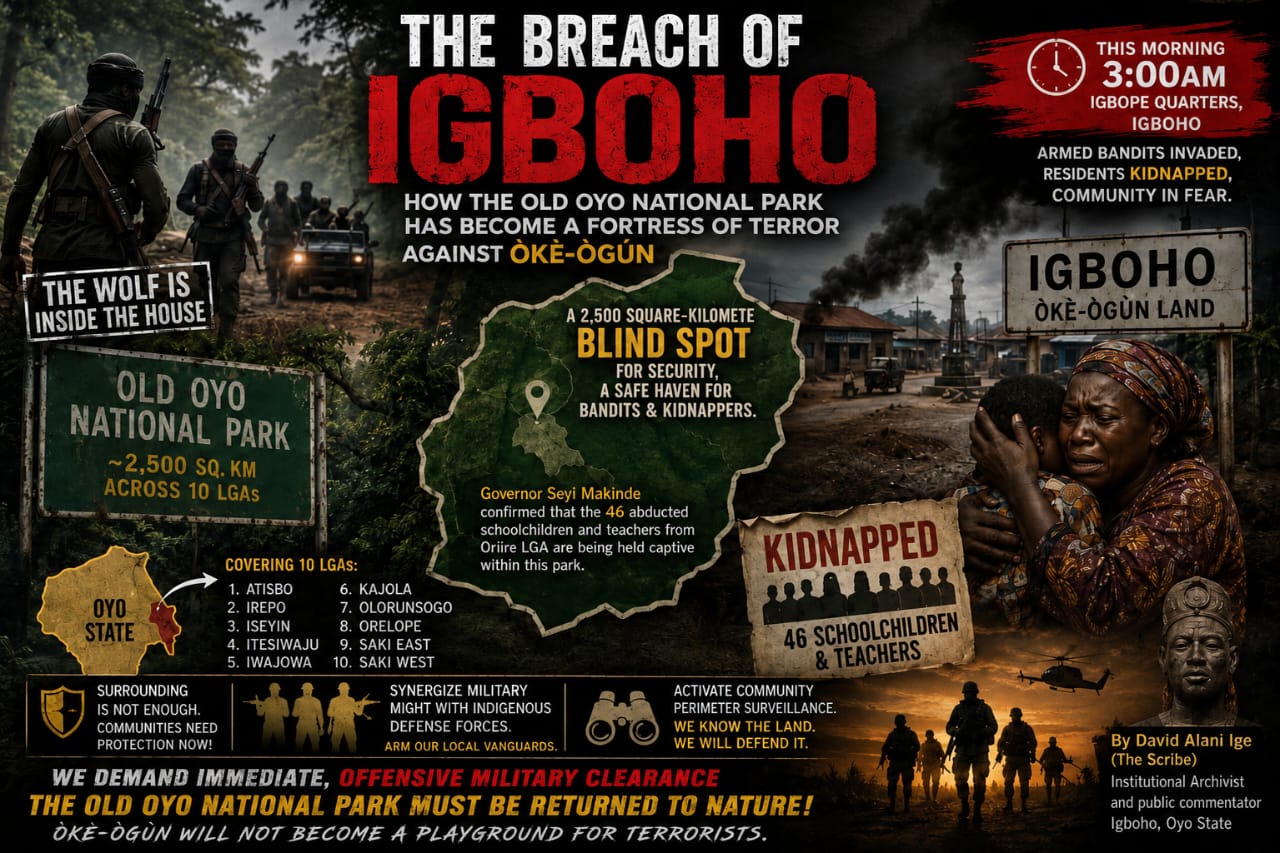
The terrifying news of armed bandits invading Igbope quarters in Igboho this morning has violently shattered whatever fragile illusion of safety we had left in Òkè-Ògùn. The attackers reportedly infiltrated the community through the fringes of the Old Oyo National Park, kidnapping residents and plunging the historic town of Igboho into severe vulnerability.
For the people of Òkè-Ògùn, this is no longer a distant crisis; the wolf is officially inside the house.
While security agencies claim to have “surrounded” the park, the geopolitical and administrative reality is that reactive measures are failing to protect our citizens. This morning’s invasion of Igboho is a direct, tragic consequence of a much larger, unchecked crisis festering within the forest’s depths.
The 2,500 Square-Kilometre Blind Spot
We must speak the truth without political window dressing. The Old Oyo National Park, a historic expanse of land meant for ecological preservation, has been forcefully converted into a sovereign operational base for armed syndicates and kidnappers.
Just days ago, the Executive Governor of Oyo State, Engineer Seyi Makinde, confirmed in his official newsletter that the bandits who abducted 46 schoolchildren and teachers from Oriire Local Government Area over a month ago are currently holding them captive within this exact park. The state government acknowledged that the park covers an estimated 2,500 square kilometres across 10 local governments, presenting a massive operational nightmare for official security forces.
But understanding the “scale of the challenge” does not stop the bleeding. If the state knows that heavily armed bandits are using the park as a safe haven, why are border communities like Igboho left exposed to their inevitable spillover?
The Urgent Need for Localized Defense Operations
Surrounding the park from the outside is a containment strategy, but it does not protect the soft targets living on the immediate borders. The invasion of Igbope proves that the bandits are testing our perimeters, gathering supplies, and taking hostages at will.
If the conventional security architecture is slowed down by the vast terrain of the Old Oyo National Park, the state must immediately authorize and heavily arm our local vanguards. Men who know the ancient hunting routes, the topography, and the hidden trails of the forest must be legally integrated into the frontline assault.
Recently, Chief Sunday Adeyemo formally offered the services of his Iru Ekun Security Network to help protect vulnerable targets across the state. The time for bureaucratic hesitation is over. The state government must synergize conventional military might with indigenous defense forces immediately.
To the elders, traditional rulers, and the youth vanguards of Òkè-Ògùn: Our survival is now entirely in our hands. The intelligence is clear—the bandits are sleeping in our backyard. We must immediately activate community-led perimeter surveillance across all towns sharing boundaries with the Old Oyo National Park.
We demand immediate, offensive military clearance of the forest reserve. The Old Oyo National Park must be returned to nature, and the bloodthirsty tenants occupying it must be flushed out permanently. Òkè-Ògùn will not become a playground for terrorists.
David Alani Ige
Institutional Archivist and public commentator
Igboho, Oyo State
📢 Follow National Periscope on WhatsApp
Get breaking news and updates directly on WhatsApp.
Join WhatsApp ChannelPost Disclaimer
All rights reserved. This material and other digital content on this website are not and do not represent the stance of National Periscope but the statements of newsmakers mentioned therein.
For your detailed news reportage... contact the Editor at Joel2oladele@gmail.com







Amotekun nabs, parades 62 suspected criminals in Ondo The Ondo Read more
JUST IN: Kidnappers invade Army Estate in Abuja, abduct two, Read more
[caption id="attachment_23590" align="alignnone" width="720"] Yisa Usman[/caption] There are defining moments Read more
Atiku blames insecurity on worsening poverty, hunger in the land Read more