

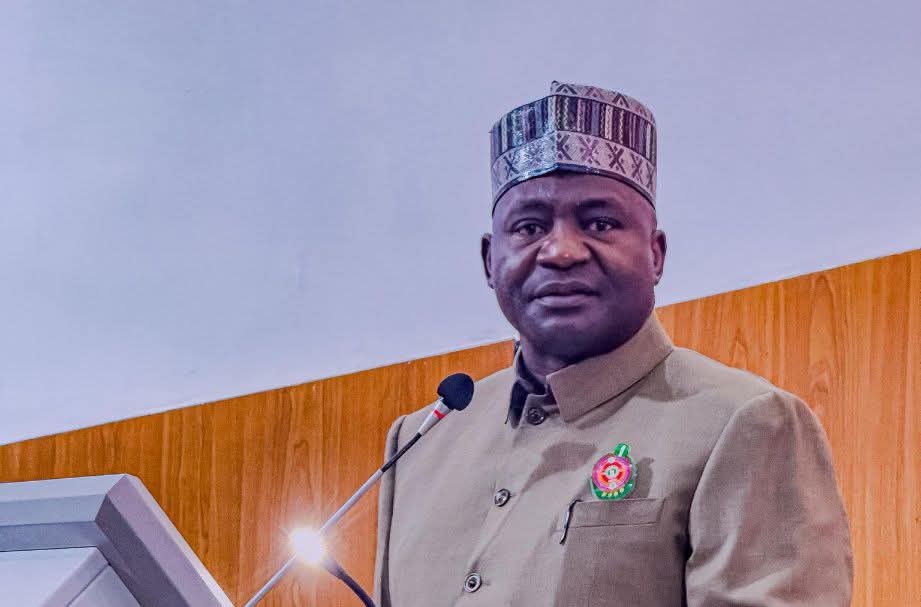
The Federal Government has urged Nigerian women to seek greater leadership roles and play a more active part in national security, saying their knowledge, experience and participation are vital to addressing the country’s complex security challenges.
The Minister of Defence, General Christopher Musa, made the call on Friday at the Inclusion and National Security Summit 2026 organised by the ITeach Africa Initiative and Empower Her for Governance Initiative in Abuja.
Musa, represented by his Gender Adviser, Lt. Col. Nneka Olimma, said the changing nature of insecurity required the country to broaden its approach beyond conventional military responses.
He said contemporary threats, including terrorism, violent extremism, kidnapping, communal conflicts, organised crime, cybercrime and disinformation, demanded closer cooperation among security agencies, communities and other stakeholders.
The minister, whose address was titled “Beyond the Battlefield: Building a Secure and Inclusive Nigeria Through Strategic Leadership,” said national security encompassed much more than troop deployment and territorial defence.
According to him, security also affects schools, homes, communities, institutions, the economy and the digital environment, making prevention, resilience, good governance, justice, opportunity and inclusion important components of the national security framework.
Musa said women should be regarded as partners in finding solutions to insecurity rather than only as victims of its consequences.
“Women are not only affected by insecurity, women are also part of the solution,” he said.
He noted that women served as professionals, members of the armed forces, community leaders, peace builders, educators and entrepreneurs, adding that their proximity to families and communities positioned them to contribute to early warning and conflict prevention.
The minister said security agencies could not be physically present in every community at all times, making information from local communities crucial to identifying tensions before they escalated into violence.
He called for a shift from a largely reactive approach to security towards a preventive model that listens to communities and responds to grievances before they are exploited by criminal and extremist groups.
“We must listen before the conflict escalates. We must engage before grievances become violence. We must intervene before vulnerable people are recruited or exploited by criminals and extremist networks,” he said.
Musa also advocated stronger representation of women in decision-making, arguing that excluding them reduced the range of ideas and capabilities available to the country in confronting complex national challenges.
He said women already made valuable contributions to the Nigerian Armed Forces in operational, medical, technical, administrative and professional capacities.
He stressed that efforts to increase women’s participation must, however, be anchored on competence, discipline, professionalism and accountability.
“Inclusion must always be accompanied by professionalism, competence, discipline and accountability,” the minister said.
Musa also encouraged more women to join the armed forces, noting that female participation in recruitment exercises remained low.
He urged women aspiring to leadership positions to prepare themselves through education, professional development, integrity and experience, stressing that inclusion should be matched by the capacity to deliver in office.
The minister further called for closer collaboration among the military, other government institutions, state governments, traditional rulers, civil society organisations, communities and international partners.
He said no single agency or institution could address all of Nigeria’s security challenges alone.
“No single institution has all the answers. No single agency can confront every threat. And no single group can build a secure Nigeria alone,” he said.
Also speaking, the Head of the Civil Service of the Federation, Mrs Didi Esther Walson-Jack, represented by the Permanent Secretary, Career Management Office, Office of the Head of the Civil Service of the Federation, Mrs Nkiruka Jones-Nebo, said women’s participation in governance should be viewed as a means of strengthening national effectiveness.
Walson-Jack said women across the Federal Civil Service were contributing to institutional reforms and public service delivery, but stressed the need to create structures that would enable more women to progress into leadership.
She identified mentoring, leadership development, transparent career opportunities and supportive workplace policies as some of the measures required to remove barriers to women’s advancement.
She also called for stronger implementation of United Nations Security Council Resolution 1325 on Women, Peace and Security, saying women should have meaningful roles in peacebuilding and security decision-making.
According to her, institutions should move beyond celebrating a few successful women and establish systems that allow more women to develop, advance and lead.
The Director-General of ITeach Africa Initiative and Empower Her for Governance Initiative, Mrs Ebimoboere Alaibe Elezieanya, said the summit was organised against the backdrop of persistent insecurity, including kidnapping, banditry, terrorism, violent attacks, farmer-herder conflicts and organised crime.
Elezieanya said insecurity had inflicted enormous human and economic costs on communities, leaving families displaced, livelihoods destroyed and communities struggling to rebuild trust.
She maintained that inclusion was essential to national security because people within communities often possessed information that could help security agencies detect threats early.
According to her, a farmer, teacher, traditional ruler or woman in a community could identify warning signs that might not be immediately visible to formal security structures.
“A nation is safest when its people feel they have a stake in its peace, a voice in its future, and a role in its survival,” she said.
She called for stronger cooperation between government, security institutions, communities, civil society, the private sector and young people in developing responses to insecurity.
The summit brought together women leaders, policymakers, civil society organisations, development partners, youth advocates and other stakeholders to discuss women’s representation in governance, diplomacy, public service, peacebuilding and national security.
The organisers said the engagement was aimed at developing practical strategies for advancing women’s leadership and participation in decision-making in line with the Renewed Hope Agenda of President Bola Tinubu.
📢 Follow National Periscope on WhatsApp
Get breaking news and updates directly on WhatsApp.
Join WhatsApp ChannelPost Disclaimer
All rights reserved. This material and other digital content on this website are not and do not represent the stance of National Periscope but the statements of newsmakers mentioned therein.
For your detailed news reportage... contact the Editor at Joel2oladele@gmail.com




FG hints on creating state police to curb insecurity The Read more
Reports that a family abducted by kidnappers in Igboho, Oyo Read more
FG rescued over 1000 abductees without ransom – Ribadu The Read more
Air Force Destroys Terror Logistics Hub Linked to April 9 Read more