

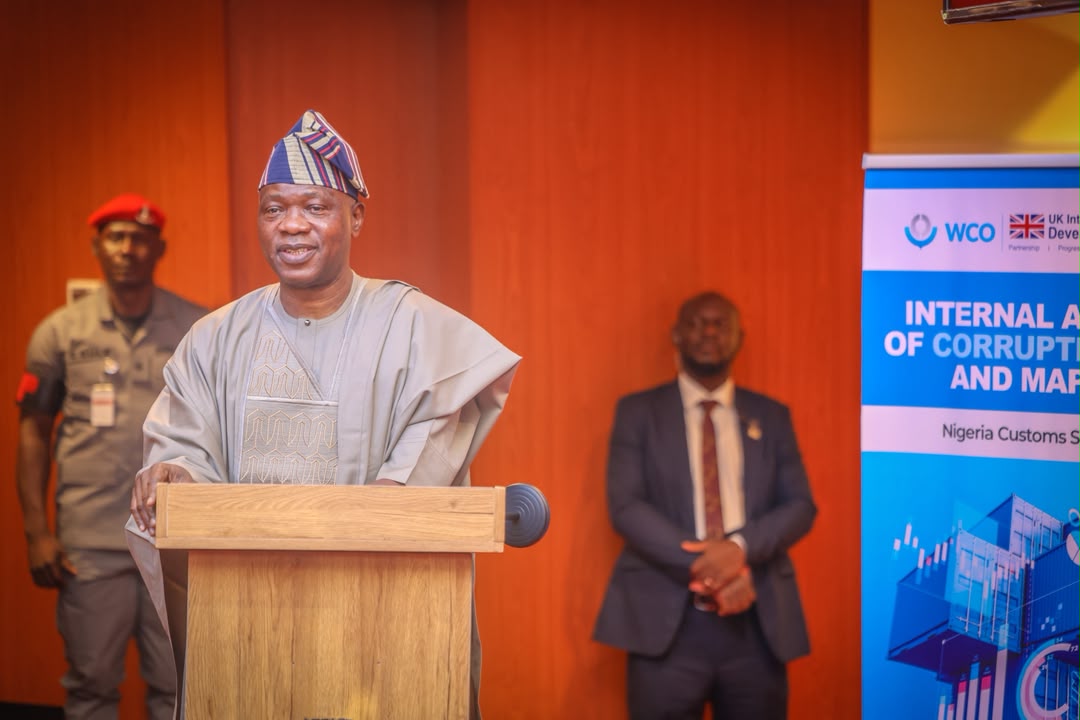
The Nigeria Customs Service (NCS) has stepped up efforts to strengthen its internal anti-corruption mechanisms through a partnership with the World Customs Organisation (WCO) and UK International Development, focusing on corruption risk mapping and the development of Standard Operating Procedures (SOPs).
The initiative is aimed at identifying vulnerabilities across Customs operations and putting preventive measures in place to reduce opportunities for corruption, improve accountability and strengthen public confidence in the Service.
Speaking at the closing ceremony of a workshop held on Friday, August 21, 2026, at the NCS Headquarters in Maitama, Abuja, the Comptroller General of Customs, Adewale Adeniyi, described the exercise as an important step in strengthening institutional integrity and improving the Service’s approach to corruption risk management.
Adeniyi stressed that the assessment was not intended to find fault or apportion blame, but to enable the Service to examine its processes, identify weaknesses and develop lasting solutions.
He said the exercise covered several critical areas of Customs operations, including regulatory and administrative procedures, cargo clearance, inspection and examination, enforcement and compliance, procurement and human resource management.
“The purpose of what we have therefore been doing with our partners was to identify such areas of vulnerabilities, assess the associated risk and develop practical measures to mitigate them,” the CGC said.
The Customs boss said the Service remained committed to strengthening transparency, accountability and internal controls while simplifying procedures and deploying technology to reduce unnecessary discretion in its operations.
According to him, making Customs processes more predictable and transparent would not only improve internal governance but also facilitate legitimate trade and encourage compliance among businesses.
“A customs administration that is transparent, that is predictable and accountable, is better positioned to facilitate legitimate trade, improve compliance, and enhance public confidence,” Adeniyi said.
The workshop forms part of broader efforts by the NCS and its international partners to adopt a preventive approach to corruption by identifying risks before they translate into misconduct or institutional weaknesses.
The WCO Lead Technical Expert under the Accelerate Trade Facilitation Programme, Arman Zhalitov, commended Adeniyi for his support for the initiative and urged members of the working group to ensure that the outcomes of the workshop were formally endorsed and implemented.
Zhalitov said the next stage should focus on translating the findings into a comprehensive action plan containing clear measures for strengthening trade facilitation and advancing the Service’s anti-corruption agenda.
Also speaking, the WCO Programme Manager for the Accelerate Trade Facilitation Programme, David Tanenbaum, highlighted progress recorded in areas including Authorised Economic Operator (AEO), post-clearance audit and the time-release study.
Tanenbaum said the progress demonstrated that the partnership between the Customs Service and its international partners was producing practical institutional and operational results.
He stressed that integrity could not be treated as an isolated issue, noting that it had to be embedded across Customs processes and reforms.
“Our work continues to bring us closer to a systematic, preventive approach to identifying and managing corruption risks within customs operations,” he said.
The partnership with the WCO and UK International Development is expected to support the NCS in developing stronger institutional safeguards while improving the efficiency and predictability of Customs procedures.
The Service said the exercise would also contribute to strengthening internal controls and reducing areas of excessive discretion, particularly through process simplification and greater use of technology.
The initiative comes as Customs continues to pursue reforms aimed at improving trade facilitation, strengthening compliance and modernising its operations.
The NCS leadership said sustained collaboration with international partners remained important to building a Customs administration that combines revenue mobilisation and enforcement with transparency, efficiency and accountability.
📢 Follow National Periscope on WhatsApp
Get breaking news and updates directly on WhatsApp.
Join WhatsApp ChannelPost Disclaimer
All rights reserved. This material and other digital content on this website are not and do not represent the stance of National Periscope but the statements of newsmakers mentioned therein.
For your detailed news reportage... contact the Editor at Joel2oladele@gmail.com





ICPC Recovers Alleged Wiretapping Devices From El-Rufai’s Abuja Home The Read more
[caption id="attachment_25332" align="alignnone" width="1080"] Some of the shortlisted candidates undergoing Read more
ICPC Secures Conviction of Lagos Civil Servant Over Double Salary Read more
[caption id="attachment_25380" align="alignnone" width="1080"] 11 newly inducted members of the Read more