
The Socio-Economic Rights and Accountability Project (SERAP) and the Nigerian Guild of Editors (NGE) have warned the National Assembly that they will consider legal action if the proposed Foreign Aids (Regulation, Transparency and Disclosure) Bill, 2026, is passed despite concerns that it could undermine civic space and media freedom.
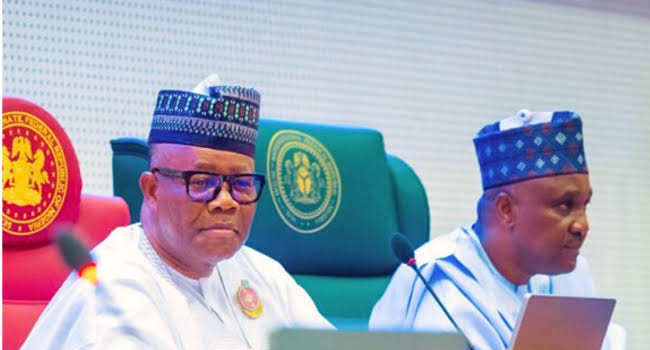
The organisations made the position known in a joint open letter dated August 29, 2026, and addressed to Senate President Godswill Akpabio and Speaker of the House of Representatives, Tajudeen Abbas.
They called on both presiding officers to reject and withdraw the bill, arguing that it would give the government sweeping powers to regulate civil society organisations, independent media, religious and humanitarian organisations and other private entities receiving foreign assistance.
The bill, sponsored by Senator Ibrahim Dankwambo (PDP, Gombe North), proposes mandatory registration and disclosure requirements for organisations receiving foreign assistance.
It also provides for sanctions, including a minimum fine of N20 million for civil society organisations and private entities, as well as possible suspension or revocation of operating licences.
SERAP and NGE said the bill was unnecessary and would create an additional layer of regulation over organisations already subject to existing financial, corporate and anti-corruption laws.
“Although the Bill is presented in the guise of promoting transparency, it would establish an extensive framework for governmental control over civil society organisations and private entities receiving foreign assistance,” the organisations said.
They argued that Nigeria already had several agencies with statutory responsibilities covering corporate registration, financial reporting, taxation, anti-money laundering and anti-corruption enforcement.
The organisations listed the Corporate Affairs Commission, Economic and Financial Crimes Commission, Special Control Unit against Money Laundering, Nigerian Financial Intelligence Unit and Federal Inland Revenue Service among the bodies currently performing such functions.
According to SERAP and NGE, the bill does not demonstrate that these institutions are incapable of carrying out their responsibilities or that a regulatory gap exists that warrants the creation of another agency.
They particularly faulted the proposed Foreign Aid Regulatory Commission (FARC), which would have powers to register NGOs, civil society organisations and private entities receiving foreign assistance, compel information, inspect records, investigate activities, monitor the use of funds, issue directives and impose administrative sanctions.
The groups said the proposed powers went beyond ordinary financial regulation and could expose legitimate organisations to intrusive government supervision.
They warned that independent media organisations could be particularly vulnerable because many rely on foreign grants and other forms of assistance to fund investigative journalism, fact-checking, journalist safety and media development projects.
“Subjecting independent media and other civil society organisations and private entities to an additional executive-controlled regulatory regime would increase governmental leverage over their operations, place pressure on independence and create conditions conducive to self-censorship,” they said.
The organisations also raised concerns over provisions requiring recipients of foreign assistance to disclose information about the source and amount of funding, conditions attached to the assistance and implementing partners.
Such information, they said, would be placed on a public National Foreign Aid Register.
They argued that the proposed requirements could affect a broad range of organisations, including labour unions, professional associations, universities, research institutes, religious and humanitarian bodies, technology hubs and other entities receiving foreign grants, donations, technical assistance or development funding.
SERAP and NGE also criticised provisions requiring foreign-funded projects to align with government-defined national development priorities and subjecting recipients to annual audits.
They said the combination of mandatory registration, extensive disclosure requirements, inspection powers and severe sanctions would impose a disproportionate burden on legitimate organisations.
The groups further objected to what they described as vague terms in the bill, including “foreign aid”, “national priorities” and “public interest”.
They argued that the absence of clear definitions and objective standards could create room for arbitrary or selective enforcement.
According to the organisations, the proposed legislation would conflict with constitutional protections for freedom of expression and association.
They cited Sections 39 and 40 of the Nigerian Constitution, as well as provisions of the African Charter on Human and Peoples’ Rights and the International Covenant on Civil and Political Rights.
The organisations maintained that any restriction on freedom of expression, association and media freedom must be lawful, necessary and proportionate in a democratic society.
They also warned that excessive regulation of civil society could have consequences beyond the organisations themselves by limiting avenues through which citizens organise, raise concerns, defend rights and participate in public affairs.
SERAP and NGE said the concerns were particularly significant as Nigeria approaches the 2027 general elections.
They pointed to what they described as a shrinking civic space, citing the increasing use of criminal defamation and cybercrime laws against journalists and activists, arbitrary arrests over peaceful expression and strategic lawsuits against public participation.
They urged lawmakers not to introduce legislation that could further restrict democratic participation or weaken independent scrutiny of government.
“Enabling and protecting freedom of association is essential to addressing Nigeria’s challenges and to the realisation of civil, political, economic, social and cultural rights,” they said.
The organisations called on the National Assembly to withdraw the bill and publicly commit not to reintroduce legislation that unjustifiably restricts civic space, media freedom or the legitimate activities of civil society and private entities.
They also urged lawmakers to prioritise legislation that strengthens transparency, accountability, media freedom and civic participation while creating an enabling environment for independent organisations.
SERAP and NGE said the National Assembly must uphold its constitutional responsibility to protect democracy, the rule of law, human rights and fundamental freedoms.
They warned that if the bill is passed despite the constitutional and human rights concerns raised, they would consider challenging it in court.
“Should the Bill be passed into law despite the serious constitutional and human rights concerns raised, SERAP and NGE will consider taking all appropriate legal action in the public interest to challenge it and protect freedom of association, media freedom and civic participation,” they said.
📢 Follow National Periscope on WhatsApp
Get breaking news and updates directly on WhatsApp.
Join WhatsApp ChannelPost Disclaimer
All rights reserved. This material and other digital content on this website are not and do not represent the stance of National Periscope but the statements of newsmakers mentioned therein.
For your detailed news reportage... contact the Editor at Joel2oladele@gmail.com



CSOs Demand Akpabio's Resignation over Electoral Fraud Judgement JOEL OLADELE, Read more
KDI Advocates Electoral Reforms Ahead of 2027 Elections ….Says only Read more
[caption id="attachment_26412" align="alignnone" width="1280"] ACOE Chairman, Comrade Shola Akingboye(2nd from Read more
JOEL OLADELE, Abuja [caption id="attachment_21689" align="alignnone" width="1280"] Comptroller-General of the Read more