

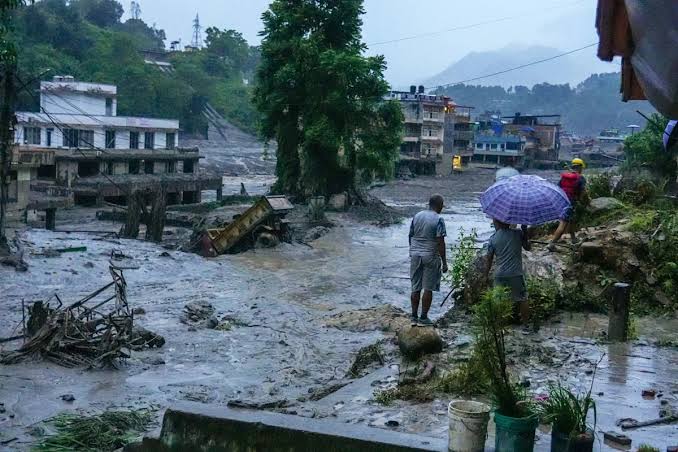
The death toll from last week’s devastating floods in Nepal has climbed to 1,222, while 4,875 people remain missing.
Rescue teams have continued their search for survivors and victims, one week after the disaster swept through several communities.
Nepal Police and the National Disaster Risk Reduction and Management Authority reported the latest figures.
Chitawan recorded the highest number of deaths, with 348 bodies recovered so far. Nawalparasi East followed with 218 deaths, while Nawalparasi West recorded 208.
Authorities also recovered 155 bodies in Nuwakot and 127 in Rasuwa. Gorkha recorded 69 deaths, while Dhading and Tanahu recorded 60 and 38 respectively.
The huge number of missing persons has complicated the search operation. Among those still unaccounted for are 583 foreigners.
Floodwaters destroyed roads, bridges and communication networks across several areas, making access difficult for rescue teams.
The Nepal Army and other security agencies have rescued 11,993 people by helicopter and through land operations.
Authorities have deployed about 21,314 security personnel for search and rescue efforts. The disaster has also left thousands of survivors struggling to access essential services.
In Bidur on Wednesday, residents used a temporary cable crossing over the swollen Trishuli River. Floodwaters destroyed roads and bridges linking the affected communities.
The Nepal Army installed the roughly 250-metre cable to restore a vital crossing. Residents and soldiers now use the structure to transport people, medicines, food and other essential supplies.
Medical emergencies have also forced residents to rely on the crossing to reach treatment centres. The disaster has extended beyond Nepal into China’s Tibet region near the Nepal border.
Chinese authorities reported 21 deaths in Gyirong county, while 541 people remain missing. China reopened the highway leading to the Gyirong border crossing on Wednesday.
Floodwaters had destroyed sections of the road, cutting off access to the disaster zone. The reopening has allowed heavy rescue equipment to reach the affected area.
Search teams have since deployed life-detection devices and sniffer dogs to assist the operation. India has also expanded its humanitarian response to the disaster.
The country sent a fifth aircraft to Nepal carrying an 11-member rescue team and specialised equipment.
The aircraft also delivered 5.5 tonnes of essential medicines, according to India’s Ministry of External Affairs. The scale of the disaster has raised fresh concerns about development and environmental practices in the Himalayan region.
Environmentalist Sunita Narain linked the devastation to decades of intensive intervention in rivers and mountain ecosystems. She particularly pointed to extensive hydropower development and attempts to continually reshape natural waterways.
Rescue teams now face the difficult task of searching remote areas while restoring access to isolated communities. With thousands still missing, authorities say the full human cost of the floods remains unclear.
📢 Follow National Periscope on WhatsApp
Get breaking news and updates directly on WhatsApp.
Join WhatsApp ChannelPost Disclaimer
All rights reserved. This material and other digital content on this website are not and do not represent the stance of National Periscope but the statements of newsmakers mentioned therein.
For your detailed news reportage... contact the Editor at Joel2oladele@gmail.com





WHO asks China for more details on unexplained pneumonia outbreak Read more
The United Nations General Assembly has backed a new world Read more
US President Joe Biden impeachment inquiry approved in House of Read more
Georgian MP punched by opposition leader as fight breaks out Read more