

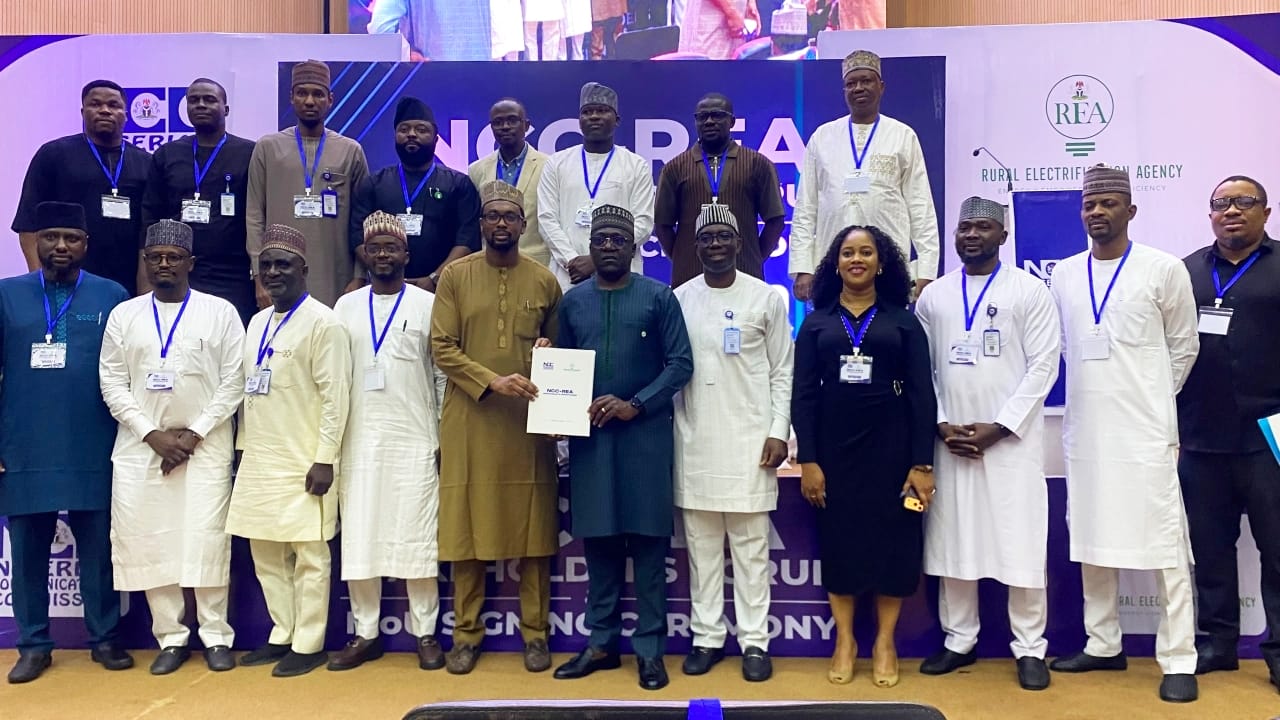
The Nigerian Communications Commission (NCC) and the Rural Electrification Agency (REA) have entered into a partnership aimed at expanding telecommunications services in rural and underserved communities by integrating renewable energy infrastructure with telecom networks.
The collaboration, formalised through a Memorandum of Understanding (MoU) signed at the NCC-REA Stakeholder Forum in Abuja on Friday, is expected to reduce reliance on diesel-powered base stations while improving network availability through the use of mini-grids.
The forum, themed “Unlocking the Energy–Telecoms Nexus for Scalable Digital Infrastructure in Nigeria,” attracted government officials, telecom operators, tower companies, renewable energy developers, financiers, development partners and investors to discuss ways of aligning electricity and telecommunications infrastructure.
Speaking at the event, the Executive Commissioner, Technical Services at the NCC, Engr. Abraham Oshadami, described electricity and telecommunications as two sectors that are inseparable in driving Nigeria’s digital economy.
He noted that telecommunications infrastructure depends on stable electricity to function, while electricity services increasingly rely on digital platforms for metering, payments and customer access.
According to him, the partnership will enable both agencies to maximise existing infrastructure by connecting telecom base stations located near existing and planned mini-grids.
“Where you have mini-grids, we’re able to identify base stations that are close to them so that we’ll be able to take electricity supply from those closest mini-grids,” Oshadami said.
He explained that the arrangement would ensure uninterrupted connectivity in communities that are not connected to the national grid, allowing residents to remain digitally connected while benefiting from renewable energy projects.
Oshadami said implementation of the agreement would commence immediately because priority locations had already been identified.
“The MoU has made provision for everybody who knows their responsibility. It’s all spelt out in that MoU. So it’s immediate effect,” he said.
He added that future rural electrification projects would also take telecommunications infrastructure into account, making connectivity a key consideration in the deployment of new mini-grids.
Also speaking, the Executive Director, Technical Services at the REA, Engr. Umar Abdullahi, said the agreement marked a new phase of cooperation between both organisations after years of operating independently.
According to him, the partnership creates a common framework that will allow both agencies to align their projects and achieve greater impact.
“Prior to today, both agencies, NCC and REA, have been working in silos. By signing this MoU, we came together to have one agenda so that all our efforts are complementing each other,” Abdullahi said.
He disclosed that implementation would be guided by data-driven planning, including mapping telecommunications coverage against electricity infrastructure to identify viable locations for joint projects.
Abdullahi said an NCC-REA Collaboration Committee had already been established to coordinate implementation, evaluate pilot projects and recommend strategies for nationwide deployment.
He added that one of the immediate priorities would be migrating telecom towers currently powered by diesel generators to cleaner and more affordable energy supplied through mini-grids.
“We are trying to move them to be powered by mini-grids. That way we are having cheaper and cleaner energy and this will bring down the cost of operation of these towers and also be able to expand coverage to Nigerians that are served and underserved,” he said.
The partnership builds on ongoing efforts by the NCC-REA Collaboration Committee to identify opportunities for coordinated infrastructure planning, renewable energy integration and infrastructure sharing.
Both agencies said the initiative is expected to improve the sustainability of telecommunications operations, lower operating costs for network providers and accelerate connectivity in unserved and underserved areas.
They added that the collaboration reflects a broader government strategy to integrate critical infrastructure projects in support of digital inclusion, economic growth and the expansion of Nigeria’s digital economy.
📢 Follow National Periscope on WhatsApp
Get breaking news and updates directly on WhatsApp.
Join WhatsApp ChannelPost Disclaimer
All rights reserved. This material and other digital content on this website are not and do not represent the stance of National Periscope but the statements of newsmakers mentioned therein.
For your detailed news reportage... contact the Editor at Joel2oladele@gmail.com






Stakeholder debunks rumoured job loss with AI adoption A digital Read more
FG Plans Cross-Border Telecom Expansion to Strengthen Security, Reduce Data Read more
MTN Suspends Xtratime Credit Service to Align with New Lending Read more
Foreign Affairs Minister mulls Nigeria-Qatari synergy for global clean energy Read more