

An 18-year-old technology entrepreneur, Georgia Oviesu, has unveiled SafeLink, an emergency communication app that allows users to send distress alerts without internet connectivity.
Oviesu, a Nigerian-German recording artiste who performs as Gia Réi, demonstrated the Android application on recently at the Radisson Blu Anchorage Hotel, Victoria Island, Lagos State.
SafeLink uses Bluetooth Low Energy (BLE) mesh technology to connect nearby devices directly. It does not depend on Wi-Fi, mobile networks or internet access to transmit emergency messages.
The app can send SOS alerts to nearby devices and notify people within the area when a user is in distress. It can also transmit the user’s location and coordinates to registered rescuers.
SafeLink can resend emergency alerts repeatedly for up to 30 minutes. It also allows users to provide personal information that registered rescuers can access when an SOS alert is triggered.
Oviesu said the technology addresses the gap between the occurrence of an emergency and the arrival of help.
“Every year millions of people around the world lose their lives to natural disasters, kidnappings, building collapse,” she said.
She said Nigeria’s insecurity and recurring emergencies had reinforced the need for faster ways to alert people and authorities when conventional communication channels fail.
The app could support emergency situations including building collapses, natural disasters, seizures, heart attacks, strokes and other medical incidents.
How SafeLink works
During the presentation, Oviesu used the example of Segun, a Nigerian father of two, to demonstrate the application’s potential use.
In the scenario, a building collapses while Segun is at work, trapping him inside and preventing him from shouting or making a conventional phone call.
SafeLink would allow his phone to send an SOS alert through Bluetooth to compatible devices within range.
People who receive the alert could then contact rescuers, security agencies or other relevant authorities.
Oviesu said the community-based approach could strengthen emergency response by turning nearby devices into part of a local communication network.
“Everybody in your vicinity can be able to receive your message, your SOS message,” she said.
She added that the alert would not remain hidden from people within the network, allowing someone nearby to recognise the distress signal and seek help.
“The thing is that every single Nigerian can have this app,” she said.
The presentation also examined possible applications in rural communities where internet access may be unreliable.
Participants, including George Uwaifo, IT Chief Technology Officer of Giteksol Solutions Limited, raised questions about how the technology could assist people facing kidnapping and other security threats.
Oviesu said she envisaged partnerships with police stations, security agencies and other relevant institutions. Such partnerships, she said, could help route emergency alerts to authorities.
Calls for partnerships
The young developer appealed to Nigerians, government agencies and potential partners to support the development and deployment of SafeLink.
She said the project should focus on helping vulnerable people rather than operating solely for profit.
“This is meant to help the poor, people who need saving,” she said.
Oviesu said her interest in developing the application grew from her exposure to computer science, coding and computational thinking through the International Baccalaureate programme.
She later learned Kotlin during an internship. She then used a compulsory school application project to develop a technology aimed at addressing a real-world problem.
“In my course, we have to create an app, every single one of us, every student in my grade. We have to create an app,” she said.
Open to criticism
Questions were also raised about ownership of the technology and possible partnerships with government institutions.
Sumbo Ojukotola, Deputy Director, Special Correctional Centre for Girls, asked how Oviesu would protect the innovation when working with government agencies and other partners.
Oviesu said she welcomed criticism and collaboration as part of the development process.
“Development without criticism is not development. It’s just you withholding your idea,” she said.
“I am very young. I’m 18 years old. I can’t know everything.”
She also addressed concerns over false SOS alerts and urged users not to attempt dangerous rescues themselves.
Instead, she advised people who receive emergency alerts to contact appropriate authorities or trained rescuers.
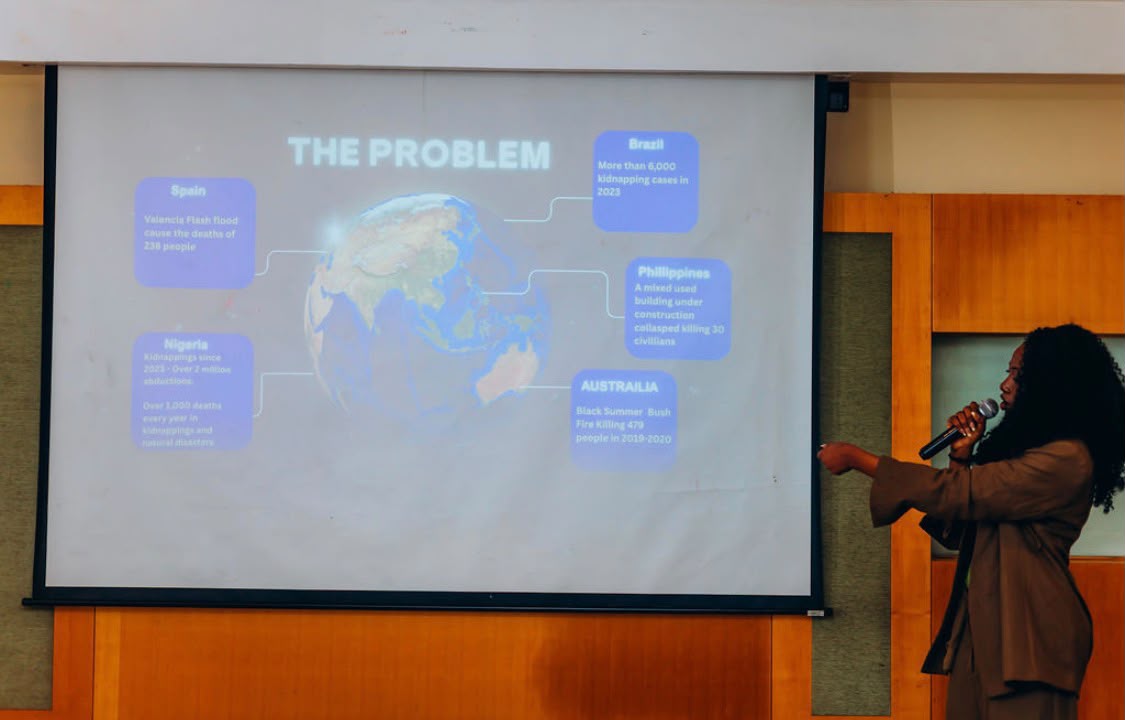
Oviesu explained that SafeLink has separate registration processes for users and rescuers. This, she said, would enable emergency alerts to reach registered rescuers.
Participants also questioned how the application would attract users and protect personal information.
Oviesu said users’ information is stored in the cloud and can only be accessed through her designated login.
The discussion also highlighted the need to address public trust, data protection and partnerships alongside the technical development of the application.
A live demonstration of SafeLink was conducted for journalists and participants at the event.
Oviesu called on the Federal Government, Nigerian Communications Commission (NCC), security agencies, Economic and Financial Crimes Commission (EFCC) and other stakeholders to partner with her on the development and deployment of the application.
Beyond technology, Oviesu is co-founder and vice president of the Bennie Griffins Academy, a free school for underprivileged children in Adiyan, Ogun State.
She also has a music career as Gia Réi, recording Afrobeats-influenced R&B and pop music. Her singles include “Cara” and “Taking Your Time.”
📢 Follow National Periscope on WhatsApp
Get breaking news and updates directly on WhatsApp.
Join WhatsApp ChannelPost Disclaimer
All rights reserved. This material and other digital content on this website are not and do not represent the stance of National Periscope but the statements of newsmakers mentioned therein.
For your detailed news reportage... contact the Editor at Joel2oladele@gmail.com






[caption id="attachment_21002" align="alignnone" width="1000"] NCC building, Abuja[/caption] The Nigerian Communications Read more
NCC orders MTN, Glo, others to disconnect SIMs without NIN Read more
Internet access reduced poverty in Nigeria, Tanzania by 7% – Read more
ICT Sector Contributes 15.97% To Nigeria’s Q3 GDP The Information Read more