

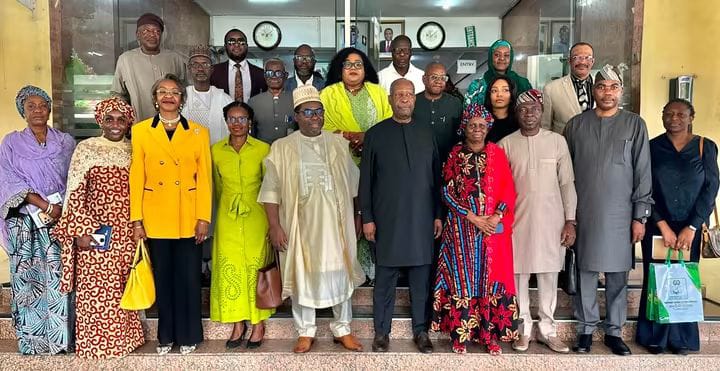
The Independent National Electoral Commission (INEC) has sought the support of the United Nations (UN) and the United Kingdom (UK) to tackle foreign-driven disinformation ahead of the 2027 general elections.
The commission identified foreign information manipulation, artificial intelligence (AI)-driven misinformation and hate speech as major threats to electoral credibility and public confidence in the democratic process.
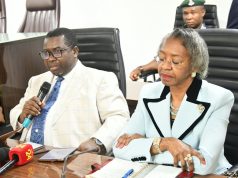
INEC Chairman, Prof. Joash Amupitan, made the appeal on Wednesday during separate meetings with the UN Special Representative for West Africa and the Sahel, Mr Leonardo Santos Simao, and the British High Commissioner to Nigeria, Mr Pete Vowles, at the commission’s headquarters in Abuja.
Amupitan told the UN delegation that the commission wanted to establish a rapid response mechanism and public awareness programmes to counter Foreign Information Manipulation and Interference (FIMI).
He described the activities of foreign actors using proxies and lookalike platforms to manipulate information as a major concern. He added that INEC’s recent research revealed a growing trend across West Africa.
To address the problem, the chairman said the commission had begun local and zonal engagements, including meetings with traditional rulers. The exercise seeks to educate electoral officials and citizens on misinformation, disinformation and the dangers of unverified information.
He also raised concerns about the misuse of artificial intelligence in spreading false information and manipulating public opinion.
During his meeting with the British High Commissioner, Amupitan called for joint efforts to tackle AI-driven manipulation, fake news and hate speech, stressing the need to protect public trust in elections.
Beyond information security, the INEC chairman sought the UN’s support for early-warning and monitoring systems to prevent election-related violence. He also proposed high-level dialogue among political actors to discourage hate speech and promote peaceful participation.
He said the commission was working with security agencies through its Election Risk Management (ERM) tool to identify areas vulnerable to electoral violence and other threats.
Amupitan also called for programmes that would promote the participation of women, young people and vulnerable groups in the electoral process.
On preparations for the elections, the chairman said INEC had moved from strategic planning to full-scale implementation of its activities.
He disclosed that the first phase of the 2027 elections would hold on January 16, 2027, adding that the commission had completed nine of the 14 major activities in its revised timetable.
According to him, Nigeria’s National Register of Voters now contains more than 103 million registered voters, with young people aged between 18 and 34 accounting for nearly 29 per cent.
He said the commission had displayed the register for claims and objections in line with Section 19 of the Electoral Act. INEC plans to publish the final register on December 15, 2026.
The chairman added that the commission was distributing Permanent Voter Cards (PVCs) across all 774 local government areas, while decentralising collection points to ward level to make access easier for voters.
On political party nominations, Amupitan said INEC’s Candidates Nomination Portal had processed submissions from 21 of the 22 registered political parties.
The submissions covered 36 presidential and vice-presidential candidates from 18 parties, 4,860 National Assembly candidates, 936 governorship and deputy governorship candidates, and 9,692 State House of Assembly candidates.
He said the commission had published the final lists in accordance with statutory deadlines and relevant court directives.
Amupitan identified technology as central to the commission’s efforts to ensure transparency, disclosing that INEC had secured 57,000 Bimodal Voter Accreditation System (BVAS) devices.
He said shipments had started arriving for batch testing and configuration, while the commission was also procuring ballot boxes and voting cubicles for 176,846 polling units nationwide.
To prevent delays in the delivery of election materials, he said INEC was working with the Nigeria Customs Service and other port authorities to establish fast-track clearance arrangements.
The commission also plans to conduct a mock accreditation and election exercise to test its technology before the general polls. However, Amupitan said budgetary constraints had limited its proposed scope.
He appealed to international partners to support an expansion of the exercise, arguing that a more comprehensive test would provide a better assessment of the commission’s preparedness.
On its ongoing readiness assessments, the chairman said INEC had completed its tour of the South-South and would begin its North-Central assessment on Thursday.
He also highlighted lessons from recent off-cycle governorship elections in Anambra, Ekiti and Osun states, the Federal Capital Territory (FCT) Area Council elections and 16 legislative by-elections.
According to him, the exercises provided opportunities to test the commission’s operational capacity, particularly in logistics, voter accreditation and electronic transmission of results.
He listed improved logistics, reliable BVAS accreditation, prompt uploads to the INEC Result Viewing (IReV) portal and intelligence-led security arrangements among the gains recorded.
The commission also improved its result collation process and provided priority voting for persons with disabilities, pregnant women and elderly voters.
Amupitan described the UK as one of INEC’s most dependable international partners, acknowledging its contributions to capacity building, gender inclusion, voter education and institutional policy development.
He sought further British assistance in strengthening cybersecurity for election equipment, data transmission networks and public portals.
He also requested specialised training for the commission’s information and communications technology personnel, legal officers and election managers, as well as voter education programmes targeting marginalised groups.
Amupitan said the credibility of Nigeria’s elections carried implications beyond the country’s borders, given its influence on regional stability and economic development.
“The integrity of Nigeria’s democracy matters not only to our citizens but to the peace, stability, and economic growth of the entire West African sub-region and the African continent,” he said.
He assured both delegations that INEC would maintain its independence and impartiality while working towards a transparent and credible 2027 general election.
Responding, Simao said the UN delegation had visited to support INEC in carrying out the demanding responsibility of organising the elections.
“We came here with a mission, and our mission is to support you,” he said.
He acknowledged the security challenges confronting Nigeria and warned against allowing elections to create additional tension.
“Election should not be another source of violence for the country, another burden for the country,” he said, assuring the commission that it would not face the task alone.
Simao disclosed that UNOWAS had consulted political parties, candidates and government institutions on preparations for the elections.
He said the UN would maintain a presence during the polls, although its mandate did not permit it to serve as an election observer. Rather, he explained, its presence would encourage positive conduct among political stakeholders.
The UN envoy also stressed the importance of Nigeria’s electoral success to the wider region, saying credible elections in the country could inspire other West African nations.
In his remarks, Vowles described his visit as an opportunity to familiarise himself with INEC’s operations. He said he had been in Nigeria for about eight weeks.
The British envoy stressed that Nigeria’s democratic development mattered to its citizens, the West African region and the international community.
He described the 2027 elections as an important opportunity for Nigeria to demonstrate how a strong democracy could function in a large and diverse country.
📢 Follow National Periscope on WhatsApp
Get breaking news and updates directly on WhatsApp.
Join WhatsApp ChannelPost Disclaimer
All rights reserved. This material and other digital content on this website are not and do not represent the stance of National Periscope but the statements of newsmakers mentioned therein.
For your detailed news reportage... contact the Editor at Joel2oladele@gmail.com



 to tackle foreign-driven disinformation ahead of the 2027 general elections.)
INEC Boss Charges New REC to Restore Public Trust in Read more
Anambra Decides: INEC Delivers Non-Sensitive Materials, Vows Credible Poll JOEL Read more
INEC Approves Registration of DLA, NDC as Political Parties JOEL Read more
INEC Refutes Claims of Blocking Parties from Accessing Election Materials Read more