

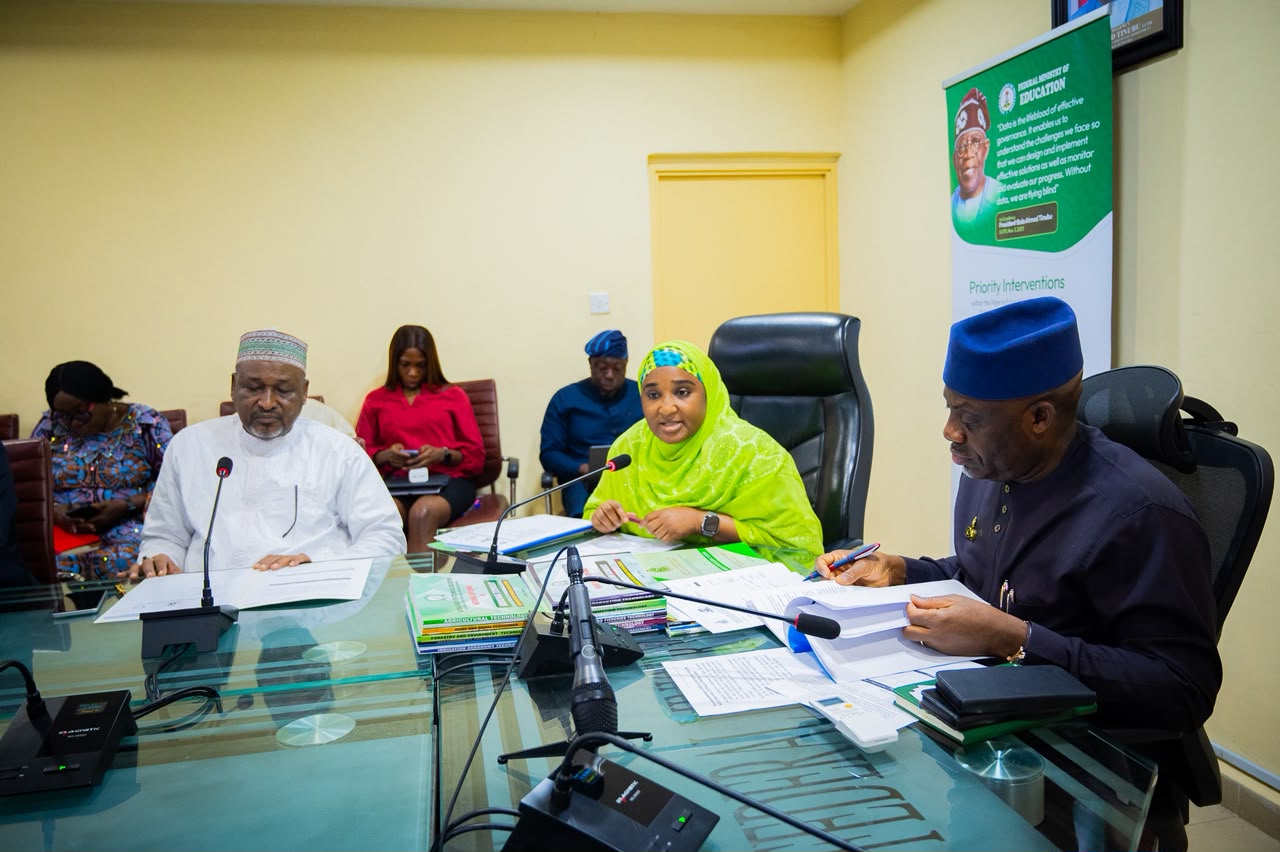
The Federal Government has commenced the restructuring of the Monotechnic and Technical Education Board (MBTE) to strengthen its capacity to supervise polytechnics, monotechnics and other technical institutions across the country.
The Minister of Education, Dr Maruf Tunji Alausa, disclosed this in Abuja, saying the exercise was aimed at repositioning the agency to drive technical and vocational education and training (TVET) in line with President Bola Tinubu’s Renewed Hope Agenda.
Alausa said the ministry had engaged KPMG to undertake a comprehensive assessment of MBTE and develop a functional organisational structure and operational framework for the agency.
According to him, the exercise would identify institutional gaps and recommend reforms to strengthen MBTE’s internal processes, oversight functions and coordination of institutions under its mandate.
He stressed that the effectiveness of the institutions responsible for implementing and supervising technical education would determine the success of the administration’s efforts to expand skills development.
Alausa maintained that MBTE must become a fit-for-purpose agency capable of ensuring that polytechnics, monotechnics and other technical institutions produce graduates with practical skills relevant to the economy.
He described the restructuring as more than an administrative exercise, noting that it was part of a broader effort to reposition technical and vocational education as a driver of employment, entrepreneurship and productivity.
“Everything about the polytechnic is technical and vocational education and training. It is all about skills. We are simply discussing skills,” the minister said.
The minister said this philosophy informed the ongoing review of polytechnic curricula and development of National Occupational Standards to bring training closer to industry requirements and employment opportunities.
The curriculum review, supported by N1 billion from the Tertiary Education Trust Fund (TETFund), produced 27 new National Occupational Standards and reviewed four existing ones, bringing the total to 31.
Alausa explained that the standards would create a clearer skills pathway from artisan-level training through the National Certificate, Ordinary National Diploma (OND) and Higher National Diploma (HND) levels.
The objective, he added, was to ensure that Nigerians who undergo technical education acquire practical competencies that could translate into jobs, entrepreneurship and improved productivity.
Providing an industry perspective, Adewale Ajayi, Partner and Head of Tax, Regulatory and People Services at KPMG Africa and KPMG in Nigeria, said the firm’s assessment identified significant challenges as well as opportunities within the country’s TVET system.
Ajayi disclosed that about 93 per cent of Nigeria’s workforce was engaged in informal employment, while approximately 12 per cent of young people were not in education, employment or technical training.
Despite the challenges, he noted that Nigeria performed strongly in the employability of TVET graduates, ranking second only to Singapore among the markets assessed.
This, according to him, demonstrated the potential of technical and vocational education to produce graduates with skills that meet labour-market demands.
Ajayi, however, called for urgent attention to curriculum development, noting that more than 55 per cent of the curricula assessed were outdated, including programmes in engineering, science, arts and design.
He attributed part of the problem to funding constraints and the five-year curriculum review cycle, while citing the recent update of the agriculture curriculum as a positive development.
Alausa said the recommendations from the KPMG assessment, alongside the ongoing curriculum and skills reforms, would provide the foundation for strengthening MBTE’s capacity to supervise and coordinate technical institutions.
He added that a more effective MBTE would improve institutional accountability while ensuring that technical education remained responsive to changing industry demands and the wider economy.
The minister reaffirmed the Federal Government’s commitment to building a TVET system anchored on practical competence, industry relevance, employability and productivity.
He described the repositioning of MBTE as central to the government’s broader human capital development strategy, saying the ultimate goal was to produce a skilled, productive and globally competitive Nigerian workforce.
📢 Follow National Periscope on WhatsApp
Get breaking news and updates directly on WhatsApp.
Join WhatsApp ChannelPost Disclaimer
All rights reserved. This material and other digital content on this website are not and do not represent the stance of National Periscope but the statements of newsmakers mentioned therein.
For your detailed news reportage... contact the Editor at Joel2oladele@gmail.com







Minister of Education, Dr Maruf Tunji Alausa, has pledged to Read more
Nursing student commits suicide over school’s failed accreditation A 300-level Read more
[caption id="attachment_20915" align="alignnone" width="1080"] Enitonna High School Alumni Association logo[/caption] Read more
OAU Management reduces tuition fees Olaitan Ogundele Obafemi Awolowo University, Read more