

For Lagos, electricity demand has continued to rise with the expansion of industries, businesses, residential communities and major infrastructure projects. But the growth has also exposed the limits of the transmission network, with capacity constraints threatening to undermine economic activities across the state.
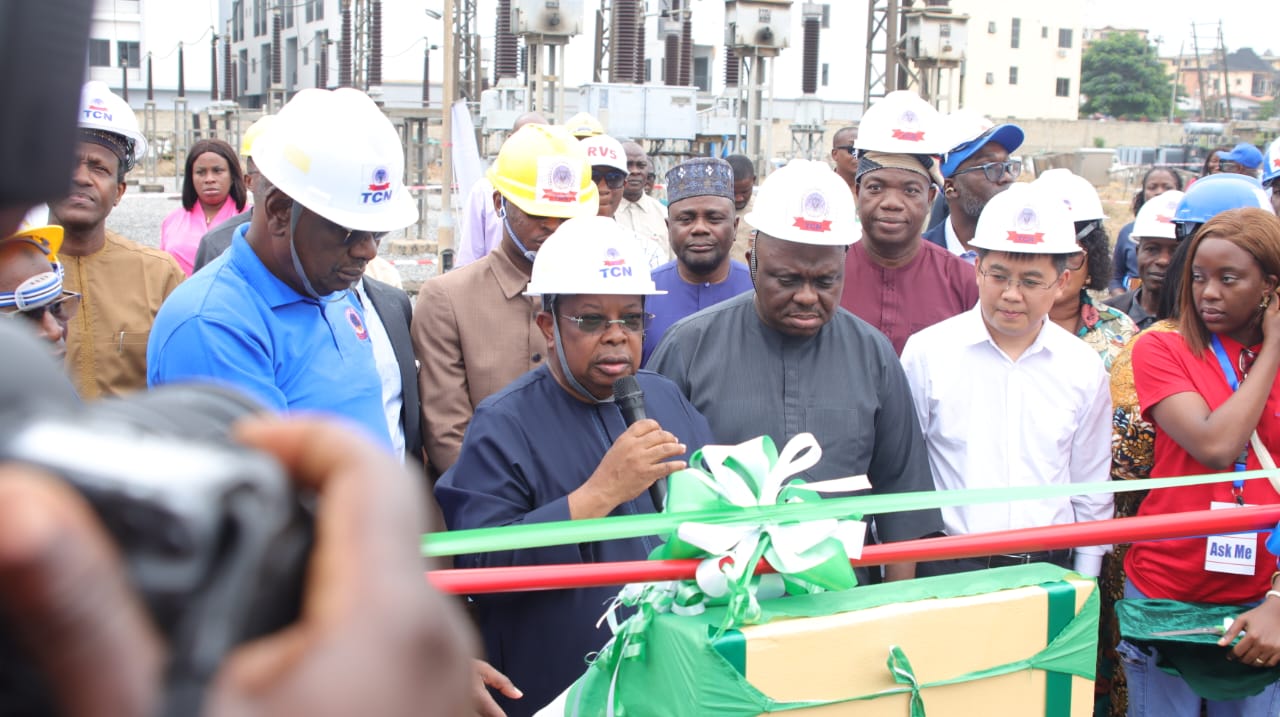
That challenge is now receiving a major intervention as the Federal Government commissions new transformer projects across four transmission substations in Lagos, adding 840MVA to the state’s transmission capacity.
The projects, commissioned by the Minister of Power, Joseph Olasunkanmi Tegbe, on Monday and Tuesday, span Apapa, Ijora, Alausa and Lekki, some of the most economically active areas of the state.
Together, the projects are expected to increase the volume of bulk electricity available to Eko Electricity Distribution Company (EKEDC) and Ikeja Electric Distribution Company (IKEDC) for onward delivery to industries, businesses and households.
But beyond the numbers, the interventions point to a broader attempt by the Federal Government to address one of the persistent weaknesses of Nigeria’s power sector — the inability of the transmission network to adequately move available electricity to areas where demand is highest.
At the commissioning ceremonies, Tegbe repeatedly linked the new infrastructure to economic activity, arguing that electricity investment must be judged by what it enables businesses and communities to achieve.
“They represent targeted investments in capacity for businesses to grow, capacity for industries to produce, and capacity for communities to prosper,” the minister said.
Lekki at the centre of expansion
Perhaps nowhere is the need for additional electricity infrastructure more evident than the Lekki axis.
Over the past decade, the corridor has evolved from a largely residential stretch into one of Nigeria’s most important emerging economic centres. The Lekki Deep Sea Port, the Dangote Refinery and other industrial and commercial investments have transformed the area and attracted further investment.
The challenge for the power sector is to ensure that the infrastructure supporting this economic expansion does not lag behind it.
The latest upgrade at the Lekki Transmission Substation is therefore significant.
The project, commissioned on Tuesday, comprises a 300MVA, 330/132/33kV transformer and two 60MVA, 132/33kV transformers.
With the intervention, transformer capacity at the 330/132kV level has doubled from 300MVA to 600MVA, equivalent to approximately 480MW. At the 132/33kV level, capacity has risen from 120MVA to 240MVA, equivalent to about 192MW.
Nine new 33kV feeders were also installed to improve the evacuation of bulk power into the EKEDC network.
For Tegbe, the location of the project is as important as its capacity.
“Lekki represents the Nigeria we are building towards, a more industrial, more commercially active, more connected to global markets and increasingly attractive to domestic and international capital,” he said.
“As investment flows into a corridor such as this, electricity infrastructure cannot be an afterthought.”
The additional transformers are expected to improve the reliability and availability of bulk electricity supplied to EKEDC for onward distribution across Lekki and its environs.
The nine feeders are equally important because increased transmission capacity has little value if distribution infrastructure cannot evacuate the power to consumers.
Strengthening the Ikeja corridor
While Lekki represents Lagos’ emerging economic frontier, Alausa and Ikeja remain at the heart of the state’s established commercial and administrative activities.
A new 100MVA, 132/33kV transformer commissioned at the Alausa Transmission Substation is expected to strengthen electricity supply in the area.
The intervention has raised the substation’s total transformation capacity from 135MVA to 205MVA, equivalent to approximately 164MW.
More significantly, it has increased the quantum of bulk power available to IKEDC by 80MW for onward distribution to consumers within its franchise area.
Tegbe described the investment as a deliberate strengthening of a strategic location where government institutions, businesses, factories, markets and workshops depend heavily on electricity.
“Ikeja is where the ambition of Nigeria meets the industrious nature of Nigerians,” he said.
The minister’s broader argument is that power infrastructure should follow economic activity rather than wait for bottlenecks to become severe before interventions are made.
That philosophy is particularly relevant in Lagos, where population growth and commercial expansion continue to put pressure on existing infrastructure.
Apapa, Ijora receive major interventions
The Apapa and Ijora projects, commissioned on Monday, are similarly targeted at areas where electricity reliability has direct implications for economic activity.
At the Apapa Transmission Substation, the Federal Government commissioned a 2x60MVA Gas Insulated Substation delivered under the Official Development Assistance programme of the Japan International Cooperation Agency (JICA).
The facility includes two 60MVA, 132/33kV transformers, a new control building, modern protection and control systems, substation automation systems and SCADA infrastructure.
The intervention increases bulk power availability in the axis by approximately 96MW.
Its impact is expected to extend across Apapa Causeway, Ijora, Amukoko, Ajegunle, Apapa Wharf and Tin Can Island, areas characterised by intense commercial and industrial activities.
At Ijora, the intervention was even more substantial in terms of capacity increase.
Two existing 30MVA transformers were replaced with two modern 100MVA, 132/33kV transformers.
The upgrade raises the substation’s total installed capacity from 90MVA to 230MVA, equivalent to approximately 184MW, while adding 112MW of transmission capacity.
The increased capacity is expected to improve bulk electricity supply to Ijora, Costain, Oyingbo, Customs and adjoining communities within the EKEDC franchise.
Transmission remains the missing link
The significance of the Lagos projects extends beyond the immediate beneficiaries.
Nigeria’s power sector has for years faced a structural problem in which generation capacity, transmission capability and distribution infrastructure have not always developed at the same pace.
Increasing generation without adequate transmission creates stranded capacity. Similarly, strengthening transmission without adequate distribution infrastructure can leave additional electricity unable to reach consumers.
The latest Lagos interventions are therefore designed to address specific transmission constraints while also improving the ability of distribution companies to take more power from the grid.
Speaking at the commissioning ceremonies, TCN Managing Director and Chief Executive Officer, Sule Ahmed Abdulaziz, said the projects would significantly increase the volume of bulk power available to both distribution companies.
At Apapa, he said the new infrastructure would improve electricity supply to major commercial and industrial areas, while the Alausa project would provide more stable electricity to at least 70,000 residents in Alausa and surrounding areas through IKEDC.
The Alausa project was executed by Shanghai Electric Limited under a World Bank-funded initiative that commenced in January 2021.
Abdulaziz said the upgrades would also enable TCN to wheel more bulk electricity to distribution load centres, strengthening grid stability and improving electricity delivery.
For the transmission company, the projects are part of a wider programme to modernise the national grid, reduce technical losses and increase its capacity to meet growing demand.
Beyond the transformers
The commissioning also comes with a recognition that the new capacity alone will not solve Nigeria’s electricity challenges.
Tegbe acknowledged that transmission constraints accumulated over many years and would require sustained investment rather than isolated projects.
“Our transmission challenges did not emerge overnight, and they will not disappear through one intervention,” he said.
The government’s approach, he explained, would be to identify bottlenecks, invest in them and unlock the capacity required to support economic activity.
“Where transmission infrastructure is constraining available power, we will strengthen transmission. Where substations require additional capacity, we will expand them. Where ageing equipment threatens reliability, we will progressively rehabilitate or replace it.”
That strategy reflects a shift towards linking power investments more directly with economic priorities.
For Lagos, the stakes are particularly high.
The state is Nigeria’s commercial nerve centre and home to major ports, industries, financial institutions, technology companies, markets and millions of households. Every improvement in electricity reliability has the potential to reduce dependence on expensive alternative power sources and improve the operating environment for businesses.
The Federal Government’s latest intervention is consequently not simply about adding transformers to substations. It is an attempt to reinforce the electricity infrastructure underpinning one of Africa’s fastest-growing urban economies.
The TCN has completed similar transmission projects in other parts of the country, with their commissioning expected in due course.
Abdulaziz, however, called for more grant support to enable the company to address other critical sections of the transmission network and sustain improvements nationwide.
For Tegbe, the ultimate destination is a power system capable of supporting rather than constraining Nigeria’s economic ambitions.
“The Federal Government’s ambition is larger than the projects commissioned today,” he said. “We are building towards a Nigeria where electricity is not merely a social service, but the foundation for industrial competitiveness and economic growth, and where investment decisions are driven by opportunity rather than infrastructure constraints.”
With 840MVA of additional transformer capacity now in service across the Lagos network, the immediate challenge is to ensure that the increased capacity translates into more reliable electricity for the businesses, industries and communities that depend on it.
That, ultimately, will determine whether the new transformers become simply additions to the grid or the infrastructure that helps power Lagos’ next phase of economic expansion.
📢 Follow National Periscope on WhatsApp
Get breaking news and updates directly on WhatsApp.
Join WhatsApp ChannelPost Disclaimer
All rights reserved. This material and other digital content on this website are not and do not represent the stance of National Periscope but the statements of newsmakers mentioned therein.
For your detailed news reportage... contact the Editor at Joel2oladele@gmail.com


FG orders revocation of licenses of electricity distribution companies President Read more
A suspected vandal was crushed to death after a 330kV Read more
[caption id="attachment_23209" align="alignnone" width="640"] Dino Melaye[/caption] The Tinubu Media Support Read more
Alleged $6b fraud: Court declines ex-Minister Agunloye’s preliminary objection Former Read more