

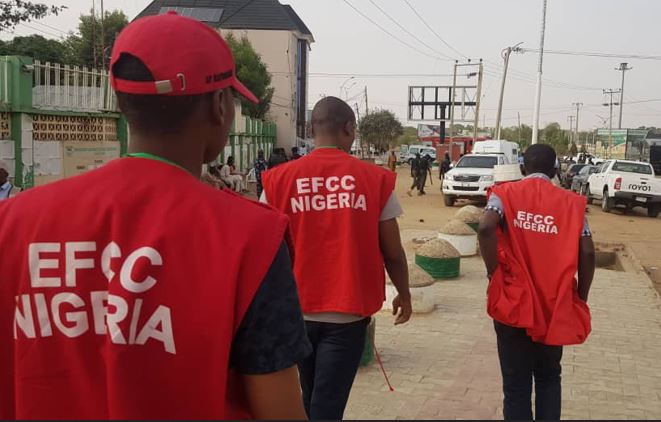
The Economic and Financial Crimes Commission (EFCC) has traced millions of naira and dollars, as well as more than 200 houses, to some public officials under investigation for corruption.
EFCC Chairman, Ola Olukoyede, disclosed this in Abuja while speaking at the 80th birthday celebration of former Attorney-General of the Federation and Minister of Justice, Chief Kanu Agabi.
Olukoyede also revealed that the commission receives more than 20,000 petitions annually alleging corruption in the public sector.
According to him, investigations have exposed cases where public officials moved from modest financial circumstances to owning substantial wealth within a few years of assuming office.
He said some officials had less than N100,000 before taking office but accumulated millions of naira and dollars within three or four years.
Olukoyede said investigations had also linked some officials to large property portfolios, with one case involving more than 200 houses.
The EFCC chairman stressed that the pattern showed how public resources could be diverted for private gain when officials abused their positions.
He said corruption should not be viewed only as an issue involving government agencies because its consequences affect ordinary Nigerians.
Olukoyede urged citizens to reject practices that allow public funds meant for development to be diverted into private accounts and properties.
He said the large volume of petitions received by the EFCC reflected the scale of corruption allegations confronting the country.
The chairman noted that the commission’s investigations were aimed at tracing illicit funds and assets and bringing those found culpable to account.
Also speaking at the event, the Chairman of the Independent Corrupt Practices and Other Related Offences Commission (ICPC), Musa Adamu Aliyu, identified public tolerance and weaknesses in institutional systems as factors that allow corruption to persist.
Aliyu said tackling corruption required more than investigating and prosecuting offenders after public resources had been stolen.
He called for stronger emphasis on integrity and anti-corruption education from the primary and secondary school levels.
The ICPC chairman also urged greater engagement with younger Nigerians, particularly members of Generation Z and Generation Alpha, to promote values that discourage corruption.
He maintained that building a culture of integrity among young people would help strengthen the country’s long-term fight against corruption.
The comments came amid renewed attention on the scale of financial crimes and abuse of public resources in Nigeria.
For the EFCC, the thousands of petitions received annually provide a steady stream of allegations requiring investigation, while asset tracing remains a key part of efforts to recover proceeds of corruption.
The disclosures also highlight the difficulty of measuring corruption only through individual cases, as investigations can uncover extensive financial and property interests accumulated over relatively short periods.
The anti-graft agencies have continued to emphasise prevention, investigation, prosecution and asset recovery as parts of the broader response to corruption in the country.
📢 Follow National Periscope on WhatsApp
Get breaking news and updates directly on WhatsApp.
Join WhatsApp ChannelPost Disclaimer
All rights reserved. This material and other digital content on this website are not and do not represent the stance of National Periscope but the statements of newsmakers mentioned therein.
For your detailed news reportage... contact the Editor at Joel2oladele@gmail.com






ICPC Case: Two Ministries’ Officials Face Trial in N12m Job Read more
Court Grants Yahaya Bello N500 Million Bail Over N110.4 Billion Read more
EFCC releases ex-power Minister Agunloye on bail The Economic and Read more
ICPC Chairman Urges Attorneys-General to Champion Integrity against Corruption JOEL Read more