

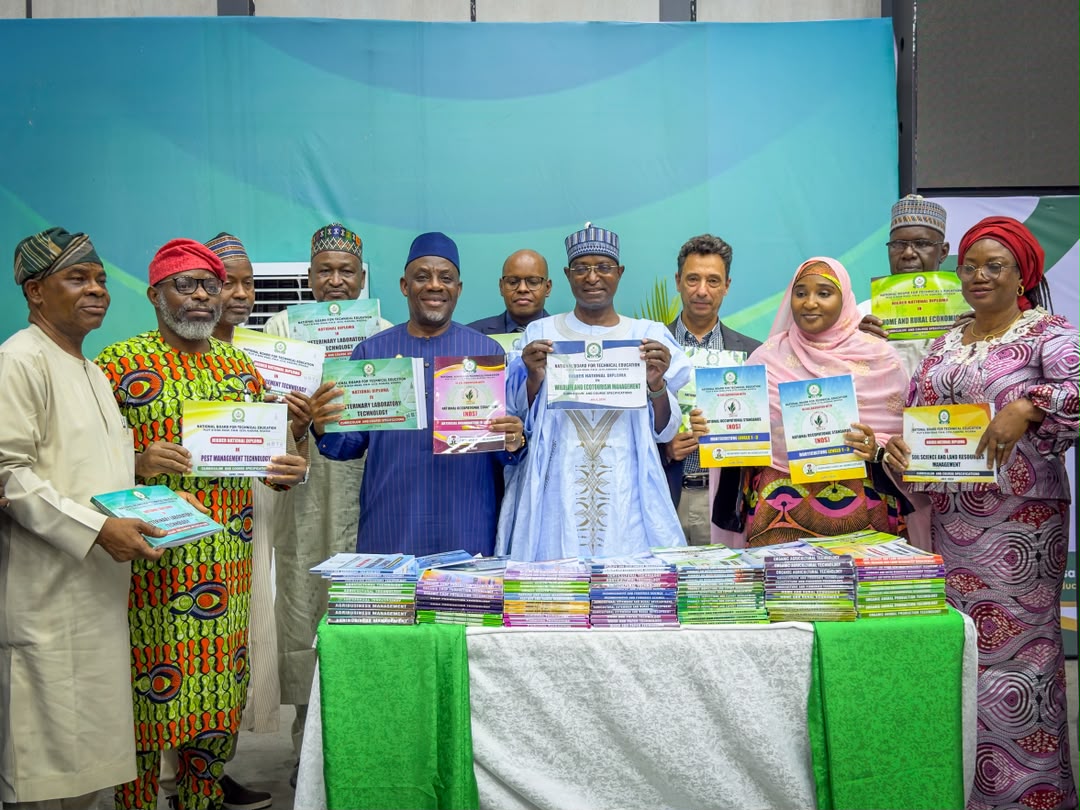
Education Minister, Dr Maruf Tunji Alausa, has unveiled 39 agricultural curricula and 31 occupational standards to improve food security, boost youth employment and raise agricultural productivity.
The reform also introduces an 80:20 practical-to-theoretical training model to equip students with industry-ready skills and encourage agribusiness development.
Alausa announced the initiative at the UBEC Digital Resource Centre in Abuja. He described it as an investment in human capital aimed at connecting education with industry needs.
He said Nigeria needed skilled workers who could apply modern technology, increase farm output and build sustainable agricultural enterprises.
The minister explained that the review began in 2025 through collaboration among the Federal Ministries of Education, Agriculture and Food Security, and Livestock Development.
Regulatory agencies, educational institutions, curriculum experts and industry stakeholders also contributed to the exercise.
The process produced 32 reviewed curricula and seven new programmes. It also established 31 National Occupational Standards covering National Diploma, Higher National Diploma and corresponding Nigeria Certificate in Education agricultural programmes.
The National Commission for Colleges of Education participated in developing the standards for relevant teacher education programmes.
Under the new model, students will devote 80 per cent of their training to practical work and 20 per cent to theory. The approach will prioritise teaching farms, greenhouses, processing facilities and agricultural technology hubs.
The curricula also cover emerging fields such as precision agriculture, climate-smart agriculture, artificial insemination and agribusiness.
Alausa said the new framework would prepare graduates for changing industry demands while encouraging entrepreneurship and job creation.
He pledged to work with ministries, regulators, schools and industry partners to ensure effective implementation.
The minister added that the government would assess the reform through graduates’ practical competence, improved agricultural output, job creation and measurable contributions to food security.
The Minister of Livestock Development, Alhaji Idi Mukhtar Maiha, welcomed the initiative, describing it as a major step towards practical, industry-driven agricultural education.
He commended President Bola Tinubu’s focus on agriculture and livestock development. He also acknowledged the contributions of the education and agriculture ministers and the technical team behind the reform.
Maiha stressed that livestock production remained vital to food and nutrition security, employment, industrial growth and export earnings.
He cited the Middle East red meat market, valued at about $3.2 billion, as an opportunity Nigeria could exploit with better skills and sector organisation.
However, he said inadequate organisation and a shortage of hands-on expertise continued to limit the country’s competitiveness.
Maiha urged educational institutions to establish functional farms and adopt digital and climate-smart agricultural practices. He also called for wider access to skills, technology, finance and markets.
He further urged regulators to make functional practical training facilities a central requirement for institutional accreditation.
Earlier, the Minister of State for Education, Professor Suwaiba Said Ahmad, said the initiative marked an important step towards repositioning Technical and Vocational Education and Training (TVET).
She explained that competency-based instruction and clearly defined occupational standards would improve training quality and align graduates’ skills with labour-market demands.
Ahmad called on regulators, educational institutions and industry partners to provide qualified instructors, adequate equipment and functional workshops.
She also advocated continuous professional development for instructors and stronger industry partnerships to support apprenticeships, industrial attachments and workplace learning.
The minister urged stakeholders to ensure that women, persons with disabilities and young people from underserved communities had equal access to the opportunities.
Alausa said the government would sustain collaboration with relevant stakeholders to translate the revised curricula into improved skills, productivity and employment across the country.
He said the ultimate goal was to produce skilled and innovative graduates who could create jobs, develop agribusinesses and contribute to national food security.
📢 Follow National Periscope on WhatsApp
Get breaking news and updates directly on WhatsApp.
Join WhatsApp ChannelPost Disclaimer
All rights reserved. This material and other digital content on this website are not and do not represent the stance of National Periscope but the statements of newsmakers mentioned therein.
For your detailed news reportage... contact the Editor at Joel2oladele@gmail.com





NYSC DG Urges Establishment of Trust Fund to Empower Corps Read more
KWASU final-year student commits suicide over ‘poor grades’ A 400-level Read more
FG Plans to Engage Retired Teachers to Tackle Nationwide Teacher Read more
•NBTE Unveils New Rules To Check Irregularities The Federal Government Read more