
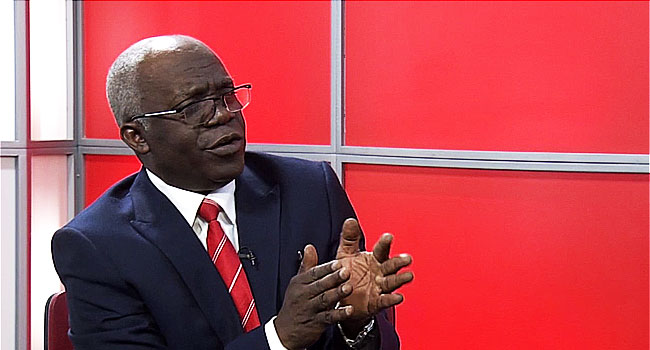
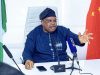
Human rights lawyer and Senior Advocate of Nigeria (SAN), Femi Falana, has challenged the Federal Government and other tiers of government to account for the additional revenue generated since the removal of petrol subsidy.
Falana said Nigerians were yet to see tangible benefits from the policy, despite repeated claims that governments at the federal, state and local levels now had more funds at their disposal.
The 68-year-old lawyer made the remarks on Channels Television’s Sunday Politics, where he questioned how the resources previously committed to subsidising petrol were being deployed.
Falana cited the condition of a road leading to Afe Babalola University in Ekiti State as an example of infrastructure challenges that, in his view, should be addressed with increased allocations to local governments.
“I was just reading some news about a particular road in Ekiti State, the road that leads to Afe Babalola University. And everybody there is asking the Abuja people to come and fix the road, whereas between January and May this year, that local government has taken about N5.4 billion,” he said.
He questioned why a road requiring less than N500 million to repair would remain unattended when the local government had received billions of naira in allocations.
Falana also argued that state governments should be held accountable for infrastructure spending, recalling that some had previously undertaken road projects and subsequently sought refunds from the Federal Government.
He said the increased revenues accruing to the three tiers of government since subsidy removal should translate into better living conditions and infrastructure for Nigerians.
“We must begin to ask questions of the local government, the state government, and the Federal Government. If you say we are making more money, we don’t want to go back to the era of the fuel subsidy scam. Where are the benefits?” Falana asked.
The lawyer said Nigerians should not be continually asked to wait for the benefits of the policy while the economic hardship caused by higher petrol prices persists.
“It’s a fallacy being told to wait and wait and wait. People are dying,” he said.
Falana further argued that Nigeria was generating more revenue from crude oil and should therefore be able to demonstrate how the additional resources were being utilised.
He said the estimated $10 billion previously earmarked annually for petrol importation should have translated into substantial savings following the subsidy removal.
According to him, however, a significant portion of the resources was now being used for debt servicing, raising questions about the extent to which Nigerians were benefiting directly from the policy.
Falana maintained that the increased allocations being received by the Federal Government, states and local councils had made accountability more urgent.
“Yes, state governments are getting more money. The Federal Government is getting more money. Local governments are getting more money on paper. It is the duty of the Nigerian people now to demand accountability,” he said.
President Bola Tinubu announced the removal of petrol subsidy shortly after assuming office in May 2023, triggering a sharp increase in the price of petrol and subsequently raising the cost of transportation, food and other goods and services.
The Federal Government has consistently defended the decision, arguing that subsidy payments were unsustainable and that the funds would be better deployed to development projects and social programmes. The policy has, however, remained one of the most contentious economic decisions of the Tinubu administration.
With the 2027 general elections approaching, the subsidy debate has also assumed greater political significance.
Former Vice President Atiku Abubakar, the presidential candidate of the African Democratic Congress (ADC), has pledged to restore petrol subsidy if elected, while Peter Obi has supported its removal but insisted that the savings must be transparently and judiciously applied.
Falana’s latest intervention adds to growing calls for governments at all levels to demonstrate how the increased revenues from subsidy removal are translating into measurable improvements in the lives of Nigerians.
📢 Follow National Periscope on WhatsApp
Get breaking news and updates directly on WhatsApp.
Join WhatsApp ChannelPost Disclaimer
All rights reserved. This material and other digital content on this website are not and do not represent the stance of National Periscope but the statements of newsmakers mentioned therein.
For your detailed news reportage... contact the Editor at Joel2oladele@gmail.com



North-Central Group passes vote of confidence on Ganduje, cautions detractors Read more
Airlines hint on increase in fares as aviation fuel hits Read more
NSCDC Deploys 20,850 Personnel for Saturday’s By-Elections Across 12 States Read more
The Civil Defence, Correctional, Fire and Immigration Services Board (CDCFIB) Read more