

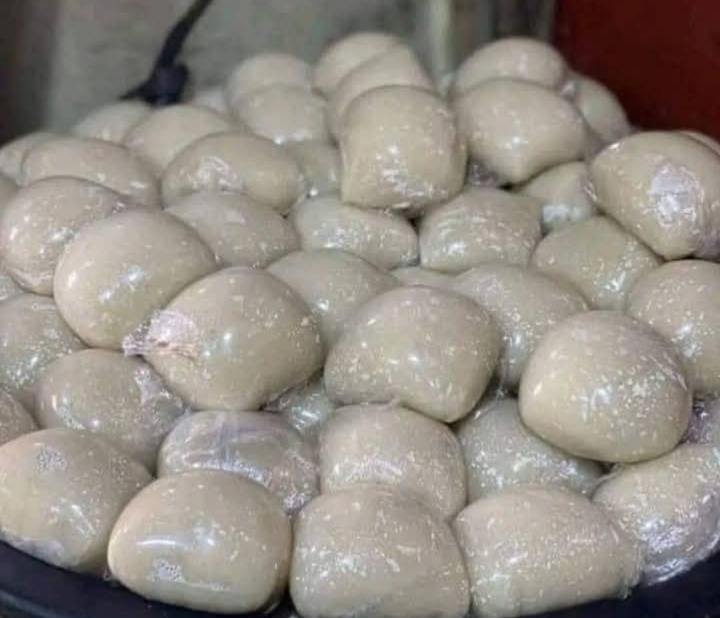
Some residents of Lagos State have raised concerns over the safety of locally processed fufu, alleging poor hygiene and questionable preservation methods by some producers.
The residents spoke in separate interviews with the News Agency of Nigeria on Sunday in Lagos, with some saying their experiences had made them reduce or stop buying fufu prepared by certain processors.
Fufu, also known as akpu or santana, is a popular Nigerian staple made from fermented cassava.
The traditional process involves peeling and washing cassava before soaking it for several days to allow fermentation and reduce naturally occurring toxins.
The cassava is then milled, strained and cooked into a smooth dough before it reaches consumers.
However, some Lagos residents said concerns about how some producers handle the staple had affected their confidence in the product.
They also complained about the quantity of fufu sold at existing prices, saying portions that previously sold for N1,000 for 13 balls now come in smaller quantities.
A resident of Ajegunle, Miss Omena Udonwa, said her family had resorted to making fufu at home because of her concerns about some producers’ practices.
Udonwa said she once discovered a piece of rubber in fufu she had purchased.
“I saw a piece of rubber inside a fufu I bought recently and, if not for my vigilance, I would have consumed it,” she said.
She also alleged that she once saw a processor washing cassava with detergent.
“I once saw a producer who used detergent to wash the cassava and saw nothing wrong with what they did,” Udonwa said.
A Costain resident, Mr Adedayo Falade, said he remained fond of fufu because it gave him energy for physically demanding work.
Despite his preference for the staple, Falade said he had reduced his consumption because of concerns over the way some producers prepared and stored it.
He complained that some fufu sold in the area had an unpleasant smell and became excessively sticky.
“I rarely eat fufu now,” he said.
Falade also alleged that some portions remained on sale for days because of poor patronage and preparation methods.
“In spite of my love for fufu, I would rather source it from outside Lagos because I no longer trust how it is prepared here,” he said.
He further alleged that some processors could compromise proper practices to reduce costs or increase their returns.
“Some processors in Lagos are just greedy for extra gain, so they can boycott good practices just to sell the product,” Falade said.
Another resident of Agege, Mrs Anuoluwapo Ayeni, urged consumers to exercise caution when buying fufu.
Ayeni, however, said consumers should not assume that every processor operates in the same manner.
“Fufu is a good meal, but I urge Lagosians to be careful where they purchase their fufu,” she said.
She advised consumers to pay attention to how and where the staple is sourced and processed.
“It will be beneficial to know how the fufu you consume is sourced and prepared to avoid health challenges in the future,” Ayeni said.
She added that some processors still maintained good practices.
“We still have good processors, but they are few. Everyone should be sure of what they consume,” she said.
However, a fufu processor at Santana International, White Sand, Oyingbo, Mrs Hope Aniekan, defended the processing methods used at her facility.
Aniekan said the cassava was first peeled and thoroughly washed with clean water before it was soaked for about two days.
She said the fermented cassava was then taken to a mill, ground and filtered to remove unwanted particles.
According to her, the resulting paste was later packed in a sack, covered with plantain leaves and pressed with a heavy stone.
“We adopt the traditional procedures in processing our fufu here. Our fufu can be trusted and our customers can attest to it,” Aniekan said.
She said her facility used salt as a preservative to prevent maggot infestation.
“We only make use of salt in our fufu as a means of preservation to prevent the infestation of maggots,” she said.
Aniekan said she did not know how other processors handled their products but alleged that some people used substances to accelerate fermentation.
“No other harmful additives are in our fufu, but I can only speak for myself. I don’t know how others process theirs,” she said.
“We have heard rumours of some unscrupulous processors adding harmful substances to quickly ferment their fufu.”
Another trader of the staple at Costain, who identified herself simply as Mama Chinonso, said she used a warmer to preserve her fufu.
She said the method could keep the product fresh for about three days during warm weather and up to one week during cold weather.
“I don’t add anything to preserve my fufu for long. When I am supplied, I simply keep it in my warmer to maintain its freshness,” she said.
According to her, the product could remain edible for about three days during warm weather and longer when temperatures were lower.
“In warm weather, the fufu can last for three days and still be edible, but in cold weather, it can last up to a week,” she said.
Mama Chinonso said her family also ate the fufu she sold, adding that this influenced her decision not to use substances to prolong its shelf life.
“My family and I eat from it, so I won’t sell what I cannot eat,” she said.
The concerns raised by the residents have drawn attention to the need for proper hygiene during the processing, handling and storage of fermented cassava products.
While the residents gave individual accounts of practices they considered unsafe, their allegations do not establish that all fufu processors in Lagos use unhygienic methods.
The account from Aniekan also showed that some processors follow traditional methods and use different approaches to preserve their products.
For consumers, however, the concerns centre on the safety of the food, the conditions under which it is processed and the methods used to keep it fresh before sale.
The contrasting accounts have left consumers with the responsibility of paying closer attention to the source and handling of the fufu they buy.
Credit: NAN
📢 Follow National Periscope on WhatsApp
Get breaking news and updates directly on WhatsApp.
Join WhatsApp ChannelPost Disclaimer
All rights reserved. This material and other digital content on this website are not and do not represent the stance of National Periscope but the statements of newsmakers mentioned therein.
For your detailed news reportage... contact the Editor at Joel2oladele@gmail.com







Police arrest teenager for allegedly killing 14-year-old friend Police operatives Read more
Gunmen kill Kwara traditional ruler, abduct wife, two others Olaitan Read more
Protests rock Lagos, Edo, Osun as CSOs urge Tinubu to Read more
Operation Safe Kugbo Eases Traffic, Cuts Crash Risks on Nyanya Read more