

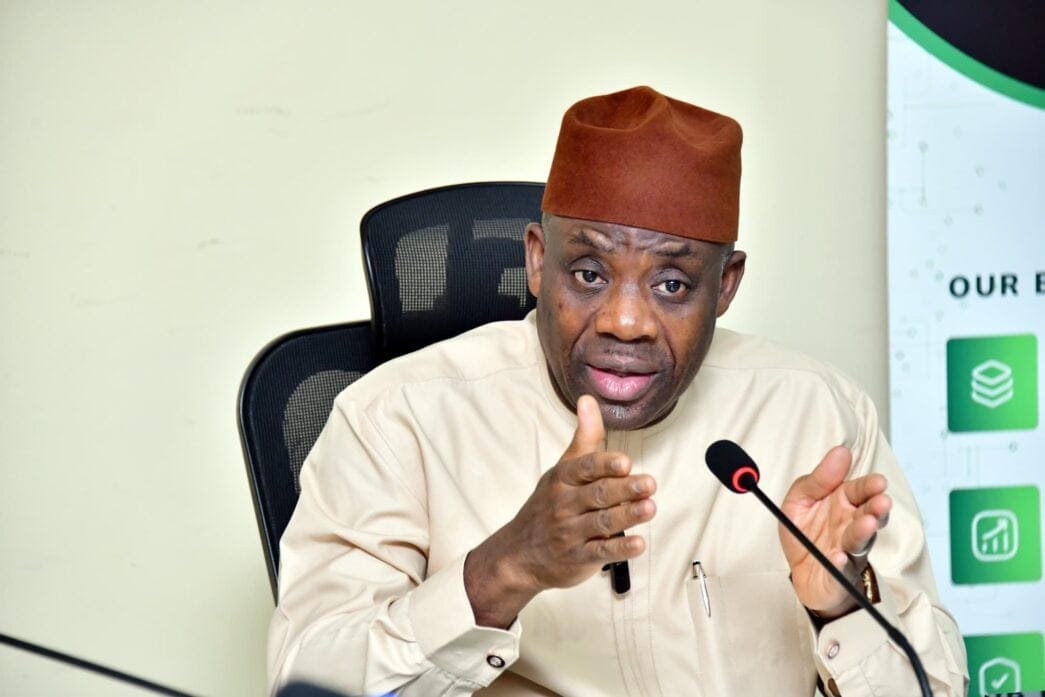
Tunji Alausa
The Federal Government has urged the National Assembly to suspend the approval of bills seeking to establish new federal universities, polytechnics and colleges of education for seven years.
It warned that the continued establishment of tertiary institutions could worsen the country’s education funding crisis and undermine academic standards.
The appeal came in a November 2, 2026 memo from the Federal Ministry of Education to the President of the Senate, Senator Godswill Akpabio.
In the memo, marked FME/DUE/NASS/153/Vol.1/147 and sighted in Abuja, the Minister of Education, Dr Tunji Alausa, urged the Senate leadership and other lawmakers to exercise restraint in considering bills for additional federal tertiary institutions.
Alausa said the Federal Executive Council (FEC) approved the seven-year moratorium at its meeting on August 13, 2025, to address the proliferation of public tertiary institutions, duplication of academic programmes and under-utilisation of existing facilities.
He said the government could no longer adequately fund the growing number of institutions, adding that the priority should be to improve existing facilities and academic standards.
According to him, Nigeria’s immediate challenge goes beyond expanding access to tertiary education. Government must strengthen existing institutions through improved funding, infrastructure, personnel and modern teaching and research facilities.
“The Federal Government’s position is that the immediate challenge confronting the tertiary education sector is not merely the expansion of access, but the urgent need to strengthen existing institutions,” he stated.
He said the moratorium would allow government to consolidate existing investments and improve the quality and capacity of institutions already established.
The minister expressed concern that lawmakers continued to consider proposals for new federal institutions despite the government’s policy direction.
Although he acknowledged the constitutional powers of the National Assembly to initiate and enact legislation, he urged lawmakers to consider national education policies, demonstrable needs and the financial implications of establishing new institutions.
Alausa warned that spreading limited resources across more institutions without addressing existing challenges could further weaken tertiary education.
He identified inadequate lecture halls, overcrowded classrooms, insufficient laboratories, shortages of qualified personnel, accommodation deficits and deteriorating facilities as some of the problems confronting existing federal institutions.
“Existing Federal Universities, Polytechnics and Colleges of Education are confronted with serious funding and infrastructure deficits, including inadequate lecture halls, overcrowded classrooms, insufficient laboratories, shortages of qualified personnel, accommodation deficits and deteriorating facilities,” he said.
The minister also highlighted outstanding government commitments to the revitalisation of public universities as evidence of the sector’s funding difficulties.
He disclosed that under the 2013–2018 Federal Government-ASUU revitalisation agreement, which carried a commitment of N1.3 trillion, government released only N250 billion between 2013 and 2021.
Similarly, he said government approved an additional N150 billion for Needs Assessment Intervention in 2025 but initially released only N50 billion.
Alausa said the funding gaps raised serious questions about government’s ability to sustain existing institutions while establishing additional ones.
“These funding gaps demonstrate the difficulty of meeting existing obligations and raise legitimate concerns about the capacity to sustain additional institutions without corresponding and guaranteed budgetary provisions,” he stated.
He cited developments in Ekiti and Imo states as examples of the difficulties associated with establishing multiple tertiary institutions without sustainable funding arrangements.
According to him, Ekiti State merged three state-owned universities into one institution, Ekiti State University, Ado-Ekiti, in 2011.
He also said Imo State had reviewed and integrated some of its tertiary institutions following the establishment of several institutions under previous administrations.
Alausa added that some state governments had approached the Federal Government to take over their universities because they could no longer sustain them financially.
He warned that institutions established without adequate funding could eventually require expensive restructuring, mergers or integration by successor administrations.
The minister further referenced Australia, Finland, Japan, the United States and South Africa as countries that had undertaken institutional mergers and consolidation to address financial constraints and administrative inefficiencies.
He said such reforms helped governments reduce duplication, improve institutional management, strengthen research capacity and ensure more efficient use of public resources.
Alausa urged Nigeria to adopt similar measures by prioritising institutional viability and academic quality rather than continually increasing the number of tertiary institutions.
He also identified competing demands on the education budget as another reason lawmakers should support the moratorium.
The minister listed interventions by the Tertiary Education Trust Fund (TETFund), the Nigerian Education Loan Fund (NELFUND) and vocational skills acquisition programmes among the government’s existing commitments.
He also cited the implementation of the Consolidated Academic Tools Allowance (CATA) and Consolidated Tertiary Institutions Tools Allowance (CONTTA) for academic and non-academic personnel.
He warned that creating more institutions without identifying reliable funding sources could undermine these interventions.
According to him, establishing a tertiary institution involves substantial financial commitments beyond the passage of an enabling law.
These include land acquisition, take-off grants, infrastructure, recruitment of personnel, equipment procurement, utilities and recurrent expenditure.
He said such obligations would continue beyond the administrations that initiated the projects.
Alausa cautioned that lawmakers could create institutions that exist only in law if they approved establishment bills without proper feasibility studies, demonstrable educational needs and credible long-term funding arrangements.
He warned that such institutions could eventually become financial liabilities, forcing future administrations to consider mergers, restructuring or outright closure, with consequences for students, workers and public investments.
However, the minister clarified that the seven-year moratorium would not permanently deny Nigerians access to tertiary education or prevent future expansion where compelling national needs arise.
Rather, he said the policy would give government time to address existing institutional weaknesses, improve academic standards and ensure that future expansion rests on proper planning and sustainable financing.
He therefore appealed to Akpabio and the leadership of the National Assembly to support the policy by suspending consideration and passage of bills seeking to establish additional federal universities, polytechnics and colleges of education during the period.
“In view of the foregoing, I respectfully appeal to Your Excellency and the distinguished leadership of the National Assembly to support the Federal Government’s seven-year moratorium by exercising restraint in the consideration and passage of Bills for the establishment of additional Federal Universities, Polytechnics and Colleges of Education during the period,” the memo stated.
Alausa maintained that the country’s educational progress should reflect the quality of graduates and the ability of institutions to contribute to national development, rather than the number of tertiary institutions established.
“The success of our education system should be measured not merely by the number of institutions established, but by the capacity of existing institutions to deliver high quality education, produce competent graduates and contribute meaningfully to national development,” he stated.
The memo was also copied to the Senate Majority Leader, Senator Michael Opeyemi Bamidele.
📢 Follow National Periscope on WhatsApp
Get breaking news and updates directly on WhatsApp.
Join WhatsApp ChannelPost Disclaimer
All rights reserved. This material and other digital content on this website are not and do not represent the stance of National Periscope but the statements of newsmakers mentioned therein.
For your detailed news reportage... contact the Editor at Joel2oladele@gmail.com






The Federal Government has paid new allowances to eligible academic Read more
The Minister of Education, Dr. Tunji Alausa, has directed vice Read more
Kwara PDP, APC trade words over out-of-school children. Olaitan Ogundele Read more
FG announces delisted foreign universities in Nigeria The Federal Government, Read more