

JOEL OLADELE, Abuja
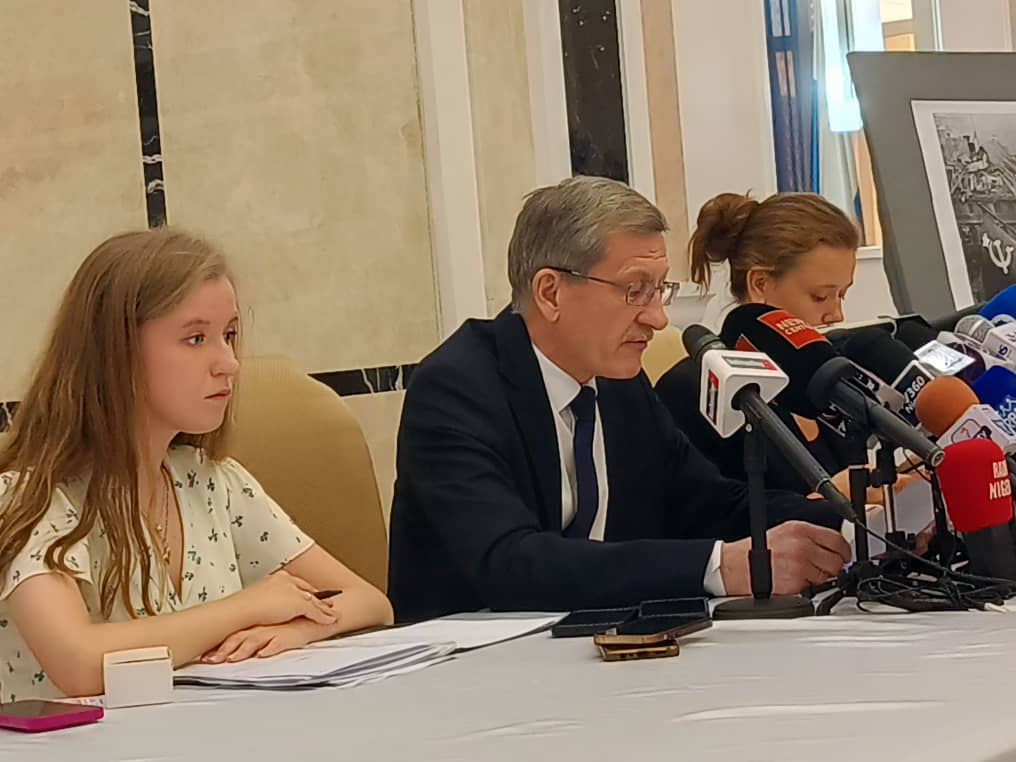
The Russian government has warned against what it described as growing attempts to manipulate historical narratives around the Ukraine crisis and the Second World War, saying such distortions undermine international trust and the post-war global order.
The position was reiterated by the Russian Ambassador to Nigeria, Andrey Podelyshev, who spoke in Abuja on Tuesday during a press briefing marking the 81st anniversary of victory in the Great Patriotic War, which Russia says is closely tied to the genocide of the Soviet people during the Second World War.
Podelyshev argued that the widely accepted Western account of the Ukraine conflict, which places its beginning in February 2022, ignores earlier developments that shaped the crisis.
According to him, “the events of February 2022 are usually analyzed without reference to what has occurred in and around Ukraine during the previous eight years starting in 2014.”
He traced the origins of the conflict to the political crisis in Ukraine between 2013 and 2014, alleging that a negotiated agreement between the government and opposition was undermined by what he described as a Western-backed coup.
He further claimed that external actors failed to enforce the agreement, allowing unconstitutional changes of power.
The envoy also said that policies introduced after 2014 resulted in the marginalisation of Russian language and culture in Ukraine, which he argued worsened internal divisions.
Drawing a comparison, he suggested that banning widely spoken languages in a multi-ethnic society such as Nigeria would have similar destabilising effects.
Podelyshev further criticised what he described as the glorification of nationalist figures such as Stepan Bandera and Roman Shukhevych, accusing them of collaboration during the Nazi occupation of Europe. He said such developments support Russia’s argument for the “denazification” of Ukraine.
Beyond the Ukraine conflict, the ambassador focused heavily on what he called a global “battle of narratives” over the legacy of the Second World War. He accused some Western countries of attempting to diminish the Soviet Union’s role in defeating Nazi Germany and revising established historical conclusions.
“Victory over Nazism became a turning point that defined the contours of the modern international order,” he said. “Any attempt to distort this memory inevitably undermines trust between states and weakens international stability.”
He also criticised the removal of Soviet-era war memorials in parts of Europe and what he described as the rehabilitation of individuals linked to Nazi collaboration, calling it a dangerous revision of history.
Citing Russian official estimates, Podelyshev said more than 27 million Soviet citizens died during the Second World War, including millions of civilians. He added that Russia now legally classifies these atrocities as genocide and has introduced legislation aimed at protecting historical truth and criminalising the justification of Nazism.
According to him, preserving the memory of the war is not only a moral obligation but also a matter of global security. He stressed that historical accounts must be based on archival evidence and international legal standards rather than political considerations.
The ambassador concluded by linking what he called “manipulated history” to current geopolitical tensions, arguing that misrepresentation of past events has contributed to the ongoing crisis in Ukraine.
“Preserving historical truth is not only a duty to the past but a responsibility to the future,” he said.
📢 Follow National Periscope on WhatsApp
Get breaking news and updates directly on WhatsApp.
Join WhatsApp ChannelPost Disclaimer
All rights reserved. This material and other digital content on this website are not and do not represent the stance of National Periscope but the statements of newsmakers mentioned therein.
For your detailed news reportage... contact the Editor at Joel2oladele@gmail.com





Authorities in Uganda have detained 62 Nigerian nationals over alleged Read more
FG hands over 50 tonnes of dates from Saudi to Read more
Foreign Affairs Minister meets Nigerians in Netherlands, mulls granting dual Read more
Tuggar at 57: DICAN lauds Minister's leadership on his birthday Read more